Archaeologists have found five pairs of iron shackles at a 2,300-year-old Celtic site in France — a discovery that suggests the small settlement was frequented by metalsmiths and slave traders.
The “extremely rare” shackles were discovered in the town of Allonnes in France’s Loire Valley in 2019, but the finds from the two-year-long excavation were announced to the public on July 9 in a translated statement from the French National Institute for Preventive Archaeological Research (INRAP).
The settlement at Allonnes was established along with a religious complex in the third century B.C., according to the statement. Specialist artisans — including blacksmiths, coppersmiths, bronze workers and sheet-metal workers — plied their trade from small workshops, archaeologists found at Allonnes.
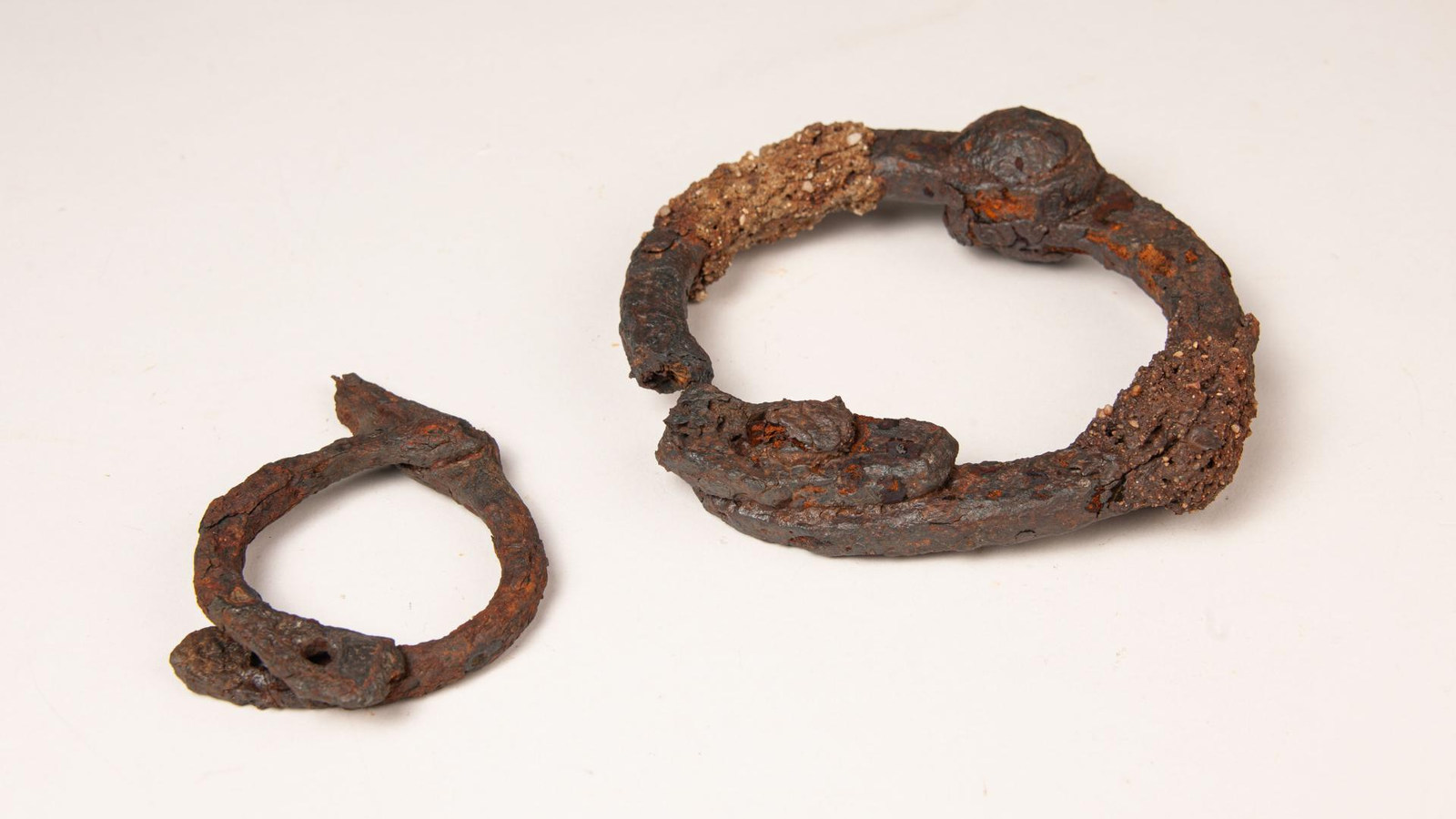
During the excavation, the team discovered a large number of high-quality metal objects — such as swords, spearheads, keys and horse harness fittings — but the iron shackles were a surprise because they are extremely rare for the time period. Excavators found a double-wrist restraint, an ankle restraint and three other portions of metal restraints.
The presence of shackles suggests that Allonnes may have been a hub for slave trading in the Late Iron Age (450 to 50 B.C.), according to the statement.
“The identification of restraints and weapons suggests a hierarchical social organization composed of dominant and subordinate groups — prisoners or slaves,” Thierry Lejars, a specialist in Celtic metalwork, said in a translated interview with INRAP.
The Gauls, a loose association of Celtic tribes, were known to enslave prisoners of war, convicts and debtors, according to the statement, and they were often forced to work in the fields. These men, women and children then lost their rights and could be bought and sold by their owners. Because the Celts did not leave many historical records of their own, however, not much is known about the practice of slavery in pre-Roman Gaul. The shackles from Allonnes provide new insight into the lives of people who were typically invisible in historical accounts.
Get the world’s most fascinating discoveries delivered straight to your inbox.
A drawing of wrist restraints, likely used on women or children, and an ankle shackle.
The small diameter of the wrist restraint — 2.4 inches (6 centimeters) — suggests it may have been used on a woman or a child, according to the statement. And the ankle restraint was over 2.2 pounds (1 kilogram), revealing the weight that enslaved people had to carry around.
Archaeologists also uncovered a religious sanctuary at Allonnes, along with offerings that included clothing and jewelry such as rings and amulets. Many of the offerings had been deliberately deformed or mutilated, likely to transform a mundane possession into a gift for the gods, the statement reported.
Hundreds of coins were also recovered at the site, and their mint dates spanned more than five centuries, Isabelle Bollard-Raineau, an ancient-coin expert with the French ministry of culture, said in the translated INRAP interview. About a third of the coins found at Allonnes had been filed, sheared or etched with a chisel.
“These mutilations reveal a ritual intention: the removal of the coin’s commercial function in order to dedicate the object to the sacred, thereby ensuring the permanence of the offering,” Bollard-Raineau said.
Allonnes was a significant Celtic site at the intersection of several major roads in ancient times, and the analysis of the metal finds has revealed important new information about some of the most powerless members of Gallic society.
See how much you know about the Celts with our Celtic quiz!
Listen to this article Estimated 3 minutes The audio version of this article is generated by AI-based technology. Mispronunciations can occur. We are working with our partners to continually review and improve the results. Astronaut Jeremy Hansen, who voyaged around the moon in April, is retiring from the astronaut corps at the Canadian Space Agency….
Your browser is not supported | floridatoday.com floridatoday.com wants to ensure the best experience for all of our readers, so we built our site to take advantage of the latest technology, making it faster and easier to use. Unfortunately, your browser is not supported. Please download one of these browsers for the best experience on…
Australia has no shortage of world-class medical researchers. What it has traditionally lacked is a seamless pathway to transform clever science into commercial medicines without sending promising discoveries offshore. That is the gap Syngenis Labs is now aiming to close. The Perth-based biotech has completed an oversubscribed $4 million pre-float capital raising that will fast-track…
Back to Article List Here’s what’s launching July 13–19: Starship’s 13th flight test targets a Thursday liftoff, a crewed Soyuz heads for the International Space Station, and Skyroot Aerospace attempts India’s first private orbital launch. The Soyuz MS-27 spacecraft, solar panels extended, approaches the International Space Station. Soyuz MS-29 is set to carry NASA astronaut…
Shanghai Henlius Biotech (SEHK:2696) is back in focus after Chinese regulators cleared phase 1 trials for its HLX37 combination therapies, while a separate study for bispecific ADC HLX48 has already started dosing patients. See our latest analysis for Shanghai Henlius Biotech. The latest HLX37 and HLX48 updates come after a mixed stretch for Shanghai Henlius…
A simple method to thicken Arctic sea ice has shown promising results in its very first field experiment, performed in Cambridge Bay, Nunavut, Canada. Researchers are considering several controversial geoengineering techniques to slow the catastrophic melt of Arctic sea ice, including stratospheric aerosol injection, which involves shooting tiny sulfur particles into the sky to blot…