Gemini Robotics 2 Controls Full Humanoids: Legs, Torso, Arms, and Fingers Under One Policy
Google DeepMind’s previous Gemini Robotics models could tell a robot arm to pick up a cup from a tabletop. Gemini Robotics 2, released today, can tell an entire humanoid to walk to the table, crouch to a lower shelf, and place that cup precisely in a bin — all under a single learned policy that simultaneously coordinates legs, torso, both arms, and a 22 degree-of-freedom hand. That is not an incremental update. It is the elimination of the architectural bottleneck that has constrained humanoid robotics AI since the category began.
The distinction matters because previous systems — including DeepMind’s own Gemini Robotics 1.5, released in September 2025 — relied on separate controllers for locomotion and manipulation, stitched together at handoff points. A robot that walks and a robot that grasps are each technically impressive. A robot that walks to a shelf while reasoning about where to place its hand, maintaining balance as the load shifts, is something closer to what a factory or warehouse actually needs. Gemini Robotics 2 collapses that separation into a single end-to-end vision-language-action (VLA) policy — meaning any new behavior requiring coordinated whole-body motion can now be trained into the model without redesigning the mechanical handoffs between subsystems.
Three Models, One Physical AI Platform
Google DeepMind shipped three models today under the Gemini Robotics 2 umbrella.
Gemini Robotics 2 is the flagship vision-language-action model — the layer that converts camera images and natural-language instructions directly into motor commands. It is the first DeepMind VLA capable of controlling a full humanoid from feet to fingertips, and it runs a single model checkpoint across three distinct hardware configurations: Apptronik’s Apollo 2 robot with SharpaWave hands, Apollo 2 with Inspire hands, and the Franka Duo bi-arm platform with a Robotiq gripper.
Gemini Robotics ER 2 is the embodied reasoning model — the high-level cognitive layer that accepts natural language, streams continuous video, plans multi-step tasks lasting several minutes, monitors progress, and decides when to call for human help. It acts as the brain while the VLA acts as the hands. It connects through the Gemini Live API via a bidirectional streaming endpoint, which means it reasons about upcoming steps while simultaneously executing current actions — eliminating the “stop-and-think” pauses that make prior robotic AI systems feel labored. ER 2 is based on Gemini 3.5 Flash and carries a 128K-token context window.
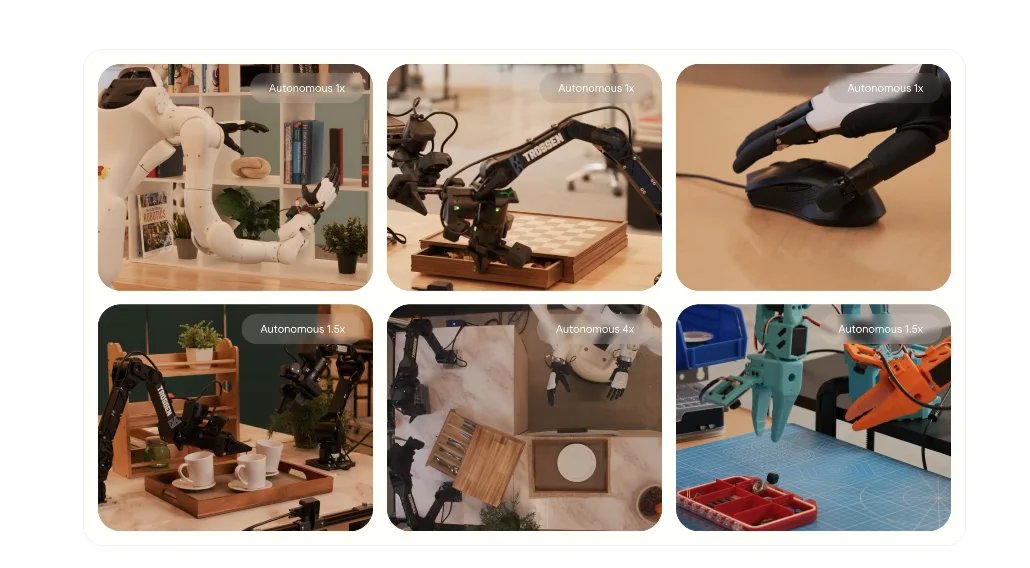
Gemini Robotics On-Device 2 is an efficiency-optimized VLA designed to run entirely on local hardware without cloud connectivity. It inherits what DeepMind calls “motion transfer” techniques from the Gemini Robotics 1.5 generation, and can adapt to a completely new robot embodiment — different shape, sensors, and degrees of freedom — in a few hours with fewer than 200 demonstration examples. DeepMind demonstrated the on-device model running on the Dexmate, SO101, and Trossen platforms, none of which were in its training data.
What “Whole-Body Control” Actually Means — and Why It Was Hard
The engineering problem Gemini Robotics 2 addresses has a name in the research community: loco-manipulation. It refers to a robot’s ability to walk through an environment and manipulate objects simultaneously, coordinating balance, locomotion, and grasping through a unified whole-body control system rather than running separate controllers in sequence. TechTimes covered this challenge in depth in the context of the IEEE Humanoids 2026 conference.
Previous robotic AI architectures largely ran separate subsystems: a locomotion controller for the legs, a manipulation policy for the arms. These had to hand off control to each other, creating brittle transition points — moments when the system had to decide which subsystem was “in charge.” That fragility is exactly what breaks down in the real-world conditions factories and warehouses require: friction that differs from simulation, sensor noise, objects in unexpected positions, and the constant need to replan both gait and arm trajectory simultaneously.
Figure AI’s Helix model (released February 2025) was the first VLA to achieve high-frequency control of an entire humanoid upper body, including arms, hands, torso, head, and fingers — a significant milestone. Gemini Robotics 2 extends that milestone to the full body, adding coordinated lower-limb locomotion under the same learned policy. The Apollo 2 demo — walking to a table, picking up a watering can, navigating to a shelving unit, crouching, and placing the can precisely in a designated bin — is a demonstration of exactly this capability.
The architectural implication goes beyond the demo. Because the legs and arms are governed by a single end-to-end policy rather than separate subsystems, new behaviors requiring coordinated whole-body motion can be introduced through model training without touching the hardware handoff logic. A robot whose locomotion and manipulation are unified becomes software-upgradeable in a qualitatively different way from one built on stitched controllers.
DeepMind’s own candor about where the system is not yet ready deserves equal attention. Published benchmark data shows the model achieves 68.4% success picking objects from a table, 76.3% from a shelf, and 45.7% from the floor on the Apollo 2 platform with Inspire hands. Those are respectable figures for a first whole-body release. The multi-finger dexterity numbers tell a more honest story: 92% on unscrewing a light bulb, 44% on tying a trash bag, 40% on sealing a ziplock bag, 36% on screwing a bulb in, and 32% on a dustpan task — all on the SharpaWave hand. The 60-percentage-point spread between the easiest and hardest fine-motor tasks is not a flaw in DeepMind’s reporting. It is the most important number in the entire benchmark package, because it draws the precise boundary between what a humanoid can do reliably and what remains a research problem.
Gripper-based tasks, which are mechanically simpler, fared better: 89.6% on precise insertion, 78.9% on diverse tool kitting, and 74.2% on general pick-and-place across the Franka Duo platform.
ER 2 Reasons in Real Time — and It’s Open to Developers Today
The embodied reasoning model is the layer most immediately accessible to the broader developer community. Gemini Robotics ER 2 is available today via the Gemini API, Google AI Studio, and in private preview on the Gemini Enterprise Agent Platform. Developers can stream video, audio, and text directly into the model, declare low-level robot control interfaces (including VLA models and navigation APIs) as callable tools, and have the model orchestrate multi-step tasks autonomously.
This is a meaningful shift in access. Every prior generation of Gemini Robotics models was restricted to a small number of trusted-tester partners. The ER 2 reasoning model is now available to any developer with a Gemini API key.
The technical gains in ER 2 address two foundational problems in robotic reasoning. The first is progress tracking: robots have historically had difficulty knowing when a task step is complete before moving to the next one. ER 2 achieves 57.4% accuracy on a five-bucket progress classification task (tracking completion from 0-20% through 80-100%) and 91.3% accuracy on moment-finding — identifying the precise video frame where a critical event occurs, such as a cup becoming full or a bolt reaching torque spec. Moment-finding runs at a mean absolute error of 0.96 seconds — sub-second latency at a fraction of the compute cost of larger model categories, which matters because safe physical robotics requires decisions faster than a human can react.
The second gain is multi-robot collaboration. ER 2 enables different robot types — a humanoid and a robotic arm, for instance — to communicate via a shared semantic understanding and divide tasks across a workflow. DeepMind demonstrated an Apollo 2 humanoid and a Franka F3 Duo arm working in parallel to clean a room. The coordination is not scripted: the ER 2 model allocates sub-tasks dynamically based on which robot is better suited to each step.
ER 2 also supports native tool calling — the model can query Google Search, a product inventory database, or any user-defined API mid-task, allowing a robot to retrieve information needed to complete a task without halting execution.
On-Device Intelligence for Disconnected Environments
Gemini Robotics On-Device 2 addresses deployment scenarios where cloud connectivity is unavailable or unacceptable: field robotics, healthcare environments with strict data-handling requirements, manufacturing facilities with network latency constraints, or any context where sending video streams to a remote server creates either a security exposure or a performance problem.
The model’s “motion transfer” approach — adapting to new embodiments in fewer than 200 demonstration examples — is the feature most likely to matter for smaller robotics companies and academic researchers who cannot afford the data collection cost associated with training a model from scratch for each new hardware platform. The Dexmate, SO101, and Trossen demonstrations confirmed that the transfer works across platforms with substantially different joint configurations, sensor arrays, and degrees of freedom from what the model was originally trained on.
Safety Infrastructure: ASIMOV-Agentic
Alongside the model releases, DeepMind published ASIMOV-Agentic, a new open benchmark for evaluating the safety of agentic robotic AI — specifically, whether the embodied reasoning layer can refuse dangerous commands from the VLA layer below it, assess whether a task is physically feasible before attempting it, and proactively request human intervention when uncertain. The benchmark is available on HuggingFace and is intended as a community resource — a standard test set that third parties can use to evaluate any robotic AI system’s safety behavior, not just DeepMind’s own models.
The name derives from the ASIMOV benchmark (for semantic action safety) released alongside Gemini Robotics 1.0 in early 2025.
On the human proximity front, ER 2 can detect when a person approaches within a safety threshold, trigger the appropriate safety tool call, and bring the robot to a controlled stop — resuming autonomously once the person clears the area. DeepMind published a dedicated Gemini Robotics 2 Safety Technical Report alongside the model release.
Partner Hardware and Access
The Gemini Robotics 2 family is running on real hardware today. Named deployment partners include Apptronik (Apollo 2), Franka (Franka Duo), and Agile Robots. Boston Dynamics is also acknowledged as a partner in the technical credits — consistent with the existing agreement, announced in May 2026, in which Google DeepMind received a fleet of Atlas robots to integrate Gemini Robotics models.
Access is graduated. The ER 2 reasoning model is available to any developer through Google AI Studio and the Gemini API today (model string: gemini-robotics-er-2-preview). The VLA and On-Device 2 models require early-access partner status, available through the Trusted Tester Program application.
Where Physical AI Stands
The Gemini Robotics 2 announcement arrives at a moment the humanoid robotics industry has been building toward for a decade: commercial platforms are shipping, real production tasks are being performed, and the primary constraint is no longer whether a robot can walk or whether it can grasp — it is whether the AI governing both can handle the full range of variation that real environments produce.
Gemini Robotics 2 does not claim to solve that problem. Its benchmarks are honest about the gap: 45.7% whole-body success rate picking from the floor, 32% on a dustpan task, and a 60-point spread across fine-motor tasks all represent significant open territory. What the release claims — and what the architecture supports — is that the separation between locomotion intelligence and manipulation intelligence has been eliminated in the software layer. The hardware is the same. The policy is unified. What that policy can do will expand with training data, and the Apptronik Robot Park in Austin, Texas, where Apollo 2 robots generate real-world training data for Gemini Robotics continuously, is where that data comes from.
That is the architecture of how physical AI scales: unified policy, hardware partnership for data, model update for new capability. Gemini Robotics 2 is the first demonstration that this loop can run on a full humanoid.
Frequently Asked Questions
What is Gemini Robotics 2 and how does it differ from the previous version?
Gemini Robotics 2 is a family of three AI models from Google DeepMind released today that, for the first time, controls an entire humanoid robot — legs, torso, arms, and multi-finger hands — through a single unified AI policy rather than through separate locomotion and manipulation systems stitched together. Previous DeepMind robotics models (including Gemini Robotics 1.5, released in September 2025) controlled only a robot’s upper body for tabletop tasks. The architectural change matters because a single unified policy can gain new whole-body behaviors through model training alone, without redesigning how subsystems hand off control to each other.
Can developers access Gemini Robotics 2 today?
The Gemini Robotics ER 2 reasoning model — which handles high-level task planning, progress tracking, and multi-robot coordination — is publicly available now to any developer via the Gemini API and Google AI Studio using the model string gemini-robotics-er-2-preview. The VLA (full-body motor control) and On-Device 2 models require joining the Trusted Tester Program via an application form on the DeepMind website. There is no announced pricing for robotics-specific access tiers as of today’s launch.
What are the real-world limits of Gemini Robotics 2 right now?
DeepMind published its own benchmark data, which reveals significant variation by task type. Whole-body manipulation success rates on the Apollo 2 humanoid ranged from 45.7% (picking from the floor) to 76.3% (picking from a shelf). Fine-motor dexterity with the 22 degree-of-freedom SharpaWave hand ranged from 32% (dustpan task) to 92% (unscrewing a light bulb). The 60-point spread across multi-finger tasks is a candid indicator of where the system remains a research challenge rather than a deployable solution. Movement speed also remains slower than the benchmark for commercial utility — DeepMind acknowledged this directly in today’s announcement.
How does the On-Device 2 model adapt to new robot hardware so quickly?
Gemini Robotics On-Device 2 uses what DeepMind calls “motion transfer” — a technique inherited from Gemini Robotics 1.5 that lets the model adapt to a new robot embodiment using fewer than 200 demonstration examples and a few hours of adaptation time, even when the new hardware has substantially different shape, sensors, and joint configurations from what the model was originally trained on. This is demonstrated on the Dexmate, SO101, and Trossen platforms, none of which were in the original training data.