How climate change is reshaping Europe’s wildfire geography
- Climate change and expanding wildland-urban interfaces have increased exposure of people and infrastructure to wildfires
- Researchers call for stronger preparedness, prevention as wildfire seasons grow longer
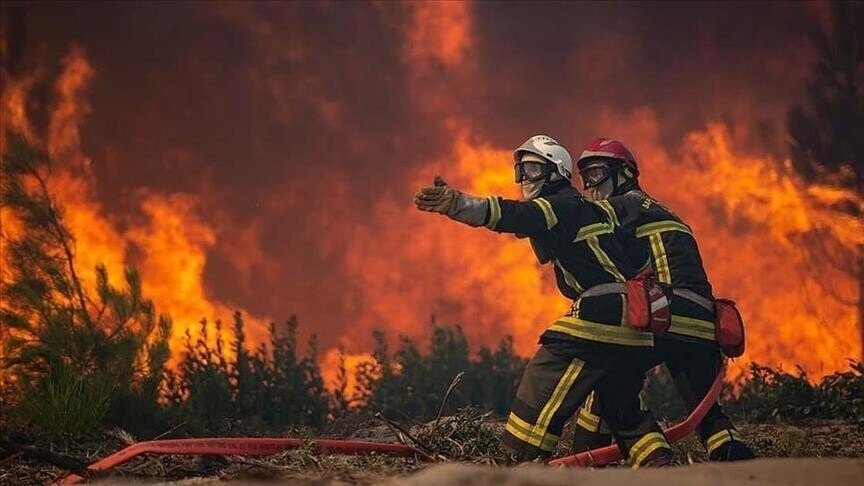
A forest fire on the outskirts of Paris has fueled concerns among scientists that dangerous wildfires are no longer confined to Europe’s traditional high-risk regions.
The Fontainebleau Forest wildfire this month burned nearly 2,200 hectares (5,437 acres) of forest in just two days. It also prompted the first deployment of Canadair water-bombing aircraft in the Paris region.
French authorities have recorded more than 13,500 wildfire outbreaks since the beginning of the year, with around 116,000 hectares (286,700 acres) burned nationwide, already surpassing the country’s previous record set in 2022.
The ongoing Gironde megafire, which has burned about 42,000 hectares (103,784 acres) since July 22, has become one of the largest wildfires recorded in mainland France in recent decades.
Although the blaze is under control, authorities have warned that high temperatures, low humidity and shifting winds continue to pose a risk of flare-ups, leading to fresh evacuations in the Lacanau area.
Climate experts warn that areas historically considered lower risk should prepare for more frequent wildfires.
Risk moving north
Joe McNorton, a scientist at the European Centre for Medium-Range Weather Forecasts, said the Fontainebleau wildfire “supports growing evidence that periods of elevated wildfire risk are no longer confined to Europe’s traditional fire-prone regions.”
“While southern Europe remains the area most frequently affected by large wildfires, recent years have seen episodes of exceptional fire weather extending further north,” he told Anadolu.
McNorton said heat waves, prolonged dry conditions and low humidity can rapidly dry vegetation, creating conditions that allow fires to ignite and spread.
Jean-Baptiste Filippi, a researcher at the French National Centre for Scientific Research (CNRS), said the Fontainebleau fire makes a long-anticipated trend more visible.
“What science has been saying for several years is that wildfire risk is moving north,” Filippi told Anadolu.
He said the Fontainebleau fire is gaining attention because of its proximity to Paris, but it is “an evolution that had been expected.”
Earlier this year, France officially classified 18 municipalities in Seine-et-Marne and Essonne as forest-fire risk zones, with authorities describing the Paris region as a “new wildfire territory” requiring dedicated prevention measures.
Earlier this month, a wildfire at Cap Frehel in Brittany’s Cotes-d’Armor department burned 38 hectares (94 acres) and forced the evacuation of around 240 residents and campers.
Cities increasingly exposed
McNorton said continued urban expansion into the wildland-urban interface is increasing the exposure of people and buildings to wildfires.
Filippi said Fontainebleau illustrates the vulnerabilities identified in the CNRS report, which examined how cities should adapt to growing wildfire risks.
He said two developments are occurring simultaneously: wildfire risk is moving north while forests and vegetation are expanding closer to urban areas, partly because of agricultural land abandonment.
“Fontainebleau illustrates very directly the vulnerabilities specific to the interfaces between the city and the forest,” he said.
Filippi said northern France remains less prepared than southern regions because wildfire has not traditionally been considered a routine threat there.
The broader trend has been reflected elsewhere in France this summer.
In Gironde, near Arcachon Bay, one of France’s busiest summer tourist destinations, more than 12,000 residents and tourists were evacuated after a wildfire burned around 2,400 hectares (5,931 acres), while another major blaze in the Var department scorched about 2,500 hectares (6,178 acres).
Longer fire seasons
McNorton said climate change is increasing the likelihood and intensity of extreme heat across Europe.
He added that heat waves across Europe have become more frequent, more intense and longer lasting, while there is growing evidence that climate change is extending wildfire seasons earlier into spring and later into autumn.
Recent modelling studies indicate that, under a moderate climate change scenario, more than half of Europe’s land area could experience at least a doubling in the probability of extreme fire weather events by the end of the century, he said.
He cautioned that this does not necessarily mean every region will experience more wildfires.
Nevertheless, regions that have historically experienced relatively limited wildfire activity “may increasingly encounter weather conditions capable of supporting large or rapidly spreading fires during exceptional summers,” he said.
The warnings come after France recorded 5,764 excess deaths during the June heat wave.
Prevention becomes essential
Filippi said France’s strategy of attacking fires quickly has proven effective in protecting lives but warned that emergency services will face increasing pressure across larger territories and over longer fire seasons.
“The response cannot rely only on increasing firefighting resources,” he said.
“It is mainly through prevention that territories will be able to adapt: developing a culture of risk, reducing fuel around inhabited areas and adapting buildings.”
He also called for urban planning that incorporates wildfire risk, wider use of wildfire prevention plans, evacuation planning and stronger enforcement of vegetation clearance requirements around homes.
Looking ahead, Filippi said climate projections indicate that the number of days with high wildfire risk at the latitude of Paris could increase fivefold in a France that is 4C (39.2F) warmer.
“These are climate projections, not actual fires,” he said.
“But if the number of days during which a major wildfire can occur increases fivefold, we can expect a very significant increase in the number of large wildfires in northern France over the coming decades.”