How ‘embodied intelligence’ makes robots seem more human

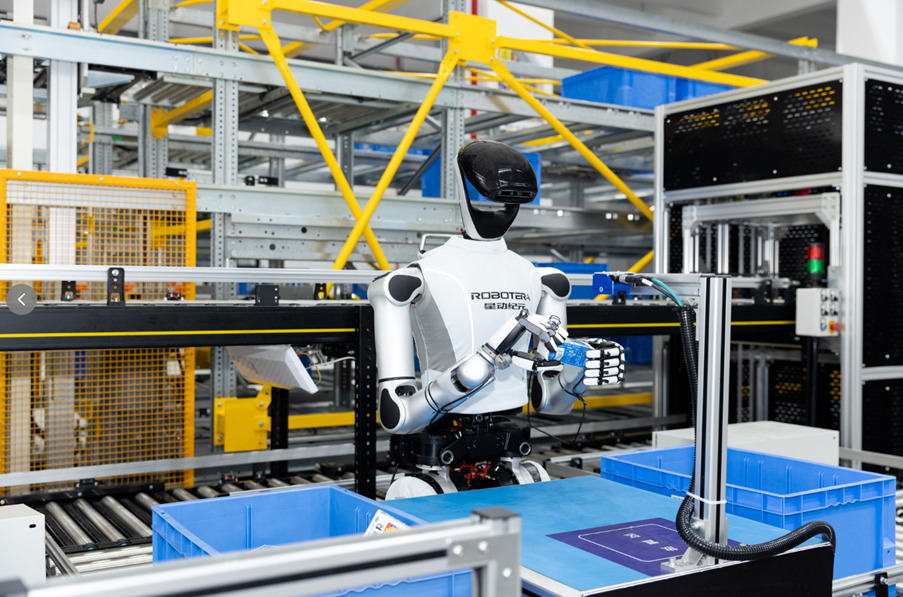
An AI-enabled humanoid robot sorts medication packs at a pharmaceutical facility.Credit: RobotEra
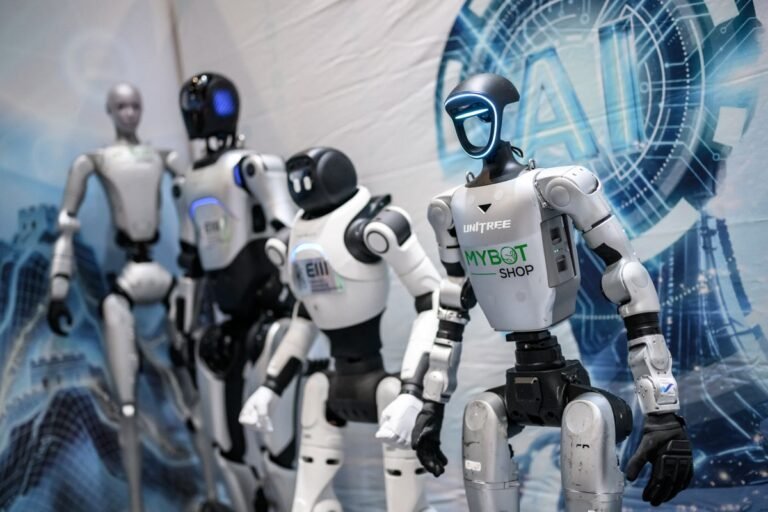
In 2025, Shenzhen-based robotics manufacturer UBTech began deploying its silver, humanoid Walker S1 model across car assembly lines in China.
Working alongside human employees, the robot quickly adjusted its posture, grip, and balance in real time, responding to visual signals and physical contact. That flexibility allowed Walker S1 to handle car components of varying sizes, weights and materials. As it operated, it also learned, enabling its skills to be transferred and redeployed at other factories.
A year later, Hangzhou-based Unitree Robotics demonstrated the same principles on national television, where its H1 humanoids performed martial arts at China’s Spring Festival Gala. The robots relied on continuous, body‑based feedback to stay balanced and upright.
Their capability is powered by ‘embodied intelligence’, where cognition emerges from the interplay between a machine’s physical structure and its interaction with the environment. Rather than relying on abstract programming alone, embodied intelligence allows machines to learn and refine skills through interaction, environmental feedback, and development from the close coupling of perception and behaviour.
In the following Q&A, we asked Fuchun Sun — vice dean of the Institute of Embodied Intelligence and Robotics at Tsinghua University in Beijing — how this approach could reshape life over the next decade.
What is embodied intelligence?
Embodied intelligence is the most advanced form of artificial intelligence (AI) that develops through continuous physical interaction with the real world, tightly linking perception, learning and action within a physical body.
The same logic appears in nature. A classic experiment in 1963 was conducted to investigate how vision and motor activity are linked in perceptual development. In the setup, kittens were placed in a carousel — some walking freely, others carried in harnesses. Though all of them saw the same scenes, only the active kittens developed normal depth perception. The study showed that motor activity plays a decisive role in visually guided perception and motor learning.
Robots with embodied intelligence learn in much the same way. When they move, probe and act, sensory input can be connected to the consequences of their own behaviour. This feedback allows them to build more accurate internal models.
Why is it important to the future of work?
One key advantage of embodiment is constraint. In the physical world, every action has consequences. These limits force robotic systems to make fine-grained predictions, adapt quickly and correct errors as they arise.
Under these conditions, intelligence becomes less about abstract reasoning and more about producing behaviour that works reliably in the real world and adapts to changing conditions. That’s why embodied robotic systems are far more useful in practice than AI confined to digital environments.
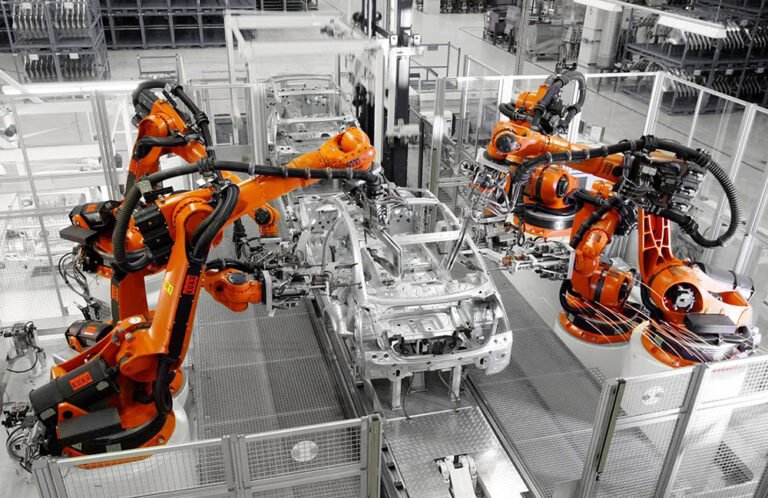
China has a large number of factories, some of which often handle small, irregular components in fast changing industries. The assembly of these components could be challenging, making these factories a natural test bed. Robots that can work independently, assess situations, make adjustments, and switch tasks easily, will deliver significant value in such settings.
Could this be a path to artificial general intelligence?
Because embodied systems can adapt quickly to new environments and be redeployed with minimal reprogramming, embodied intelligence could serve as a key pathway toward artificial general intelligence — a long-standing goal for robotics in which systems can learn and perform across many tasks with human-like competence.
Over time, this could transform society’s perception of robots — potentially recasting them as teammates and companions. This shift could transform how they contribute to manufacturing, logistics, travel, household tasks, care in ageing societies, and even scientific discovery.

Tsinghua researchers are training robots with an embodied intelligence framework Bcent.Credit: Tsinghua University
What breakthroughs are driving its progress?
A series of breakthroughs over the past five years has brought embodied intelligence to a tipping point in 2026. High-fidelity simulation platforms — such as NVIDIA’s Isaac Sim released in 2019 and Stanford’s BEHAVIOR launched in early 2021 — allow robots to train in virtual environments that replicate friction, fluids, and other physical aspects of real environments, reducing cost and risks before deployment.
Another breakthrough has come from the rise of large language models (LLMs) since 2022. They have enabled abstraction, multi‑step planning, knowledge integration and language‑based reasoning. Google’s PaLM‑E, released in March 2023, was an early step, combining language models with robotic sensing and vision in a single system. Four months later, the company’s RT‑2 went further by directly linking reasoning to action. Together, these breakthroughs are reshaping how robots learn and adapt.
How are researchers closing the loop between brain and body?
Today’s embodied intelligence systems still rely on modular processes, and struggle to integrate perception, planning, and control into a unified whole. In particular, weak coupling between perception and behaviour limits effective feedback.
To overcome this, we introduced Bcent in 2021 — short for Brain–Body Co‑developmENT — a framework that defines embodied intelligence as a closed loop in which perception, cognitive decision and action continuously shape one another1. Under Bcent, perception is active rather than passive. Sensors move, reorient and probe the environment. Cognition continually updates internal models of the world, often drawing on LLMs for planning and abstraction. Crucially, action itself becomes a source of learning, feeding directly back into perception and reasoning in real time. This enables robots to cope with messy, unpredictable settings, where lighting changes, people behave unpredictably, and objects bend, slip or break.
We have been exploring this idea for years. In earlier brain–computer interface research on prosthetics, for example, my team showed that commands from the human brain should not be followed blindly: they had to be validated against sensor and camera data, enabling robotic arms to reject instructions that conflicted with physical reality2.
Today, we are developing an experimental robotic system for factories in southern China, using the Bcent architecture to automate assembly tasks such as loading, unloading, and handling irregularly shaped parts and flexible flat cables. Working with manufacturing partners, we are using embodied learning to improve the assembly of complex electronic components. The focus is no longer fixed programming, but continuous adaptation — allowing robots to handle variation, uncertainty and change.
What obstacles remain?
While tens of thousands of high-profile experimental models already exist, significant hurdles remain, including imperfect sensors and actuators, high computational costs, and the difficulty of integrating complex systems at scale. However, we believe another catalyst is approaching.
The roll out of high-speed, low latency 6G networks in the next five years will allow robots to process physical feedback instantly and share learning data over long distances, greatly speeding up development.
What’s the future direction?
Robotic intelligence is now moving decisively into the physical world. Ethical and safety guardrails will need careful attention, but the direction is clear.
If the past decade of AI was about scaling ever larger artificial ‘brains’, the next may be about giving those brains bodies — and seeing what happens when they collide with reality.
Looking further ahead, advances in self-developing design or biologically inspired materials that change shape or build capacity in response to external stimuli — much like muscles or plant tissue — may produce robotics that can physically adapt to their environment.