
How to Transition to Quantum-Safe Encryption Before It’s Too Late
The encryption protecting your business today defeats ordinary computers, but a very different machine is now on the horizon. The defense already exists; the challenge is moving to it in time. A 2025 ISACA survey of 2,600 professionals found 62% expect quantum computers to break current encryption, yet only 5% have a response plan. This guide covers why that window is tighter than expected, and the steps to migrate before it closes.
Key Takeaways
- Quantum safe encryption resists attacks from both classical and quantum computers.
- Data stolen today can be unlocked once quantum machines mature.
- Migration touches billions of devices and can outlast the threat’s runway.
- A cryptographic inventory comes first; crypto-agility keeps you safe after.
- Regulators are setting deadlines, so early movers avoid a costly scramble.
Quantum-Safe Encryption in One Minute
Quantum safe encryption withstands attacks from quantum computers while running on hardware you already own. Building a clear plan for a quantum safe encryption migration is now a strategic priority for most organizations.
You will also see it called post-quantum or quantum-resistant cryptography, all describing the same goal. In 2024, the US standards body finalized the first three post-quantum standards, so the technology is ready. What has been missing is a clear rollout plan.
Why the Deadline Is Closer Than It Looks
Two forces compress the timeline. The first is harvest now, decrypt later.
| Warning: attackers can copy encrypted data today and store it, then unlock it once a capable quantum machine exists. Any information that must stay secret for years is therefore at risk already, even though the machine is not here yet. |
The second force is scale. Gartner expects public-key cryptography unsafe by 2029, fully breakable by 2034. WEF estimates 20 billion devices need upgrading, and past migrations took 10 to 20 years.
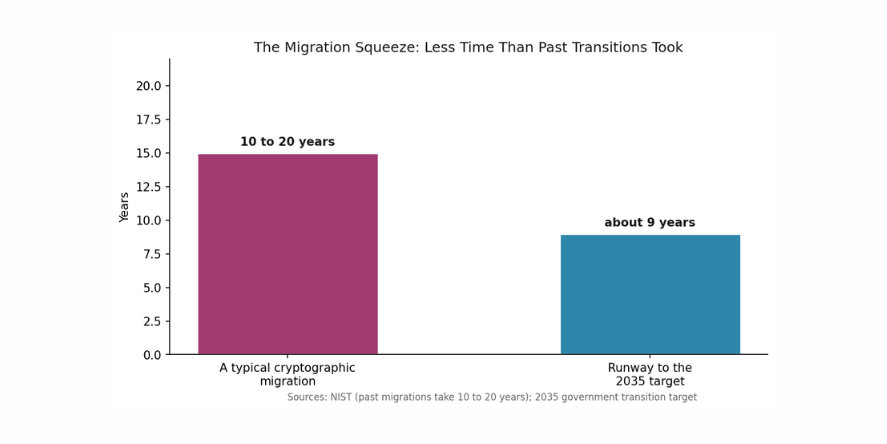
The runway is short. The EU has told member states to begin migration by the end of 2026 and finish by 2030. The table below shows what has to change.
| Replace now (broken by Shor’s algorithm) | Keep, with adjustments (still resistant) |
|---|---|
| RSA | AES-256 with longer keys |
| Elliptic curve (ECC) | SHA-384 and larger hashes |
| Diffie-Hellman | Hash-based signatures |
The Five-Step Transition Roadmap
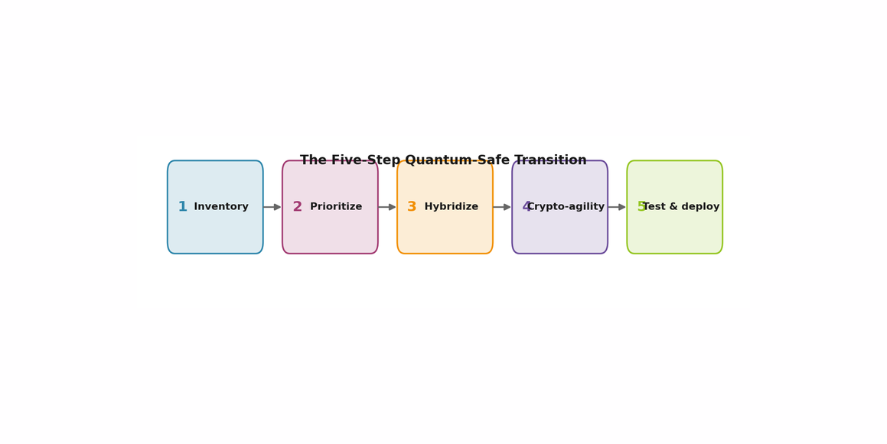
A migration this large only works as a sequence. These five steps turn an overwhelming problem into a manageable program.
| Step | What to do | Why it matters |
|---|---|---|
| 1. Inventory | Catalog every place cryptography is used, across apps, networks, and suppliers | You cannot protect what you cannot see |
| 2. Prioritize | Rank systems by data lifespan and exposure | Long-life, high-value data faces the harvest threat first |
| 3. Hybridize | Run classical and post-quantum algorithms together | Keeps services working during the switch |
| 4. Crypto-agility | Design systems to swap algorithms without a rebuild | Future standards will change again |
| 5. Test and deploy | Pilot, measure performance, then roll out and monitor | New algorithms behave differently and need tuning |
A WEF white paper offers guidance built for business leaders for this shift. That discipline mirrors the cryptography underpinning modern business more broadly.
Pitfalls That Derail a Migration
Even well-funded programs stumble in predictable ways. Watch for these traps:
- Waiting for certainty instead of acting on current evidence.
- Ignoring third parties, since one weak supplier reopens the risk.
- Overlooking embedded and long-life systems that outlast the migration.
- Skipping performance testing, since post-quantum algorithms can run slower.
- Treating the effort as a one-off rather than ongoing capability.
“Call it ‘YQK,’ except this time the ‘Q’ stands for ‘quantum.’” Dario Gil, IBM Research
The Y2K comparison is apt: a known deadline averted only because work started early. The same logic protects the technologies reshaping finance, where trust depends on security. Each trap above is avoidable with the roadmap already covered.
[Video: “Crypto Agility Explained: Protect Data from Quantum Computing Threats” by IBM: https://www.youtube.com/watch?v=1c2f7jlmB90]
This short explainer shows how crypto-agility keeps data protected as standards evolve.
Building Momentum Now
Start small. Name a program owner, secure a discovery budget, and fold quantum risk into existing risk tracking.
| Key stat: a late 2025 industry study found that 81% of security professionals believe their cryptographic tools and hardware are not yet ready for the switch, so beginning now is itself a competitive advantage. |
Push the discipline outward: hold every vendor to a clear quantum-safe roadmap. The rigor behind compliance and data protection and sound security and compliance controls applies here, just as digital finance shows: treating security as infrastructure keeps customer trust.
| Pro tip: anchor the program in governance, not heroics. Assign accountability, set milestones, and review progress alongside your other resilience work, so momentum survives budget cycles and staff changes. |
Frequently Asked Questions
What is quantum safe encryption?
Methods that stay secure against quantum computers on ordinary hardware, replacing RSA with NIST’s 2024 standards.
How do I start the transition?
Start with a cryptographic inventory, then prioritize long-life data, deploy hybrid encryption, build crypto-agility, and test before rollout.
Why is data stolen today already at risk?
Adversaries can store encrypted data now and decrypt it once quantum computers mature, exposing long-lived data today.
How long does the migration take?
Plan for years, not months. Past cryptographic migrations took 10 to 20 years, so start early.
Do quantum computers exist that can break encryption now?
Not yet. No public quantum computer can break strong encryption today, but future hardware plus stolen data is the real risk.
The Only Variable Left Is When You Begin
Every major security transition looks optional until it isn’t. Quantum safe encryption is on that path, set by physics and adversaries. Organizations that inventory their cryptography and build crypto-agility will move through the shift with room to spare.
Blog received via E-mail