Humanoid robot markets expand as Australia reckons with AI revolution
The evening before Prime Minister Anthony Albanese’s speech on Wednesday, in which he announced he was taking control of Australia’s AI strategy, the head of Google DeepMind, Demis Hassabis, posted an essay urging pre-release testing of AI models.
He was quickly supported by a chorus of other US AI companies.
A clue about why they are suddenly keen on having frontier AI models tested before they go out emerged on Friday with the release of yet another Chinese model, Kimi K3, which is said to be as clever as Anthropic’s and OpenAI’s latest and brightest, except open-source and about a tenth of the price.
That accelerated the share price declines of the US AI and chip companies.
Chinese firms are eating American and European lunches much faster with AI than they did with cars, solar panels, phones, computers and toys. Just a couple of years after they started, they already have more global AI market share than the Americans.
Hassabis and the others want governments to pull up the regulatory drawbridge.
He wrote on Tuesday:
“Initially, Frontier Labs would voluntarily share models with the Standards Body for review up to 30 days before release. Once the assessment protocol is shown to be effective and robust, formalisation could quickly follow, meaning that Frontier Models would be required to pass it to be deployed in the US market.“
It was the first time anyone in the industry had accepted the need for pre-release testing, as happens with pharmaceuticals.
Sam Altman of OpenAI responded with: “This is a thoughtful proposal from Demis”; Elon Musk posted: “It is a thoughtful framework overall and certainly a good starting point”; Microsoft CEO Satya Nadella posted: “We need more of this kind of thinking”; and one of the founders of Anthropic, Jack Clark wrote: “everyone at the frontier of AI agrees that third parties should test out AI systems and use these to develop standards to feed into policy.”
Jim Chalmers has said AI is central to his aim to turn around Australia’s lagging productivity. (ABC News: Mark Moore)
Whole of government approach to AI
Australia now has an AI Safety Institute and while pre-release testing is on the table, a decision about that hasn’t been made.
When I asked Treasurer Jim Chalmers about it in my That’s Business podcast interview with him on Friday, he said: “I don’t think it’s necessarily an either or when it comes to considering technology which is about to be deployed versus technology that is already deployed.”
Actually, I think it is an “either/or” Treasurer. Either you test a product before it goes on the market or after. Doing both makes no sense.
When pressed, Chalmers followed up with: “What I was trying to say is that our regulatory models evolve with the technology themselves, and there is more work to do.”
Which is fair enough. There is definitely a lot more work to do, and Australia is now one of the global leaders in it.
The Albanese government’s approach, starting with the National AI Plan published in December and led by the minister for industry, science and innovation, Tim Ayres, and assistant minister Andrew Charlton, is well-organised and sophisticated — a model for other countries like the social media ban for under-16s.
The new Office of AI in the Department of Prime Minister and Cabinet will mainly deal with data centres because they involve planning, electricity and water and therefore require coordination with the states, which the PM will have to lead in National Cabinet.
Apart from controlling the mushrooming data centres, there are five other work streams run by various ministers and their departments: safety, national security, jobs, copyright and research.
The need for this sort of whole-of-government approach to regulating AI was reinforced by a new statement about its risks posted on a website two days before the PM’s big AI speech, and signed by 2,526 economists, AI researchers, tech executives and policymakers.
It said:
1. AI may become radically more powerful over the next 10 years.
2. This could drive an unprecedented transformation of our economy, larger than the Industrial Revolution, but unfolding over a vastly shorter time frame. It could bring risks, including large-scale job displacement, as well as opportunities such as major gains in living standards.
3. Economists, policymakers and technology leaders must act now to understand the economics of transformative AI and to build the incentives, guardrails, and institutions needed to steer AI in a direction that complements humans and benefits society.
Anthony Albanese will seek state leaders’ agreement on the new set of standards. (ABC News: Matt Roberts)
‘Hacking the code of human civilisation’
And then on Thursday, the intellectual, author and professor of history at the Hebrew University of Jerusalem, Yuval Noah Harari, gave a lecture in which he said that “AI is now hacking the code of human civilisation.”
“Every mechanism of control humans built over millennia is now vulnerable because its operating system is verbal and AI is mastering the verbal,” he wrote.
Harari also wrote that the “the battlefront is shifting from attention to intimacy”, and that “AIs will learn to form intimate relationships with humans”.
In fact, this is already happening to the point where the Chinese government has passed what it calls “Provisional Measures on the Administration of Human-like Interactive Artificial Intelligence Services”. The new rules came into effect on Wednesday morning, a few hours before Albanese’s speech.
One of the news stories about this had the headline: “China shuts down AI girlfriends, boyfriends, leaving users heartbroken”.
The new rules apply to AI services that “provide the public with sustained emotional interaction services that simulate natural persons’ personality traits, modes of thinking, and communication styles”.
Where the providers “discover that users have manifested extreme emotions, they shall promptly generate related content such as emotional consolation and encouragement to seek help”.
Also, providing “virtual close relationships to minors” is completely banned, thus the headline about shutting down AI girlfriends and boyfriends, and where they are provided to the elderly, there must be guidance on the healthy use of it and conspicuous security risk alerts.
On Wednesday, three Chinese providers of AI chatbots — ByteDance’s Doubao, Alibaba’s Qwen and Tencent’s Yuanbao — immediately had to pull some of their features.
One user of ByteDance’s Doubao wrote on social media: “My heart feels hollow because my AI companion was like my family, my lover.”
Another said: “My AI lover was my heart, my spiritual pillar and I can’t accept that it is leaving me forever.”
Loading Instagram content
An Australian humanoid
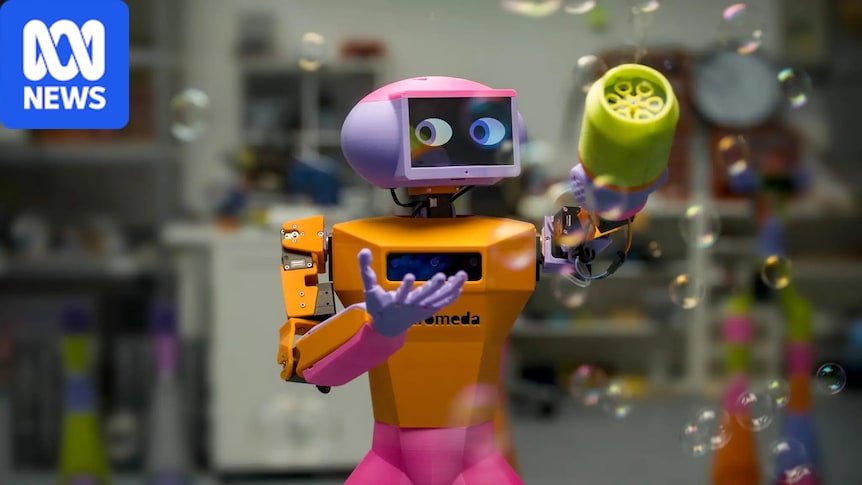
A South Melbourne startup called Andromeda is selling an AI robot called Abi to aged care facilities around the world. The website says: “We’re building robots with heart — empathetic companions that create genuine connections, turning isolation into moments of joy and meaning.”
But an Australian robotics company is a rarity: China is leading the world in making and using them.
On Friday I attended the Australian launch of AgiBot, one of China’s leading humanoid robot companies, complete with robots dancing the Nutbush on stage.
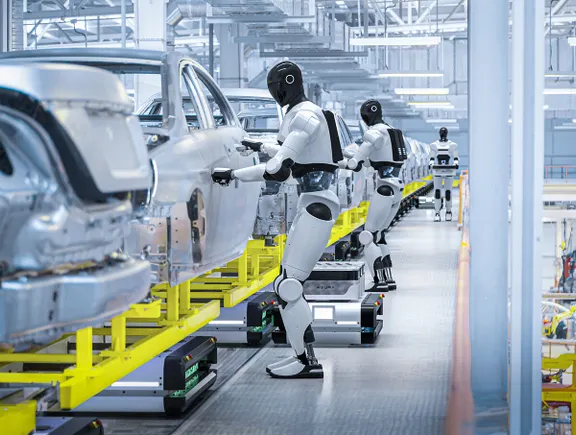
Whether these US$40,000 – $50,000 machines can do more than dance was not shown, but apparently they can: Chinese production is up to 100,000 units this year, growing rapidly, and they are being used for repetitive assembly jobs in manufacturing, in warehouses, and as concierges and sale assistants in hotels and shops.
Clearly AI humanoid robots present another level of regulatory challenge, and this has a long way to go, including the extent to which they are allowed to look and seem human.
By the way, the current price of these machines is roughly equivalent, in today’s money, to that of an African slave in the American south in the late 18th century, although as production scales the price will come down.
And since it’s the 250th anniversary of America’s Declaration of Independence, which begins “We hold these truths to be self-evident, that all men are created equal…”, let’s remember that its main author, Thomas Jefferson, owned more than 600 slaves during his life.
The ownership of humans was finally abolished in most places during the 19th century.
Now it’s back, except with the addition of three letters — the suffix “oid” which eliminates the moral problems and turns them into a very acceptable, large-scale industrial and consumer product.
That only took 200 years of technological development — the blink of an eye in human history.
Loading
Alan Kohler is a finance presenter and columnist on ABC News. He hosts the podcast That’s Business with Alan Kohler in the ABC Business Daily feed on Friday. He also writes for Intelligent Investor.