Humanoid Robot Steers Naval Vessel for First Time as South Korea Faces Crew Crisis
On the bridge of a naval training simulator, a watch officer issued a crisp command: “Left rudder 5 degrees. Steer course 330.”
The voice that came back was not a sailor’s. A humanoid robot repeated the order, turned the ship’s wheel until the simulated vessel settled on course, and reported: “Steady on course 330.”
With those exchanges on July 24 at a naval training facility in Changwon, South Korea, approximately 300 km (186 miles) southeast of Seoul, the Republic of Korea Navy and the Korea Advanced Institute of Science and Technology completed what both institutions are calling the world’s first operational experiment of a humanoid robot performing naval helmsman duties. The robot was Pibot — a humanoid developed by KAIST Professor Shim Hyun-chul under a ₩5.7 billion (approximately $3.9 million USD, exchange rate as of July 25, 2026; conversions are approximate) defense technology project funded by South Korea’s Agency for Defense Development. This was Stage 1 of four.
From Cockpit to Bridge: Physical AI Finds Naval Application
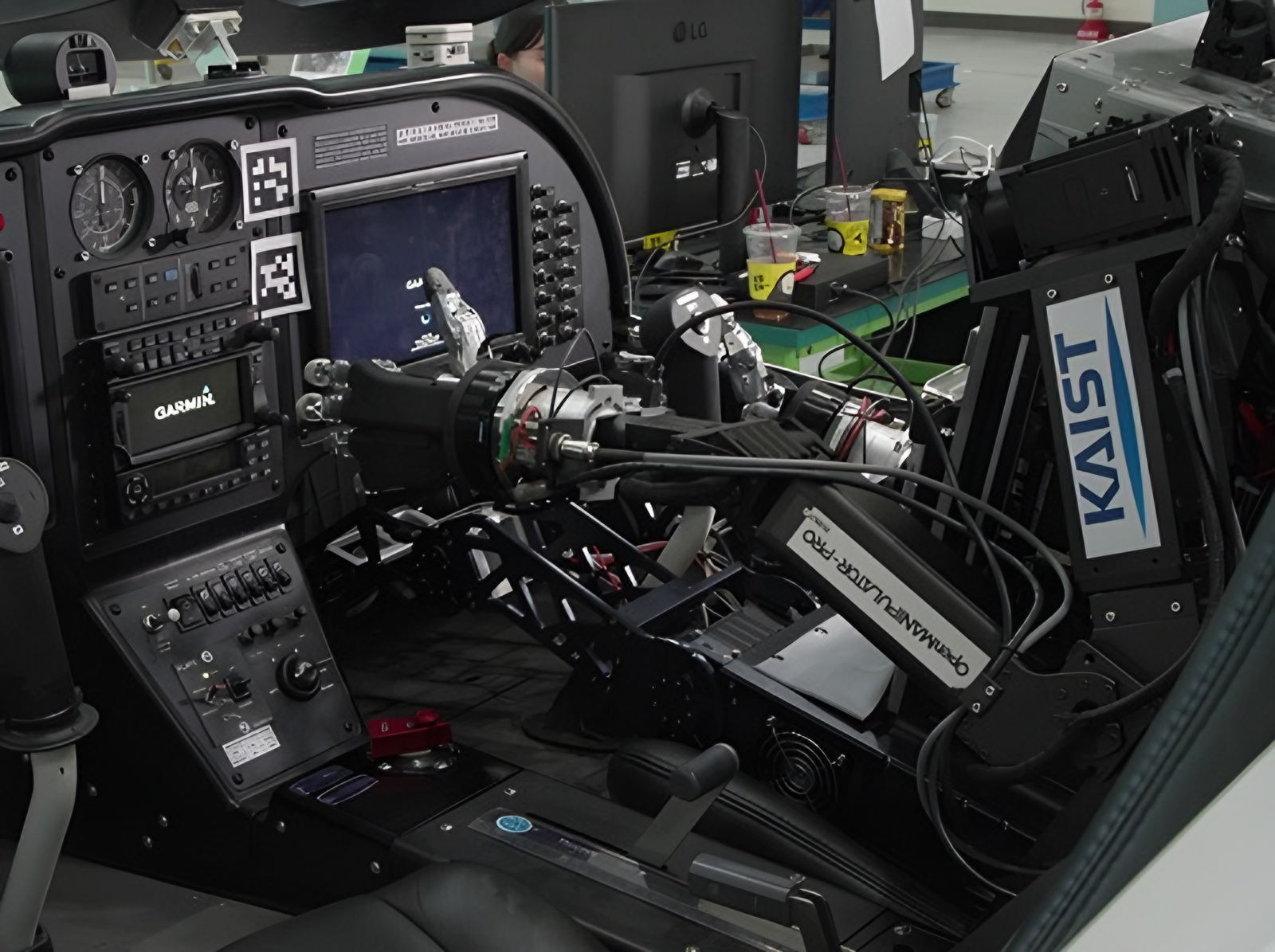
Pibot’s origin is in the air. KAIST’s research team, under the “Key Unmanned Systems Technology with Minimal Invasion” project, built Pibot from the ground up as a humanoid aircraft pilot — one capable of sitting in an unmodified cockpit, reading natural-language flight manuals, and flying from takeoff to landing without any hardware changes to the aircraft.
Professor Shim calls this design philosophy “minimally invasive” robotics: instead of rebuilding a vehicle around a robot, build a robot that fits any vehicle designed for humans. A cockpit was designed for human hands and senses; so was a ship’s bridge. Pibot slots into either without requiring expensive retrofits.
In June 2026, KAIST’s autonomous piloting framework for Pibot earned the Best Paper Award from IEEE Robotics and Automation Magazine — selected from papers published in 2025 — with the award ceremony held at the International Conference on Robotics and Automation in Vienna, Austria. The paper, led by Professor Shim and his research team, documented the full system architecture for humanoid aircraft piloting based on natural-language manual processing.
For the naval adaptation, the team extended the same natural-language processing pipeline to parse standard naval ship-handling vocabulary. Where the aviation version parsed Jeppesen aeronautical navigation charts, the naval version was trained on bridge communication protocols — the acknowledgment conventions, course-reporting language, and steering order phrasing that characterize naval helmsman duty.
How the Technology Actually Works: LLM Meets Physical Control
What makes Pibot’s naval application technically distinct from conventional marine autopilot is not that it steers a ship — autopilots have done that for decades — but how it does so.
A conventional marine autopilot receives digital inputs from integrated navigation computers. It requires hardware interface to the ship’s electronic control architecture. Installing one on an older vessel means modifying the ship’s electronics.
Pibot receives spoken verbal inputs from a human officer using the standard naval communication protocol — and physically operates the mechanical controls a human helmsman would use: the ship’s wheel, the course-hold controls, the instrument readouts. No hardware modification to the vessel is needed. The robot’s articulated arms and fingers, camera-based visual processing, and microphone-based acoustic input replace what a human sailor’s hands, eyes, and ears would do.
The pipeline works in three steps. First, Pibot’s LLM receives the spoken order through its acoustic system and parses it into a structured command. Second, before executing, it repeats the order back to the watch officer — a critical safety gate that confirms the LLM correctly interpreted the spoken instruction before any physical action is taken. Third, it executes the maneuver by physically manipulating the ship’s wheel, holds the course until the vessel stabilizes, and verbally reports the completed heading.
This command-repeat protocol is not mere mimicry of naval procedure. It is the architecture’s primary defense against LLM parsing errors in a safety-critical environment. A model that mishears “port” as “starboard” and executes before the officer can correct it poses a different risk profile than one that repeats the interpreted command and waits for confirmation. The system treats verbal confirmation as the authorization gate for physical action.
The trade-off is real: this approach is inherently slower than direct digital autopilot integration, and it introduces LLM misinterpretation as a potential failure mode that conventional autopilots do not face. But it also means that any vessel with existing physical controls — including aging naval ships that would require expensive upgrades for conventional autopilot integration — becomes a candidate for Pibot operation at low adoption cost.
Stage One: What the Test Actually Involved
The July 24 experiment was not a simple demonstration. Pibot was required to handle frequent close-quarters navigation scenarios and maintain a steady course in simulated rough seas, where high waves repeatedly pushed the virtual vessel off its ordered heading.
The test took place at the Naval Education and Training Command’s ship-handling training facility in Changwon, South Gyeongsang Province, with Pibot operating under orders from a bridge watch officer assigned to the destroyer Seoae Ryu Seong-ryong. The Korea Times additionally reported the simulation included narrow waterways, rough night seas, and severe weather — conditions beyond what the basic command-and-hold sequence would require.
Researchers will analyze three metrics from the Stage 1 data: latency between receiving an order and completing it; accuracy of steering movements; and ease of integration with naval personnel operations. The findings will drive modifications before the program advances.
Rear Adm. Kim Hyung-jun, head of the Navy’s Force Analysis, Test and Evaluation Group, described the result as “the first step in determining whether a robot could perform ship-handling duties without error.”
“Ship handling has traditionally been the exclusive responsibility of crew members,” Kim said. “Using the results of this experiment, the Navy will explore ways to operate robots aboard ships and respond proactively to the changing defense environment.”
Three more stages remain. Stage 2 moves Pibot onto an actual vessel moored in port. Stage 3 tests it during daytime navigation at sea. Stage 4 — the most ambitious — will involve extended day-and-night operations under real maritime conditions. The Navy stated that safety and reliability will receive particular attention before any open-water trial proceeds.
Demographic Imperative: South Korea’s Conscript Cliff
This is not a science experiment looking for a use case. It is a direct institutional response to a specific emergency.
South Korea’s active-duty military fell by 20% in six years — from 560,000 troops in 2019 to 450,000 in 2025 — well below the 500,000-troop threshold long considered necessary to deter North Korea, according to South Korea’s Defense Ministry. The pool of 20-year-old men eligible for conscription dropped approximately 30% in the same period, to roughly 230,000 in 2025.
The projections are starker. The Republic of Korea’s own 2022 Defense White Paper projected the conscription-eligible pool would fall from approximately 226,000 in 2025 to roughly 130,000 by 2040 — a 42% drop in fifteen years. Sangmyung University Professor Chou Byung-ook has calculated that the South Korean military needs to onboard approximately 200,000 soldiers per year to sustain current troop levels — a figure it will no longer be able to reach from the male conscript pool alone within a decade.
Jo Bee-yun, a research fellow at the Sejong Institute, called the demographic trajectory “the biggest structural challenge faced by South Korea’s overall defense strategy.” Former Korea Institute for Defense Analyses head Kim Yun-tae has warned that troop numbers could fall to around 300,000 by 2040, which he described as spelling “a complete collapse” of a military structure built around a 500,000-soldier baseline.
Seoul’s formalized response is the “Defense Innovation 4.0” plan — rebranded by the current administration as a “slimmer yet smarter” military pivot that uses AI, autonomous systems, and robotics to compensate for shrinking personnel numbers.
The Pibot naval program sits explicitly within this framework. It falls under Navy Sea GHOST — “Guardian Harmonised with Operating manned Systems and Technology-based unmanned systems” — the hybrid manned-unmanned fleet doctrine launched by the ROK Navy in November 2022. The doctrine envisions close cooperation between human crew members and autonomous systems, with humanoid robots absorbing repetitive, physically demanding, and sustained-vigilance roles that historically required dedicated human sailors.
Why Humanoid Form Factors Matter Here
The question is worth asking directly: why a humanoid robot at all, when dedicated automation technology exists for ship steering?
The answer goes back to minimally invasive design. Naval vessels, particularly those designed years or decades ago, contain physical controls — wheels, handles, switches, readouts — that weren’t built to accept digital commands from purpose-built machines. Retrofitting them for conventional autonomous control means hardware modification per vessel: expensive, time-consuming, and requiring separate certification for each ship class.
A humanoid robot that can board any compliant vessel and operate its existing physical infrastructure drops the per-vessel adoption cost dramatically. The technology scales across an entire fleet without redesigning each platform. For a navy facing both a personnel shortage and the cost pressures of a demographic emergency, that economic argument is not incidental — it is central to why the program exists.
There is also a communication interoperability argument. Naval helmsmen are trained in a specific procedural language that has not changed substantially for decades. An LLM-enabled robot that can participate in that existing communication framework means the Navy does not need to develop new officer training for interacting with automated systems. The robot adapts to the human workflow, not the reverse.
Andrew Oros, professor of political science at Washington College, speaking at a June 2024 Center for Strategic and International Studies event, characterized “the more urgent shortage of people to serve in the military” in South Korea as the primary driver of investments in labor-saving robotics that elsewhere might be justified on pure efficiency grounds.
Beyond the Helm: Platform Generalization and What It Implies
The helmsman role is a starting point. The Navy has stated explicitly that it plans to examine other duties aboard ship that robots could perform — particularly tasks that are repetitive, physically demanding, or that require sustained vigilance over long periods.
Professor Shim’s description of Pibot as an evaluation of “physical artificial intelligence” — AI that not only reasons but acts in the physical world — points toward the broader implication. Because Pibot’s architecture is vehicle-agnostic by design, the same system that parsed naval helm commands in Changwon could, with different procedural training, be adapted to operate any human-designed station aboard a vessel. Damage control panels. Engine room controls. Weapons systems. The “minimally invasive” philosophy does not stop at the helmsman position; it describes an architectural commitment to operating any human-centered environment without redesign.
This is the largest implication the helmsman framing underplays: Pibot’s naval debut is not just a proof-of-concept for crew reduction in a specific role. It is a first field test of a platform architecture that, if successful across all four stages, could be extended across the entire human-designed portion of a warship’s operation without requiring the Navy to build new vessel types from scratch.
Whether that trajectory is achievable depends on factors the Stage 1 data will begin to answer: command latency, steering accuracy, and officer integration ease. The Navy has set a high bar — safety and reliability scrutiny at every stage, with open-water testing gated on the results of prior phases. The remaining three stages will be the real measure.
Frequently Asked Questions
What is Pibot, and what makes it different from conventional ship autopilots?
Pibot is a humanoid robot developed by KAIST professor Shim Hyun-chul, originally designed as an autonomous aircraft pilot capable of reading natural-language manuals. Unlike conventional marine autopilots — which require hardware integration into a ship’s electronic control systems — Pibot operates the ship’s physical controls directly using its articulated arms and hands, the way a human helmsman would. This means it can be deployed on any existing vessel without hardware modification. The naval version uses a large language model to parse spoken commands from a bridge watch officer, repeats each order before executing as a safety gate, then physically turns the wheel and reports the completed heading.
Can a robot actually replace a sailor on a warship?
Not yet, and not without significant further testing. The July 24 experiment was Stage 1 of four — a land-based simulator trial. Stages 2 through 4 will test Pibot on a moored vessel, during daytime at-sea navigation, and in extended day-and-night operations. The Navy has stated safety and reliability will receive particular scrutiny before any open-water trial proceeds. Beyond the technical hurdles, liability frameworks for autonomous systems in military contexts, adversarial robustness questions, and the political dimensions of replacing uniformed personnel with machines in a country where military service is a legal obligation and a social institution all remain unresolved.
What is Navy Sea GHOST, and why does it matter for this test?
Navy Sea GHOST — “Guardian Harmonised with Operating manned Systems and Technology-based unmanned systems” — is the ROK Navy’s strategic framework for building a hybrid manned-unmanned fleet, launched in November 2022 under South Korea’s Defense Innovation 4.0 plan. It envisions human crew members working alongside autonomous systems, with robots absorbing repetitive and physically demanding duties. The Pibot helmsman program sits explicitly within this framework. Sea GHOST also includes unmanned surface vessels, undersea vehicles, and ship-mounted drones — the humanoid helmsman experiment is the most visible test of whether human-form robots belong in that mix.
What is driving South Korea’s push to automate naval crew duties?
A demographic crisis. South Korea’s active-duty military fell 20% in six years — from 560,000 troops in 2019 to 450,000 in 2025 — as the pool of conscription-eligible men declined by roughly 30% in the same period. The country’s 2022 Defense White Paper projected the conscription-eligible pool will fall from approximately 226,000 in 2025 to roughly 130,000 by 2040. South Korea’s fertility rate is among the world’s lowest, and military planners have concluded that without robotic augmentation, the armed forces cannot maintain current operational capacity through demographic means alone.