Humanoid Robots Enter the Factory: IEEE Humanoids 2026 Sets Labor Displacement as Its Defining Theme
The paper submission window for the IEEE-RAS International Conference on Humanoid Robots closed Friday — the signal that the world’s premier humanoid robotics gathering is now officially in motion for its December 6–9 run at the Santa Clara Convention Center. What attendees will find when they arrive in Silicon Valley this winter is not the same conference that launched twenty-five years ago asking whether bipedal machines could walk. They will find a field that has already crossed into commercial production — and a community that has named what that transition means: the future of work.
The IEEE Robotics and Automation Society designated “Humanoids and the Future of Work” as the special topic for its 25th annual edition. That choice is not thematic decoration. It reflects a specific editorial judgment from the research community: that humanoid robots have reached the deployment threshold at which the primary open question is no longer engineering capability but economic consequence. Boston Dynamics shipped its first commercial Atlas units to Hyundai’s Robotics Metaplant Application Center and to Google DeepMind in 2026, following its CES announcement. Figure AI’s Figure 03 platform deployed forty units at BMW’s Spartanburg, South Carolina plant in late June, following an 11-month Figure 02 pilot that contributed to production of more than 30,000 BMW X3 vehicles, as detailed in Figure AI’s official announcement. Agility Robotics’ Digit is working commercial shifts at Toyota Motor Manufacturing Canada’s Ontario facility and at a GXO Logistics warehouse in Flowery Branch, Georgia, as the company announced a merger with Churchill Capital Corp XI on June 24, 2026, valuing it at $2.5 billion. The machines are no longer experimental. They are on clock.
Special Topic Chairs Gary Bolles (Singularity University) and Nell Watson (IEEE lecturer and AI ethics researcher) will shape the conference’s programming around the questions that follow from that status: who deploys these systems, under what labor conditions, with what safety certification, and with what economic consequences for the workers already doing the jobs the robots will assume, according to the conference’s organizing committee.
Workshops and Competition Proposals Due August 3 — Nine Days Away
For researchers, engineers, and industry professionals, the most immediately actionable date from the conference calendar is August 3, 2026 — nine days from now. Workshop and tutorial proposals, competition team proposals, and supplementary video uploads for accepted paper submissions are all due by that date via PaperPlaza, per the call for workshops and tutorials. Workshop and Tutorial Chairs Enrico Mingo Hoffman (INRIA), Yan Gu (Purdue University), and Rafael Cisneros-Limón (AIST) will accept or reject proposals by September 28. Competition acceptances will be announced September 21.
The full conference calendar extends through December:
- October 6: Paper acceptance/rejection notifications
- October 16: Early-bird registration deadline
- October 26: Camera-ready paper deadline
- December 6: Public forums, seminars, and hackathons
- December 7: Workshops and tutorials
- December 8–9: Main conference with plenary sessions, oral presentations, interactive sessions, industry forum, and exhibition hall (open 9:00 a.m. to 5:30 p.m. ET daily)
Standard exhibition booth rental is $35 per square foot (approximately $29.75 per square foot for early-bird pricing, which was available through July 1), per the conference’s exhibit and partnerships page.
Why the Loco-Manipulation Challenge Is This Year’s Most Watched Event
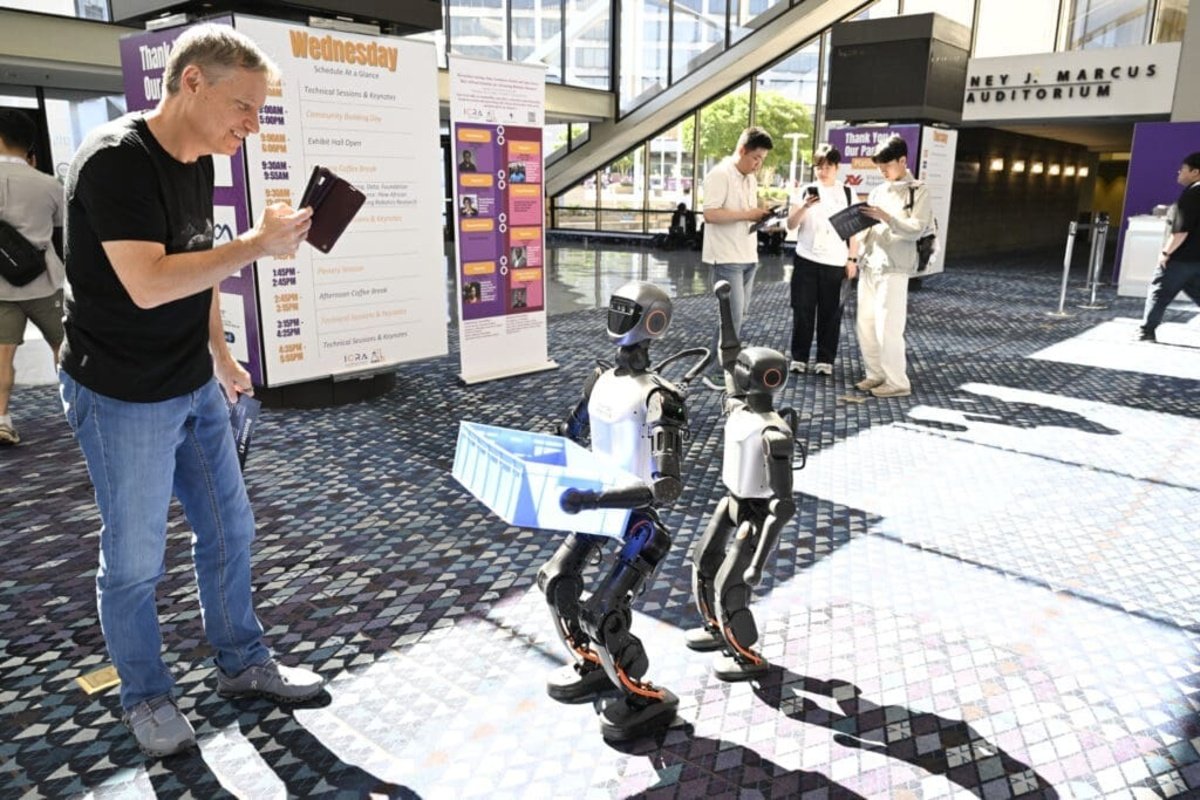
Among technical highlights, the Humanoids 2026 Loco-Manipulation Challenge will draw the closest attention from both academia and industry. Between 10 and 15 teams will compete across one practice day and two competition days on a circuit of tasks evaluating three capabilities: mobility, manipulation and dexterity, and reasoning.
The term “loco-manipulation” names a specific engineering problem that separates useful humanoid robots from laboratory demonstrations: the combined, simultaneous execution of locomotion (walking through an environment, navigating uneven surfaces, maintaining balance) and manipulation (grasping, carrying, reorienting objects). A robot that can walk or a robot that can grasp are each technically impressive; a robot that can walk to a shelf and pick up an unsorted component, maintaining its balance as the load shifts its center of mass, is something closer to what a warehouse or factory actually needs.
The technical barrier is whole-body control: the robot must coordinate its legs and arms through a unified control policy rather than running separate locomotion and manipulation systems in sequence. This requires real-time replanning of both gait trajectories and arm movements as the task demands change — and it must do so in a physical environment whose friction, contact dynamics, and sensor noise differ from the simulated environments where most robot policies are trained. The “sim-to-real gap” — the engineering distance between a policy that works in physics simulation and one that works on real hardware — remains the primary constraint on how quickly these capabilities can be deployed at scale.
What makes the 2026 competition structurally different from previous robotics challenges is its explicit benchmark function: some of the world’s leading commercial humanoid platforms will be evaluated on the same task circuit as academic research robots, before and after the competition period, enabling a direct published comparison between the state of the art in research and the state of the art in commercial deployment. Competitions Chairs Kamel Saidi, Ben Beiter, and Peter So designed the scoring to incentivize autonomy while still awarding points for teleoperated performance, acknowledging that even partially autonomous systems have commercial value and that understanding the current autonomy ceiling is itself a research contribution.
The challenge draws on the legacy of the DARPA Robotics Challenge — the US Defense Advanced Research Projects Agency competition whose Trials ran in December 2013 and whose Finals took place in June 2015 — which is widely credited with catalyzing the modern humanoid robotics industry. Teams from those competitions went on to found or lead most of the companies now shipping commercial platforms. The Humanoids 2026 competition is, in a sense, a test of how much the field has moved in the decade since.
What Vision-Language-Action Models Changed About the Robot Business Model
The technical reason commercial humanoid robotics became viable in 2025–2026 is not a mechanical breakthrough in actuators or chassis. It is a shift in how robots learn to do things — from task-specific controllers programmed for individual operations to foundation models trained across diverse tasks and environments.
Vision-Language-Action (VLA) models are AI architectures that unify visual perception, language instruction understanding, and motor action generation in a single end-to-end system: the robot takes in camera images and a natural-language instruction, and the model outputs the motor commands that execute the task. Rather than being programmed to insert a specific sheet-metal panel into a specific welding fixture at a specific height, a VLA-trained robot is trained on broad demonstrations across many object types and many tasks — and generalizes from that training to objects and configurations it has not explicitly seen before.
Figure AI’s Helix model, which runs on the Figure 03 platform currently deploying at BMW Spartanburg, is a VLA architecture the company built in-house after ending its earlier collaboration with OpenAI in 2025. Google DeepMind’s Gemini Robotics foundation models are running on Boston Dynamics Atlas hardware as part of their strategic partnership. Separately, Apptronik opened its Robot Park facility — a nearly 90,000-square-foot data collection and training facility in Austin, Texas — where fleets of Apollo 2 robots perform real production tasks continuously to generate the training data that Gemini Robotics needs, under a research partnership with Google DeepMind.
The business-model implication is significant: VLA-trained robots are software-upgradeable in ways that task-specific programmed robots are not. A commercial platform that ships with a foundation model can receive new capabilities through model updates rather than hardware redesigns. That is why companies like Boston Dynamics, Figure AI, Apptronik, and NVIDIA are racing to own both the hardware stack and the AI model — and why Google DeepMind is simultaneously partnering with Boston Dynamics and Apptronik, not because they need the hardware, but because they need the real-world data from deployed robots to improve Gemini Robotics.
The Industry Arriving in Silicon Valley This December
The commercial landscape that will arrive at Santa Clara Convention Center in December is substantially different from the one that gathered at last year’s Seoul edition.
Boston Dynamics announced at CES 2026 in Las Vegas that the production version of its fully electric Atlas robot was ready to ship, with all 2026 deployments committed to Hyundai’s Robotics Metaplant Application Center and to Google DeepMind. Hyundai plans to begin using Atlas for parts-sequencing tasks in 2028, with the scope of deployment expanding in subsequent years. The partnership with Google DeepMind focuses on integrating Gemini Robotics foundation models with Atlas hardware — with research expected to begin in 2026 and scale through the following years.
Figure AI, after ending its OpenAI collaboration in early 2025, built its in-house Helix VLA model and deployed 40 Figure 03 units at BMW’s Spartanburg, South Carolina plant following a successful 11-month Figure 02 trial, as confirmed in Figure AI’s official announcement. The prior Figure 02 deployment supported the production of more than 30,000 BMW X3 vehicles. As of May 2026, Figure AI’s BotQ factory in California manufactures one Figure 03 per hour — a manufacturing rate that represents a 24-fold increase in throughput from 120 days earlier, as reported in TechTimes’ Automate 2026 coverage.
Agility Robotics announced on June 24, 2026, a merger with Churchill Capital Corp XI (a special purpose acquisition company) that values the company at approximately $2.5 billion, with more than $620 million in gross proceeds. The combined company will trade on Nasdaq as AGLT, becoming the first publicly listed pure-play humanoid robot company with robots in active commercial operation. The company has roughly $300 million in contracted multi-year revenue from customers including GXO Logistics, Toyota Motor Manufacturing Canada, and Schaeffler, and its RoboFab manufacturing facility in Salem, Oregon is capable of scaling past 10,000 Digit units annually.
Apptronik opened Robot Park on June 30, 2026, a nearly 90,000-square-foot (8,361-square-meter) facility in Austin where fleets of Apollo 2 robots perform real production tasks continuously to train Gemini Robotics models. Google DeepMind is Apptronik’s research and data partner; the relationship is structured so that the data Apollo 2 generates at Robot Park feeds back into the foundation model training that will prepare Apptronik’s future commercial fleet for deployment.
Chinese manufacturers are scaling aggressively on volume. AgiBot rolled out its 15,000th robot in late June 2026 — a milestone reached less than three months after hitting 10,000 units, as covered in TechTimes’ AGIBOT report. Unitree has cumulatively produced approximately 11,000 bipedal humanoid robots as of early June 2026 and is targeting 10,000–20,000 annual shipments in 2026. Unitree’s G1 platform is commercially available at $16,000 — a price point that significantly undercuts most Western competitors. Companies headquartered in China operate under the obligations of China’s National Intelligence Law (2017), which requires all organizations and citizens to support, assist, and cooperate with national intelligence work, and the Data Security Law (2021), which includes provisions for government access to data. These legal requirements apply regardless of where the robots operate or what the company’s stated privacy policy says.
Goldman Sachs projected in 2024 that the humanoid robot market will grow from $2.9 billion to $38 billion by 2035. China’s Ministry of Industry and Information Technology stated at the 2026 World Artificial Intelligence Conference that China’s annual humanoid robot production volume is expected to exceed 100,000 units in 2026.
An Honor humanoid robot named Lightning won the Beijing E-Town Half-Marathon humanoid race on April 19, 2026, completing the 21-kilometer (13.1-mile) course in 50 minutes and 26 seconds — faster than the human world record of approximately 57 minutes held by Uganda’s Jacob Kiplimo. The previous year, the fastest robot in the same event finished in 2 hours and 40 minutes; the 68% improvement in a single year is a visible signal of how quickly locomotion capability is advancing among Chinese manufacturers.
What Papers Will Cover: The Broadest Call for Research in the Conference’s History
Program Chairs Luis Sentis (University of Texas at Austin), Serena Ivaldi (INRIA), and Gentiane Venture (University of Tokyo) closed the paper submission window on July 24, 2026, with more than 200 submissions received. Acceptance notifications are due October 6. All accepted papers will be published on IEEE Xplore.
The Call for Papers spans the broadest scope in the conference’s 25-year history. On the mechanical and design side: human biomechanics and motor control, novel actuators and materials, exoskeleton and wearable robot design, prosthesis design, dexterous multi-finger hands, and humanoid faces and social presence. On the control and learning side: whole-body dynamics and control, model predictive control, dynamic legged locomotion, loco-manipulation, dual-arm dexterous manipulation, reinforcement learning for humanoid robots, simulation and physics-based animation, and brain-robot interfaces. On the application side: physical and social human-humanoid interaction, real-world deployments in industry, healthcare, home environments, space, and disaster response, and long-term deployment of bipedal robots.
The final two topic categories in the call — benchmarks and performance indicators, and ethical and social challenges of deployment — reflect the maturation of the field. When a research conference has to formally solicit papers on “ethical and social challenges of humanoid robot deployment” as a distinct research area, it signals that the community has moved from asking whether these machines will work to asking what it means for them to work at scale in human environments.
Who Will Be in the Room
General Chairs Andra Keay (Silicon Valley Robotics) and Ross Mead (Semio) selected Santa Clara specifically for its geographic concentration of humanoid robotics activity: 1X, Agility Robotics, Figure AI, and Tesla’s Optimus team all operate within driving distance of the Convention Center, as do the robotics research arms of Google DeepMind, NVIDIA, Meta, and Toyota Research Institute, according to the conference’s organizing committee.
The conference expects more than 1,200 attendees from over 70 countries, balancing academic researchers from UC Berkeley, Stanford, the University of Tokyo, and INRIA against industry researchers from Toyota Research Institute, Google DeepMind, Meta, and NVIDIA — and against engineers from the commercial humanoid platforms that have clustered in Silicon Valley and across the Bay Area. The Workshop and Tutorial Chairs have explicitly prioritized diverse speaker lineups across seniority, gender, geographic origin, and the industry-academia balance — a reflection of a field that now draws significant contributions from South Korea, Japan, France, Germany, China, and the United States simultaneously.
Early-bird registration is open through October 16, 2026. Full conference details, registration, and submission links are available at 2026.ieee-humanoids.org.
A 25-Year Arc, Now Accelerating
The first IEEE-RAS International Conference on Humanoid Robots took place in 2000 — the same year Honda unveiled ASIMO — when bipedal walking was the field’s defining research challenge and the notion of a humanoid robot performing useful work in an uncontrolled factory or warehouse environment was genuinely speculative. The arc since then has not been linear. Progress came in research phases (bipedal locomotion, dexterous manipulation, whole-body control), then in demonstration phases (DARPA Robotics Challenge 2013 and 2015, the viral Boston Dynamics videos of robots performing parkour and loading trucks), and only very recently in deployment phases.
What is different about the 25th edition is that the deployment phase is no longer a distant aspiration being modeled in a roadmap. It is the context in which the conference now operates. Robots are on the clock at BMW Spartanburg. They are moving totes at a GXO warehouse in Georgia. They are being trained on real production tasks at a 90,000-square-foot facility in Austin. An Honor robot ran a half-marathon faster than any human in history. AgiBot rolled out its 15,000th unit in June. The Goldman Sachs projection of a $38-billion market is being cited not as a fantasy but as a planning figure.
The organizing committee’s decision to make “Future of Work” the 25th edition’s defining theme is the conference’s own acknowledgment that this threshold has been crossed — and that the hardest questions now are not about whether the robots can do the work, but about what it means for the people who have been doing it.
Frequently Asked Questions
When and where is the IEEE-RAS Humanoids 2026 conference?
The 25th IEEE-RAS International Conference on Humanoid Robots will take place December 6–9, 2026, at the Santa Clara Convention Center in Santa Clara, California. Day 1 (December 6) features public forums and hackathons. Day 2 (December 7) is for workshops and tutorials. The main academic conference, exhibition hall, and industry forum run December 8–9. Early-bird registration closes October 16 at 2026.ieee-humanoids.org.
What is loco-manipulation, and why does the Loco-Manipulation Challenge matter for commercial deployment?
Loco-manipulation refers to a robot’s ability to walk through an environment and manipulate objects simultaneously — coordinating balance, locomotion, and grasping through a unified whole-body control system rather than running separate controllers in sequence. It is the engineering capability that bridges laboratory bipedal robots and useful factory floor machines, because real production tasks — moving unsorted components, pulling carts, loading sequencing trolleys — require both at once. The Humanoids 2026 challenge will publish a direct comparison between academic research robots and leading commercial platforms on the same task circuit, giving the industry its first rigorous public benchmark of where the gap currently stands.
Humanoid robots from Chinese manufacturers are much cheaper — is it safe to adopt them?
Price differences are real: Unitree’s G1 is commercially available at $16,000, which significantly undercuts most Western alternatives. But every company headquartered in China operates under specific legal obligations that are independent of price or the company’s stated policies. China’s National Intelligence Law (Article 7, 2017) requires all organizations and citizens to support, assist, and cooperate with national intelligence work. The Data Security Law (2021) and Cybersecurity Law (2017) include additional data localization and government-access provisions. These obligations apply regardless of where the robot is deployed, where the company’s servers are located, or what its privacy policy states. Any enterprise evaluating Chinese humanoid robots should account for these fixed legal conditions alongside cost, performance, ecosystem maturity, and the still-limited independent security audit record for most platforms, as analyzed in TechTimes’ coverage of AGIBOT’s obligations.
Will humanoid robots replace factory workers — and how fast could it happen?
The honest answer is: faster than most workers or policymakers are currently planning for, in specific sectors. Logistics and automotive assembly are the leading deployment sites in 2026, and both involve high-repetition physical tasks where the engineering case for humanoid robots is now proven, not theoretical. The concern is not that robots will replace all factory workers immediately — the current scale (hundreds to low thousands of units in active commercial use globally) is still small relative to the labor forces in these sectors. The concern is that deployment is accelerating: AgiBot went from 1,000 to 10,000 to 15,000 units in a time span measured in months, not years. Goldman Sachs projects the market to grow 13-fold by 2035. The question “How fast?” is precisely why the IEEE-RAS Humanoids conference chose “Future of Work” as its 25th-year theme — because the researchers and engineers in that room know the answer better than anyone, and they know it is not slow.