I tested a 4TB quantum-resistant USB drive – but you don’t have to spend $3000 for this much security
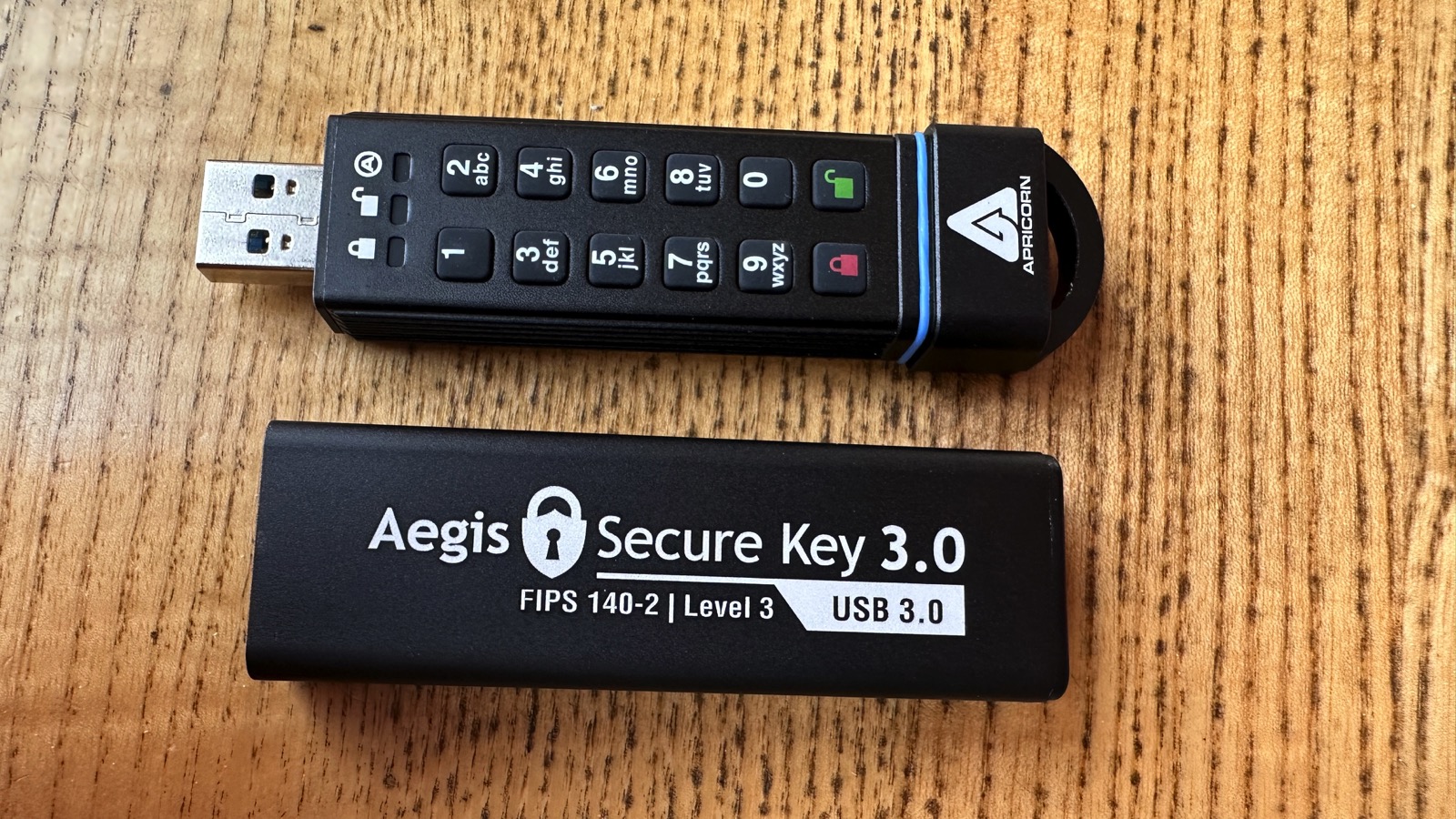
Apricorn Aegis Secure Key 3
pros and cons
- Quantum-resistant encryption
- Totally platform independent
- Very tough, crush-resistant, and IP68 rated
- Very expensive
- Overkill in terms of capacity for most users.
more buying choices
Follow ZDNET: Add us as a preferred source on Google.
Losing a laptop is inconvenient, but usually the worst that happens is some finger-pointing and a bit of awkward explaining. Losing an unencrypted USB drive containing client data can trigger a breach notification under HIPAA or GDPR, even if nobody ever plugs it in.
And that’s why I recommend hardware-encrypted storage drives. They don’t stop you from losing the drive, but they do make the data on it worthless.
Also: Why I still recommend Synology’s DS225+ NAS – even if it can’t replace your cloud storage
Apricorn is a manufacturer of encrypted storage drives that I’ve been reviewing — and using personally — for years, including the 3NX, the 3Z, and other Aegis keys. Last week, it released a 4TB version of its Aegis Secure Key 3, the highest-capacity hardware-encrypted USB drive of its kind.
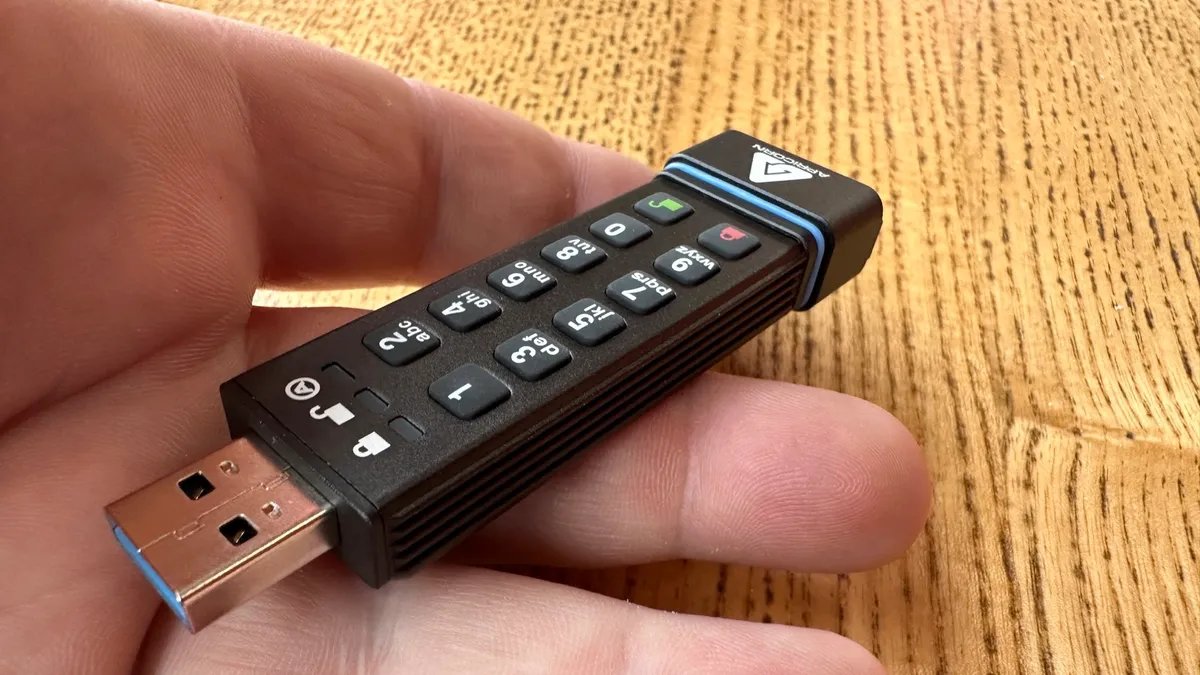
And this isn’t some bulky thing that sits on your desk. No, this is a quantum-resistant hardware-encrypted flash drive that you can slip into your pocket.
What is ‘quantum-resistant hardware encryption’?
Modern encryption has moved well ahead of letter substitution codes. Imagine a combination lock, but rather than three wheels with 0 to 9 on them, as you have on a locker or toolshed offering 1,000 possibilities, this has roughly the same number of possibilities as atoms in the universe (a mind-bogglingly massive number: a 1 followed by 77 zeros).
These are not numbers anyone will be able to guess at — or brute-force — even with a powerful computer at their disposal.
Also: I ditched Google Drive for my own self-hosted storage – and I wish I’d done it sooner
Well, not yet…
The problem is that computers are getting faster, and quantum computers could boost performance to the point that something considered secure today could be trivial to crack down the line. So, if you’re holding data with a long confidentiality shelf life (like health records, company data, or the plans for the Death Star), you want any encrypted data that might have leaked into the wild to stay encrypted for as long as possible.
“Quantum-resistant” encryption protects against the threat posed by “harvest now, decrypt later,” and that’s what the AES-256 XTS encryption used by Apricorn provides.
How Apricorn protects against real-world attacks
But while we tend to think of breaking encryption as involving big, fancy supercomputers, most attacks are far simpler, relying on things like default passwords, people using weak ones, or keypads revealing the PIN because the often-used keys show signs of wear.
Yes, high security can fail because of something that simple.
The drive works perfectly on USB-C-equipped Macs with a third-party USB-C-to-USB-A adapter.
Adrian Kingsley-Hughes/ZDNET
Apricorn has this covered. From shipping the drive with no default passwords or PIN codes, to blocking short PINs and passcodes, to building the keypad from a wear-resistant polymer.
Think you can break open the drive and get it to spill its secrets? The drive has been packed full of epoxy resin to prevent tampering.
Unlike a lot of encrypted flash drives, this one is easy to use and self-contained. There’s no app or executable you have to run. You plug it into a USB port, press a button, enter the passcode, and you’re in. And because the drive doesn’t rely on running an app, it’s totally platform-independent, so you can use it on any device that supports USB storage.
Also: The best external hard drives: Expert tested and reviewed
The drive features anti-brute-force protection that wipes the drive if someone tries to guess the passcode, and a built-in unattended auto-lock that secures the drive if you walk away or become distracted.
For an added level of security, there’s also the ability to set a self-destruct PIN to quickly wipe the drive of its contents, yet make it seem like it is fully working.
Apricorn says the drive meets and exceeds FIPS 140-3 Level 3 requirements and has submitted it to NIST for formal validation.
It’s also IP68 rated against dust and water ingress (completely dustproof and protected against prolonged water immersion), and built from tough, extruded aluminum, so it’s drop-resistant and crushproof to 6,500 pounds.
How it compares to iStorage and Kingston
Apricorn isn’t the only player in this market, and the Aegis Secure Key 3 has competition from the likes of the iStorage datAshur PRO+C and Kingston IronKey.
And what’s interesting is that when you compare these two against the Aegis Secure Key 3, they’re very similar — until you look at maximum capacity.
|
|
Apricorn Aegis Secure Key 3 |
iStorage datAshur PRO+C |
Kingston IronKey Keypad 200 |
|
Min/Max capacity |
16GB/4TB |
32GB/512GB |
8GB/512GB |
|
Encryption |
AES-256 XTS, hardware-based |
AES-256 XTS, hardware-based |
AES-256 XTS, hardware-based |
|
FIPS status |
Submitted to NIST CMVP for 140-3 Level 3 validation (pending, not yet certified) |
datAshur PRO+C: FIPS 140-3 Level 3 validated |
FIPS 140-3 Level 3 validated |
|
Keypad |
Yes |
Yes |
Yes |
|
IP rating |
IP68 |
IP68 |
IP68 |
|
Entry price |
~$169 (16GB tier) |
~$96 (32GB) |
~$75 (8GB) |
|
Top-tier price (max capacity) |
~$3,000 (4TB) |
~$259 (512GB) |
~$389 (512GB) |
Apricorn’s real differentiator isn’t the drive’s security — AES-256 XTS offers the same quantum resistance across all devices — it’s capacity. Nobody else makes a hardware-encrypted USB flash drive above 512GB, so the 4TB Aegis Secure Key 3 has no direct competitor at that tier.
Who needs 4TB for pocketable storage?
Not a lot of people do, and this is exactly why Apricorn makes the Aegis Secure Key 3 in nine capacities, going from 16GB to 4TB.
Also: This coin-sized flash drive doubles my laptop’s storage space – and it’s cheaper than you think
However, as Apricorn points out, government agencies, defense contractors, healthcare providers, financial institutions, legal professionals, and digital forensic investigators may find themselves handling sensitive information. There are also all sorts of data that shouldn’t travel across networks and require an air-gapped transfer method.
ZDNET’s buying advice
A 4TB flash drive that uses quantum-resistant cryptography isn’t cheap, and the Aegis Secure Key 3 certainly isn’t cheap — given its $3,000 price tag. But at the lower end of the capacity spectrum, prices start at $169, making this kind of encryption within reach of most.
On paper, the Aegis Secure Key 3 has quite a fair bit of competition, but not when it comes to capacity. If you want a hardware-encrypted flash drive that’s bigger than 512GB, you’ll be going with Apricorn.