Investors rejected crypto basket ETFs and now this $1.9 trillion manager is putting the reason to the test
T. Rowe Price manages roughly $1.89 trillion, with about 66% of that money tied to retirement accounts, advisers, and institutional relationships that the crypto industry has spent years trying to reach.
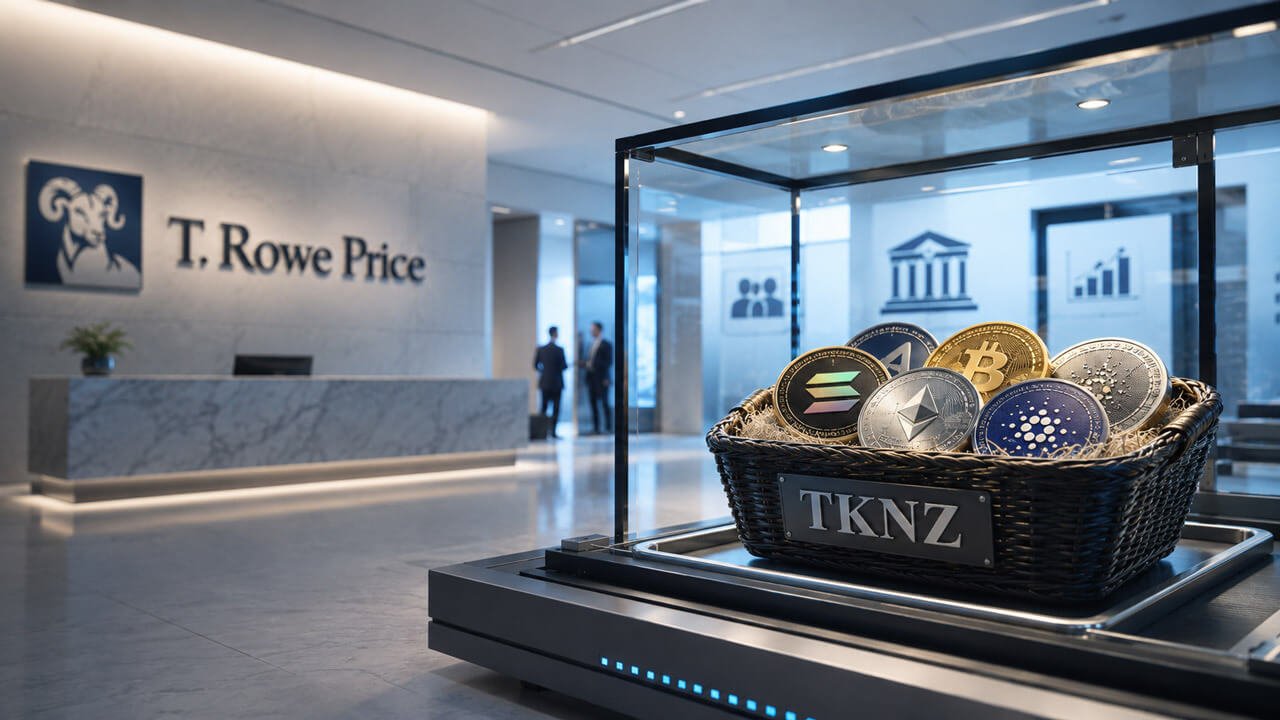
Its first crypto product, a spot ETP called TKNZ that began trading on NYSE Arca on July 16, walked straight into the diversified multi-token basket, which is the one corner of the crypto ETF market that has drawn the least money so far.
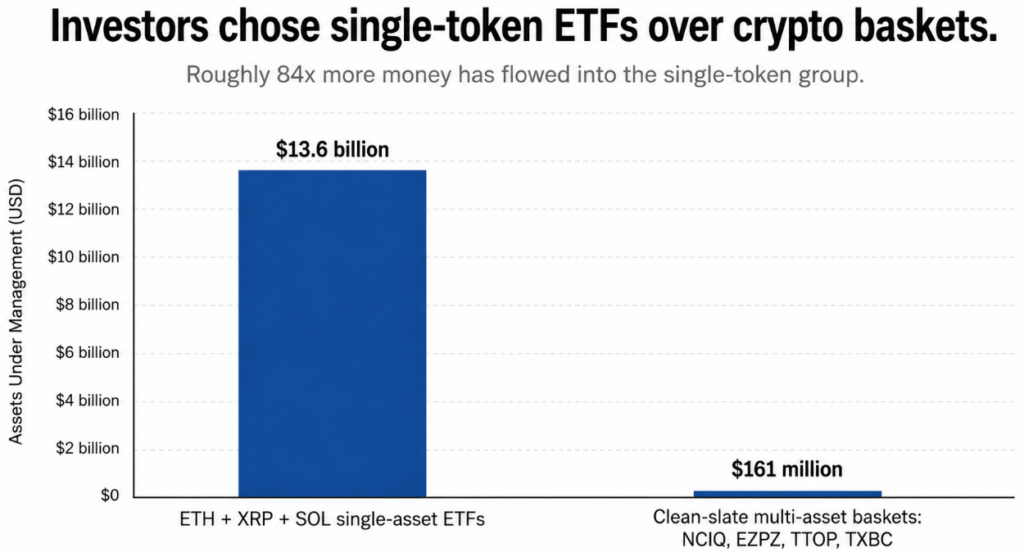
Single-asset spot ETFs tracking Ethereum, XRP, and Solana have pulled in roughly $13.6 billion combined, excluding Bitcoin entirely. Four comparable multi-asset products built from scratch, NCIQ, EZPZ, TTOP, and TXBC, have gathered about $161 million over the same rough stretch.
A gap that size still survives the timing caveat.
A forecast that missed the mark
Several well-known crypto commentators expected multi-asset crypto ETFs to be among the next triggers for institutional adoption.
Matt Hougan argued that many traditional investors have no strong opinion on Ethereum versus Solana and would prefer broad exposure. Roxanna Islam expected the sheer number of new crypto ETFs to overwhelm adviser due diligence and push buyers toward simpler basket products.
Nate Geraci called himself bullish on one-click crypto exposure, and James Seyffart expected index-style crypto ETPs to become a major category this year.
The shared assumption was that professional allocators would eventually stop picking individual tokens and start buying the asset class as a whole.
Pensions and endowments held less than 5% of spot Bitcoin ETF assets as of mid-2025, with retail investors still dominating the category.
A conviction buyer who wants Ethereum’s recovery or XRP’s payments thesis specifically has little reason to dilute that bet across eight other tokens picked by someone else.
Crypto also lacks anything resembling the S&P 500, a widely accepted definition of what belongs in the investable market. Every basket has to make its contentious decisions about which tokens count as decentralized enough, liquid enough, or legally eligible.
Buying an index transfers token selection to whoever built the index, someone else making that same choice on the buyer’s behalf.
Hashdex’s NCIQ, one of the cheaper baskets at a 0.25% fee, still sits close to 90% Bitcoin and Ethereum, an exposure that most investors could replicate with two single-asset ETFs and full control over the weighting.
Diversifying away from Bitcoin during a stretch when altcoins have lagged reads as a drag, the opposite of how a bond allocation cushions a stock portfolio. An adviser explaining a client’s stake in a basket of underperforming tokens has a hard conversation.
| Problem | What investors expected | What happened instead | Why it matters |
|---|---|---|---|
| Buyer mismatch | Advisers and institutions would prefer broad crypto exposure | Retail and conviction buyers still dominate | Token-specific theses beat abstract asset-class exposure |
| Weak diversification | A basket would reduce single-token risk | Many baskets remain heavily BTC/ETH-weighted | Investors can replicate most exposure with single-asset ETFs |
| No crypto “S&P 500” | Index exposure would feel neutral | Token inclusion is still subjective and contentious | Buying a basket outsources token selection |
| Poor timing | Altcoins would make baskets look broader and more attractive | Altcoins lagged while Bitcoin dominated | Diversification looked like performance drag |
| Structural baggage | Converted products would validate the category | Legacy holders exited after ETF conversions | Outflows blurred the signal on new demand |
What T. Rowe brings that’s new
Bitwise’s BITW has logged roughly $328 million in trailing-year redemptions, and Grayscale’s GDLC saw heavy withdrawals of its own once it converted into ETF form.
Conversion lets legacy shareholders who’d been stuck in older, less liquid structures finally exit at net asset value, so the outflows mix old holders cashing out with any verdict on new demand.
That conversion baggage still left the category looking like a place investors were exiting.
TKNZ combines four advantages for the first time in this category. T. Rowe brings the adviser and retirement-platform relationships that the original basket thesis always assumed would show up.
It’s also actively managed, free to move weights based on fundamentals and momentum and to hold cash or stablecoins when conditions turn, an active stance in place of the mechanical hold-every-qualifying-token approach older baskets used.
T. Rowe is also direct about the fund’s design, openly selling its own judgment about which tokens deserve the money.
That combination turns TKNZ into a test of three separate explanations for why baskets have struggled: a distribution gap between investors and issuers, a rejection of passive Bitcoin-heavy baskets specifically, or a genuine preference for picking tokens directly.
If TKNZ still fails to gather real money, the third explanation gets much harder to argue against.
What T. Rowe still has to prove
If TKNZ pulls in $300 million to $750 million in net creations over its first quarter, excluding the assets it launched with, that would show T. Rowe’s distribution and active management can reach money that the crypto-native basket issuers missed entirely.
Real adviser placement and retention through any altcoin weakness would turn this from one fund’s early traction into evidence that the basket thesis just needed the right issuer.
If net creations stay under roughly $25 million to $50 million with T. Rowe’s name and reach fully deployed, that outcome would point out that institutional and adviser demand for diversified crypto exposure may still be small at any meaningful scale.
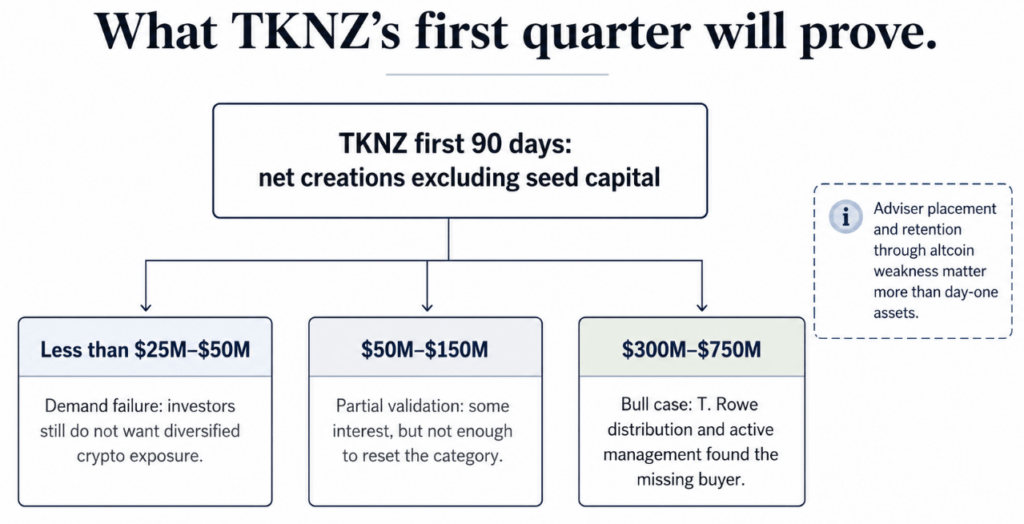
The evidence sits in what TKNZ gathers over its first quarter once seed capital comes out of the count, whether that money moves through adviser platforms, the channel the original thesis always counted on, and whether it stays put through the market’s next rough patch for altcoins.
That’s the window that finally tells the industry if professional money wants crypto as part of a portfolio.