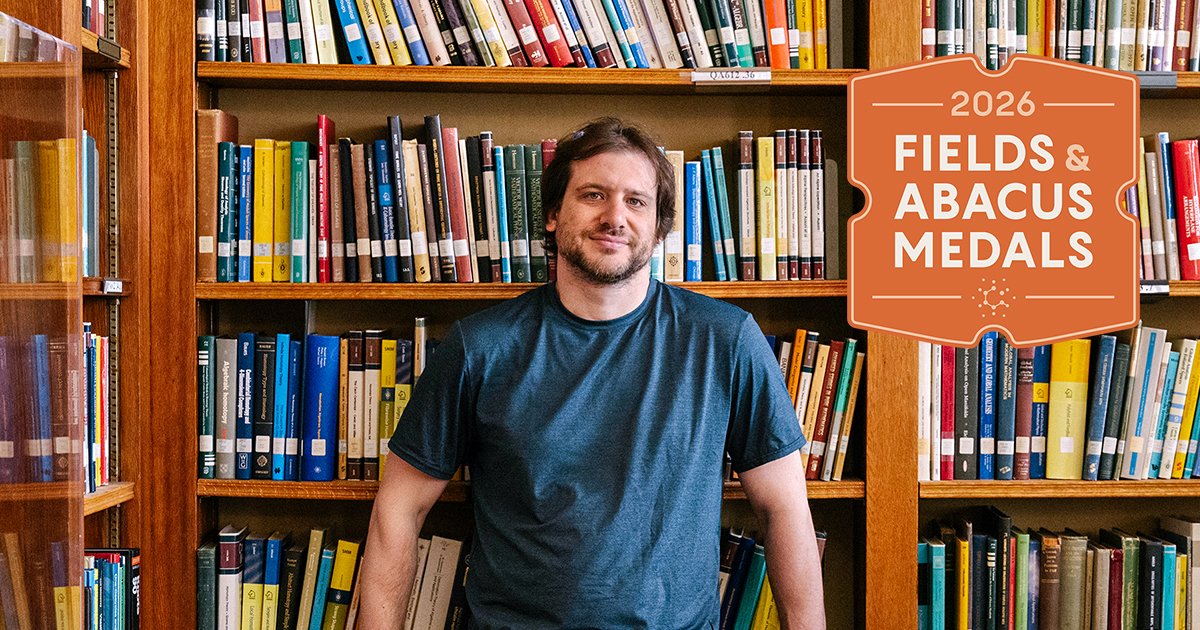
Jacob Tsimerman Wins 2026 Fields Medal for André-Oort Conjecture Proof
After Tsimerman’s flirtation with finance, he confronted his lingering doubts about his fitness as a researcher. At Princeton, he had proved he could solve research problems, but many of the problems that had shaped him had come from Sarnak. Tsimerman wanted to prove to himself that he could set his own research agenda.
He began by looking for places where the tools he knew gave him a competitive advantage. Mathematicians often talk about the value of bringing ideas from one area into another. Tsimerman talks that way too, but with a more competitive edge. To him, moving between areas of math is a way of finding problems where he has resources that established researchers in the area might not.
“You want to learn expertise in one area and bring it to another area where it’s useful but not yet used,” he said. “That’s the golden goose.”
One possibility was to focus on Hodge theory, an area of mathematics that studies geometric spaces by translating them into analytic objects — objects built from functions, integrals, and other more flexible tools than polynomial equations.
In the 1970s, a mathematician named Philip Griffiths had predicted that in some situations, even after these objects pass from the rigid geometric world into this more flexible analytic world, some underlying geometric structure should remain.
The problem, known as Griffiths’ conjecture, had the same flavor as André-Oort, where a loose analytic object, when viewed the right way, should turn out to have hidden algebraic structure. The work also brought him closer to Benjamin Bakker, a friend from graduate school.
“In grad school I had the feeling we were on pretty different paths math-wise,” said Bakker, now a professor at the University of Illinois, Chicago. “He was more on the number-theory side, and I was more on the geometry side of things. But of course you can draw a line from any one point in math to any other point, so that’s all an illusion.”
Working with Bakker and Yohan Brunebarbe, Tsimerman brought tools he had learned from André-Oort into Hodge theory. In 2018, they proved Griffiths’ conjecture and developed a framework called o-minimal GAGA, which gave mathematicians a new way to show that some analytic spaces have hidden algebraic structure.
After years of demonstrating his ability as a problem solver, Tsimerman had now shown that he could build new mathematical machinery as well.
“We like in math to say people are problem solvers and theory builders,” Sarnak said. “Jacob is a problem solver and a theory builder; I say that in a very strong way.”
The Final Push
By the early 2020s, Tsimerman had established himself as one of the best mathematicians in the world. The doubts that had followed him to Princeton and for years after had fallen away, and he began racking up results at a rapid clip.
In 2021, Tsimerman, Pila, and Ananth Shankar posted a proof of the full André-Oort conjecture, completing the long process that had begun when Tsimerman first took up the problem as a graduate student. By then he had also delved deeper into Hodge theory, where the machinery he’d helped develop kept producing new results. In 2024, Tsimerman, Bakker, and two collaborators proved a major new theorem about certain spaces arising in Hodge theory.
The results brought prizes. Tsimerman won the 2022 New Horizons in Mathematics award and the 2023 Ostrowski Prize. By the time he entered his mid-30s and last cycle of eligibility for the Fields Medal, winning it no longer seemed a remote possibility. Realizing that, he abandoned his vow not to become obsessed with the honor and made it his explicit goal.
“I worked hard and sacrificed enjoyment to try and win it,” he said.
The sacrifice was less about working longer hours and more about changing what he chose to work on.
Until then, Tsimerman had preferred to work on fun projects that caught his interest — what he describes as “cool little things here and there.” But in the last few years, he decided to commit himself to projects with the kind of depth and impact he thought would matter most to mathematicians judging his body of work, including the committee that chooses the Fields medalists.
“I stopped doing fun side projects and buckled down on projects that were high-return,” he said.