JWST May Be Missing Water Hidden Deep Within Mini-Neptune Worlds
Sub-Neptune exoplanets, exoplanets that are slightly smaller than Neptune, have been designated as the most common type of planet in the Milky Way Galaxy based on their vast discovery numbers, totaling almost 3,300 out of the more than 6,300 confirmed exoplanets to date. Despite these numbers, the characteristics of sub-Neptunes remain relatively unknown. This is primarily due to our own solar system not having its own sub-Neptune to use as an analog, along with their atmospheres being thick and hazy. As a result, this makes telescopic observations, even from powerful instruments like NASA’s James Webb Space Telescope, extremely difficult.
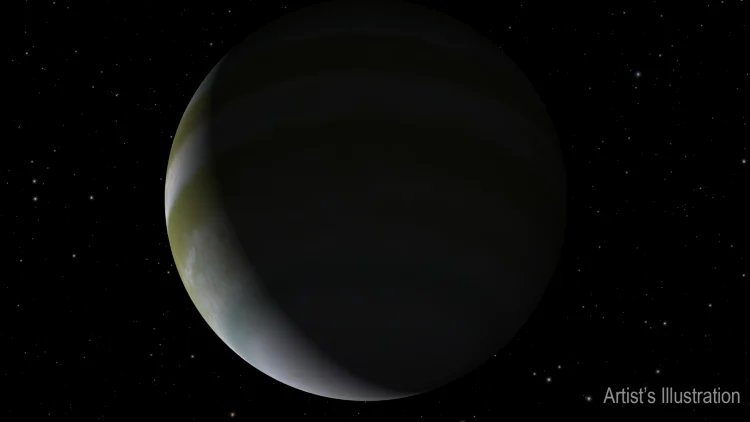
Now, a team of researchers from the United States and Canada and led by the University of Chicago (UChicago) might be one step closer to better understanding the compositions of sub-Neptunes, which they discuss in a recent study published in The Astrophysical Journal. For the study, the team used a series of computer models to simulate the atmospheric and interior composition of TOI-270 d, which is a sub-Neptune discovered in 2019 and located about 73 light-years away. Its radius and mass are about two times and 4.2 times of Earth, respectively, and it takes about 11.4 days to orbit its red dwarf star, which is smaller and cooler than our Sun. TOI-270 d and its sister planets, TOI-270 b and TOI-270 c, all orbit within the interior of their star’s habitable zone.
JWST had previously identified the existence of carbon dioxide, methane, and hydrogen within TOI-270 d’s atmosphere, which this combination indicates the presence of water. However, the exact state of the water remains unknown, meaning scientists don’t know if the water is a solid, a liquid, or a gas, along with the conditions that enable water and hydrogen to mix or separate.
In the end, the researchers found that a combination of temperature and the water-hydrogen ratio play a role in determining the mixing and separating of water and hydrogen. Specifically, TOI-270 d has a larger amount of water than hydrogen and combined with its warmer temperatures of 537 degrees Celsius (1,000 degrees Fahrenheit) could result in the water sinking beneath the hydrogen atmosphere, with the former shielding the lower-level water from observations, even from JWST. Essentially, sub-Neptunes could possess more water than scientists had previously estimated, and this challenges longstanding hypotheses that sub-Neptunes had well-mixed interiors instead of separated interiors as proposed by this study.
“It’s very possible these planets are hiding much more water than their atmospheres let on,” said Dr. Caroline Piaulet-Ghorayeb, who is a postdoctoral researcher at UChicago and lead author of the study. “It’s an interesting question, both because water is so important for life as we know it, and because it signals we have to interpret the data coming in from new, powerful telescopes in a more nuanced way to really know what’s going on.”
Some examples of “new, powerful telescopes” that Dr. Piaulet-Ghorayeb could be alluding to include several NASA, European Space Agency (ESA), and European Southern Observatory (ESO) planned telescopes. Most notably, NASA’s Nancy Grace Roman Space Telescope is slated to launch on August 30, 2026, and whose primary mission will include using a coronagraph to directly image exoplanets. An example of a ground-based telescope that could contribute to exoplanet atmospheric science is the ESO’s Extremely Large Telescope (ELT), which is currently under active construction and is slated to begin scientific operations around December 2030.
What new insights into sub-Neptunes and their deep, watery atmospheres will researchers make in the coming years and decades? Only time will tell, and this is why we science!
As always, keep doing science & keep looking up!