LSU Engineering Researchers Secure $5.5M in NIH Funding for Breakthrough Work in Cancer, Medical Imaging and Mental Health Technology
LSU Engineering faculty have secured major funding from the National Institutes of
Health to advance transformative research in cancer biology, medical imaging and mental
health technology, highlighting the university’s growing national research impact
across engineering, biomedical science and digital health.
The newly funded projects, totaling more than $5.5 million in NIH support, span disciplines
ranging from cancer therapeutics and MRI imaging to virtual reality-based behavioral
interventions for ADHD.
Decoding Drug-Resistant Cancer Through Spatial Lipidomics
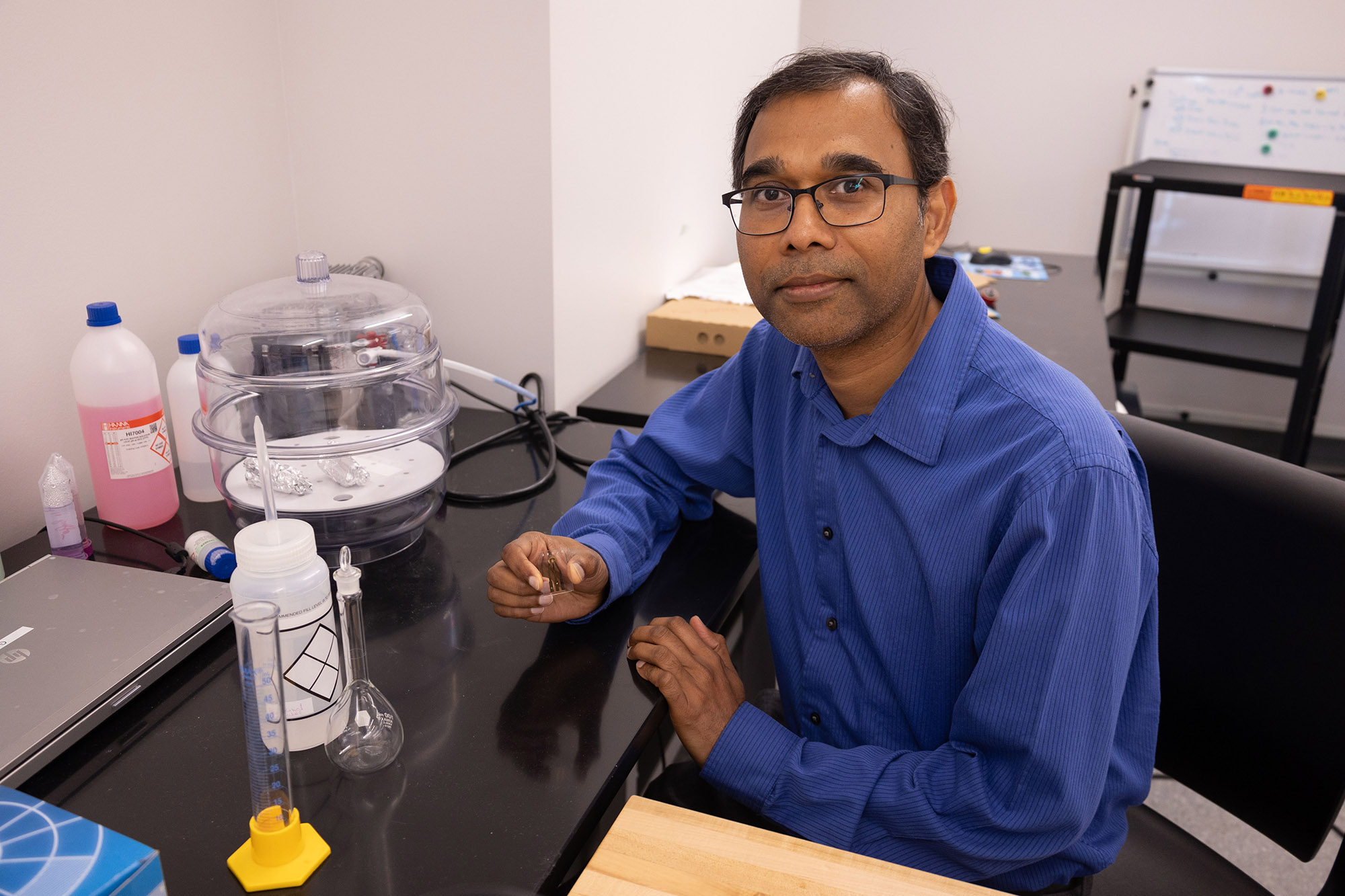
LSU Mechanical Engineering Associate Professor Manas Gartia
LSU Mechanical Engineering Associate Professor Manas Gartia received a five-year NIH
Maximizing Investigators’ Research Award (MIRA) R35 grant from the National Institute
of General Medical Sciences totaling approximately $1.875 million for a project titled
“Spatial Lipidomics to Decode Drug-Resistant Cancer Cell Death.”
Drug resistance remains one of the leading causes of cancer recurrence, with growing
evidence pointing to dysregulated lipid metabolism as a major driver not only in cancer,
but also in diseases such as sepsis, cardiovascular disease, diabetes and neurodegeneration.
Gartia’s lab is developing advanced spatial Raman imaging techniques capable of mapping
lipid distributions and chemical modifications at single-cell resolution while preserving
their location within cellular structures. Traditional lipid analysis methods such
as liquid chromatography-mass spectrometry require samples to be homogenized, eliminating
critical spatial information.
The research focuses on ferroptosis, an iron-dependent form of cell death that may
help resensitize drug-resistant cancer cells to chemotherapy. The project will move
from two-dimensional and three-dimensional cell culture models into in vivo validation
studies.
Gartia hopes the work will produce both a powerful new spatially resolved multi-omics
platform and broader insights into disease progression mechanisms that extend beyond
oncology.
Developing Safer Metal-Free MRI Contrast Agents
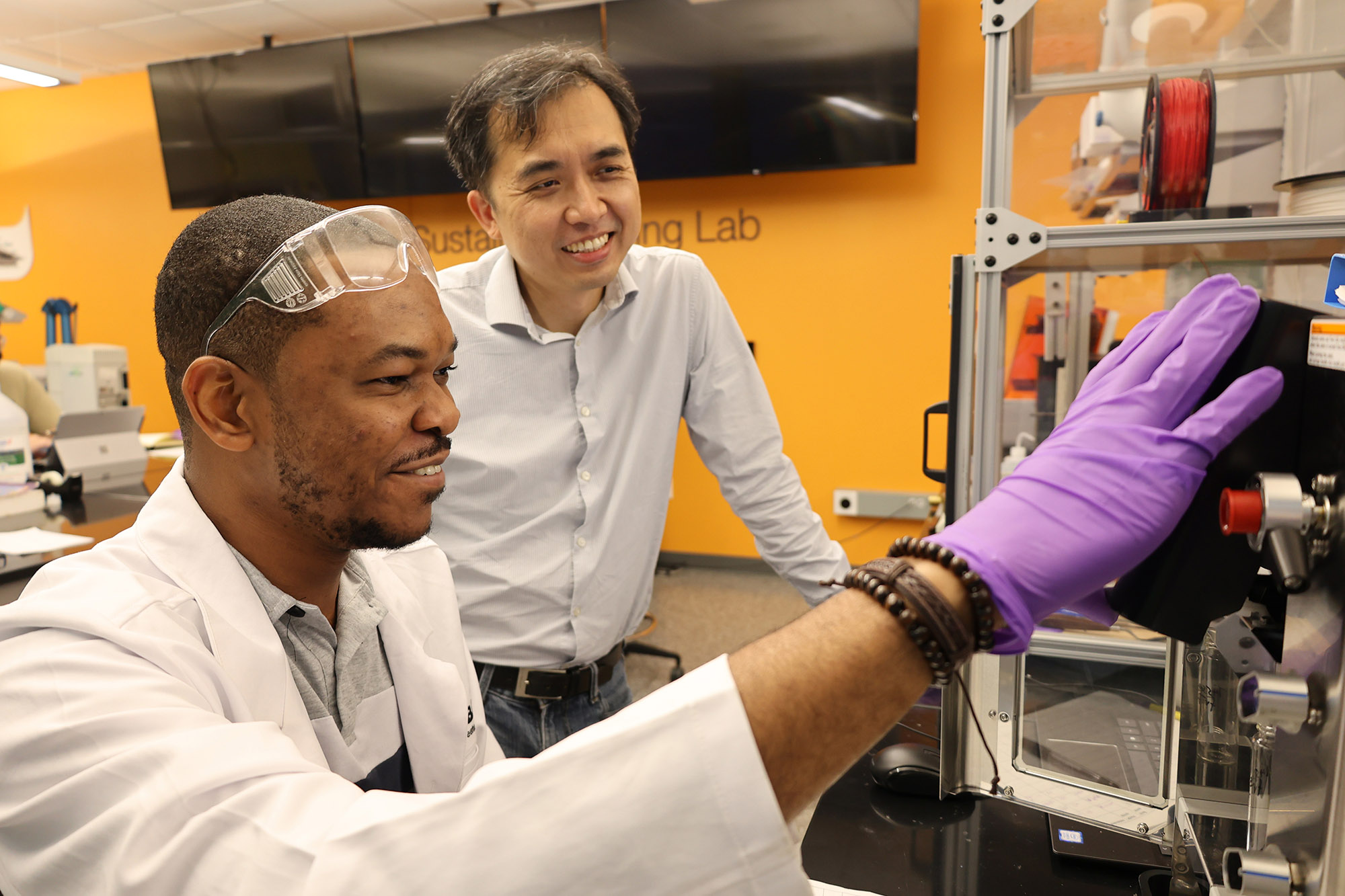
LSU Chemical Engineering Associate Professor Jimmy Lawrence with his student (Nduka
D. Ogbonna, now a postdoc at Oak Ridge National Laboratory).
LSU Chemical Engineering Associate Professor Jimmy Lawrence also received an NIH MIRA
R35 award from the National Institute of General Medical Sciences totaling approximately
$1.875 million for research focused on safer MRI contrast technologies.
Current gadolinium-based MRI contrast agents can pose serious health risks, including
metal accumulation in the body, hypersensitivity reactions and nephrogenic systemic
fibrosis. These risks limit their use in patients with kidney disease, pregnant women
and children.
Lawrence’s lab is designing metal-free fluorine-19 MRI contrast agents using precisely
engineered bottlebrush polymers with perfectly uniform molecular structures. The polymers
contain alternating fluorinated groups, which generate a highly specific MRI signal,
and water solubilizing functional groups that improve water solubility and biocompatibility.
A major challenge lies in achieving perfect molecular uniformity — known as dispersity
of 1.0 — because variations in polymer size can broaden MRI signals and reduce diagnostic
performance.
If successful, the technology could expand access to contrast-enhanced MRI for millions
of patients currently unable to safely receive conventional contrast agents while
also creating new opportunities for targeted molecular imaging and sensing applications.
Using Virtual Reality to Expand ADHD Behavioral Therapy
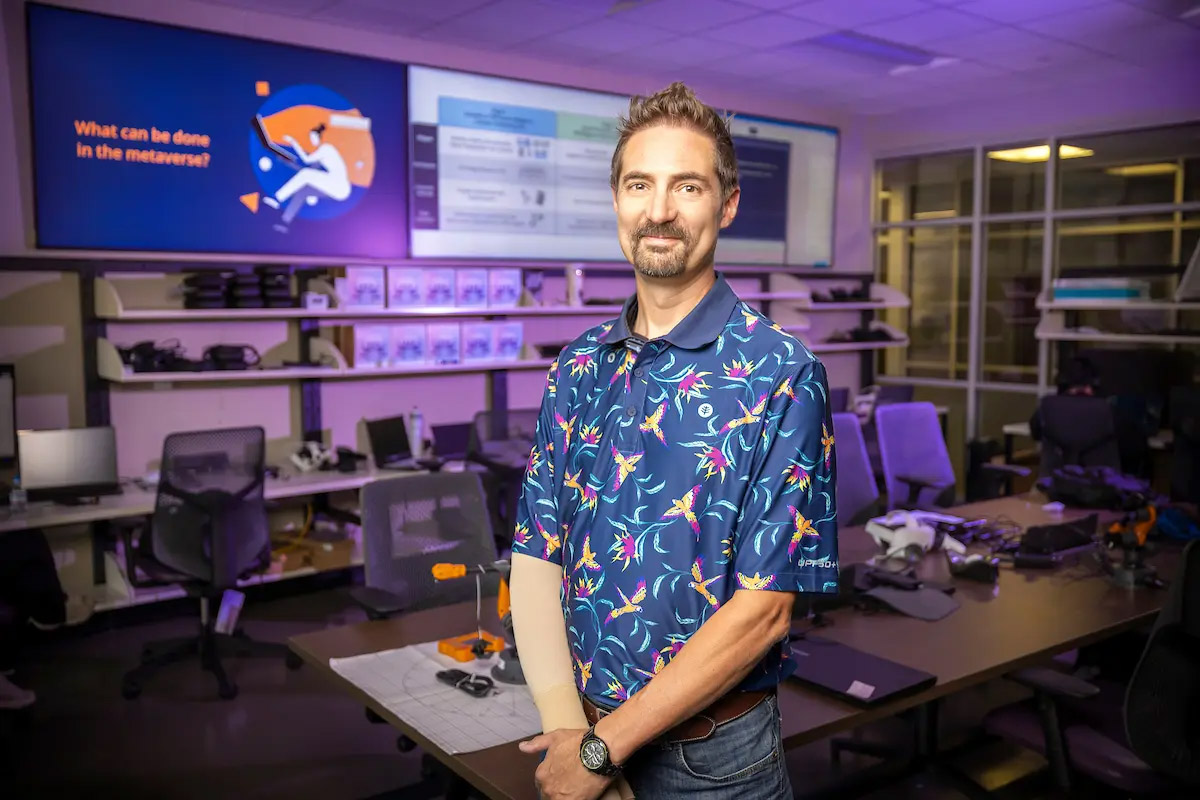
LSU Computer Science Associate Professor David C. Shepherd
LSU Computer Science Associate Professor David C. Shepherd is leading the virtual
reality engineering and systems development component of an approximately $1.8 million
NIH-funded collaborative project with Rutgers University focused on improving behavioral
treatment access for children with ADHD.
Funded through an NIH National Institute of Mental Health R61/R33 award, the project
aims to create a scalable virtual reality platform that automates key components of
behavioral therapy without requiring continuous clinician oversight.
The VR system places students inside a structured virtual environment that monitors
attention and on-task behavior in real time using keyboard and mouse interaction data.
Students receive immediate visual feedback through a green-yellow-red system paired
with automated reinforcement strategies designed to improve focus and task completion.
The project successfully completed its initial R61 feasibility phase, which included
algorithm development, feedback system refinement and a small, randomized trial. Following
NIH milestone review approval, the team has now entered the larger R33 clinical trial
phase involving 252 participants across multiple intervention groups over an eight-week
treatment period.
Shepherd leads LSU’s contributions involving VR engineering, behavioral monitoring
algorithms and systems integration.
Expanding LSU’s National Research Impact
Together, the projects reflect LSU’s growing strength in interdisciplinary research
that combines engineering, medicine, chemistry, computing and translational science
to address major public health challenges.
From advancing cancer treatment and diagnostic imaging to developing technology-assisted
behavioral therapies, LSU researchers are creating innovative tools with the potential
to improve patient care and expand healthcare access nationwide.
Like us on Facebook or follow us on LinkedIn, Instagram, Bluesky, and X.