Mangaluru Engineering Students Develop Low-Cost Autonomous Vehicle For Healthcare, Defence, Industrial Use

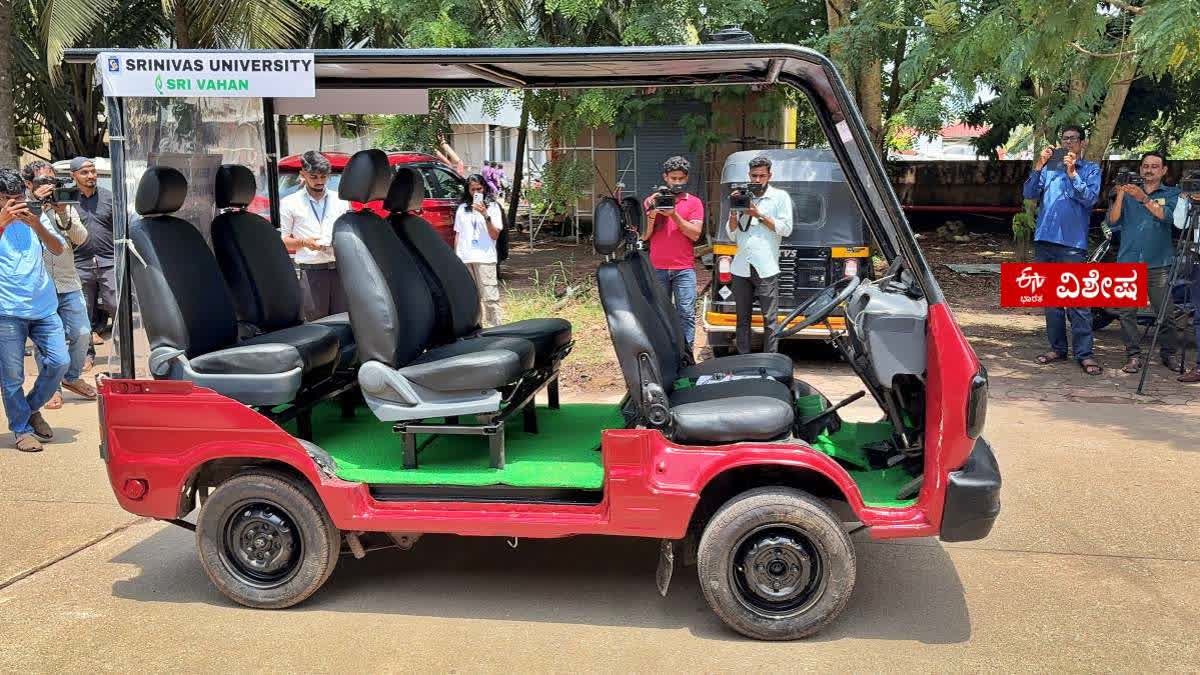
Low-Cost Autonomous Vehicle Sri Vahan (ETV Bharat)
Mangaluru: A team of engineering students and faculty members from Srinivas University in Mangaluru has developed a low-cost autonomous vehicle capable of operating without a driver. The invention is considered a cost-effective alternative to expensive self-driving technologies.
Named ‘Sri Vahan’, the prototype uses artificial intelligence (AI), sensors and camera-based navigation, with potential applications in healthcare, defence, industrial campuses, and educational institutions. The team developed Sri Vahan at an expense of approximately Rs 4 lakh. The researchers said the autonomous technology can also be retrofitted to conventional or older vehicles.
The vehicle’s autonomous mode is restricted to a speed limit of 5 km/h for safety, roughly matching the average human walking speed. In manual mode, however, it can reach speeds of 20–25 km/h.
The electric vehicle offers a driving range of 15–22 km on a single charge. It can carry a payload of up to 360 kg, accommodating up to six passengers or an equivalent weight in cargo.
Technologies powering the autonomous vehicle
The prototype vehicle operates using AI-powered software, sensors, and a pre-mapped navigation system. Once trained on a designated route, it can travel autonomously by following stored maps without requiring driver intervention. This makes the vehicle an autonomous vehicle in a geofenced area as it operates in a limited operational domain.
| Types of Autonomous Vehicles | Navigation | Environment | Decision-making |
|---|---|---|---|
| Automated guided vehicle (AGV) | Fixed path | Controlled | Minimal |
| Autonomous vehicle in a geofenced area | Pre-mapped + sensor-based | Limited operational domain | High |
| Fully autonomous vehicle | Dynamic routing | Open roads | Very high |
It is fitted with advanced cameras at the front and near the headrest so the operators can monitor the vehicle remotely. The developers said the technology could be deployed in university campuses, software parks, and industrial complexes to transport students and employees. The vehicle can also be converted into a compact autonomous ambulance for transporting patients between different hospital blocks.
Additionally, the vehicle could be used to transport food, ammunition, and other essential supplies in border areas and hazardous operational zones. The remote-control capability would allow military personnel to operate the vehicle from a safe location.
“We wanted to develop an autonomous ground vehicle that was practical, affordable and adaptable. Following the university management’s vision, we created a low-cost autonomous system that can even be installed in older vehicles. We also incorporated a remote override system with live visual feedback to ensure safe operation in case of any technical issue,” said project mentor Prof. Vishwas.
Dr Ramakrishna Hegde, Dean of Srinivas Institute of Engineering and Technology, said. “Our Founder Chancellor envisioned students creating solutions that benefit society rather than limiting learning to classrooms. Recently, a team exploring remote-controlled vehicles for military operations along the Assam and Sikkim borders found that our vehicle matched their requirements. Its 360-kg payload capacity makes it suitable for defence logistics.”
The project was led by Vishakh, along with fellow Mechanical Engineering students Shreyas, Ujwal, Adviteeya, Prakhyat, Akshay and Manjunath. The team completed the prototype in five to six months. “Our next goal is to enhance the system and expand its real-world applications,” Vishakh said.
University Unveils AI-Powered Reception Robot
A team of young researchers from Srinivas Institute of Engineering and Technology (SUIET), part of Srinivas University in Mukka, successfully developed an advanced AI reception robot named ‘Srinibot’. This robot is designed to welcome visitors at the university reception and provide them with necessary information.
AI reception robot named ‘Srinibot’ (ETV Bharat)
Developed by a three-member team—Samanth Nagnur, Joel and Niketh—under the guidance of K P Akhil and other key officials of Srinivas University, this ‘Srinibot’ will soon begin official operations on campus.
5-Foot ‘Srinibot’ Developed in Just One Month!
Standing approximately 5 feet tall, this ‘Srinibot’ was built in just one month at a cost of around ₹5 lakh. The robot’s outer body is entirely 3D-printed, featuring a beautiful LED screen to display facial expressions and an interactive 11.6-inch touch display on its chest. Equipped with a lithium battery system, the robot can operate for 8 to 10 hours on a single charge. It also features manual control via Bluetooth when required.
Using the integrated camera, the robot instantly recognizes the face of a person approaching it and warmly greets them with “Welcome to Srinivas University. People can interact with it through natural conversation. It has the ability to engage in voice conversations and respond in English and Hindi.
If asked for details about courses, fee structure, hostel facilities, or university research, the robot will directly open the university’s website on its screen and provide information.
Samanth Nagnur, the researcher who led the project, says this robot can be customised to suit the needs of schools, colleges, large hospitals, hotels, corporate offices, and government institutions.
Read More: