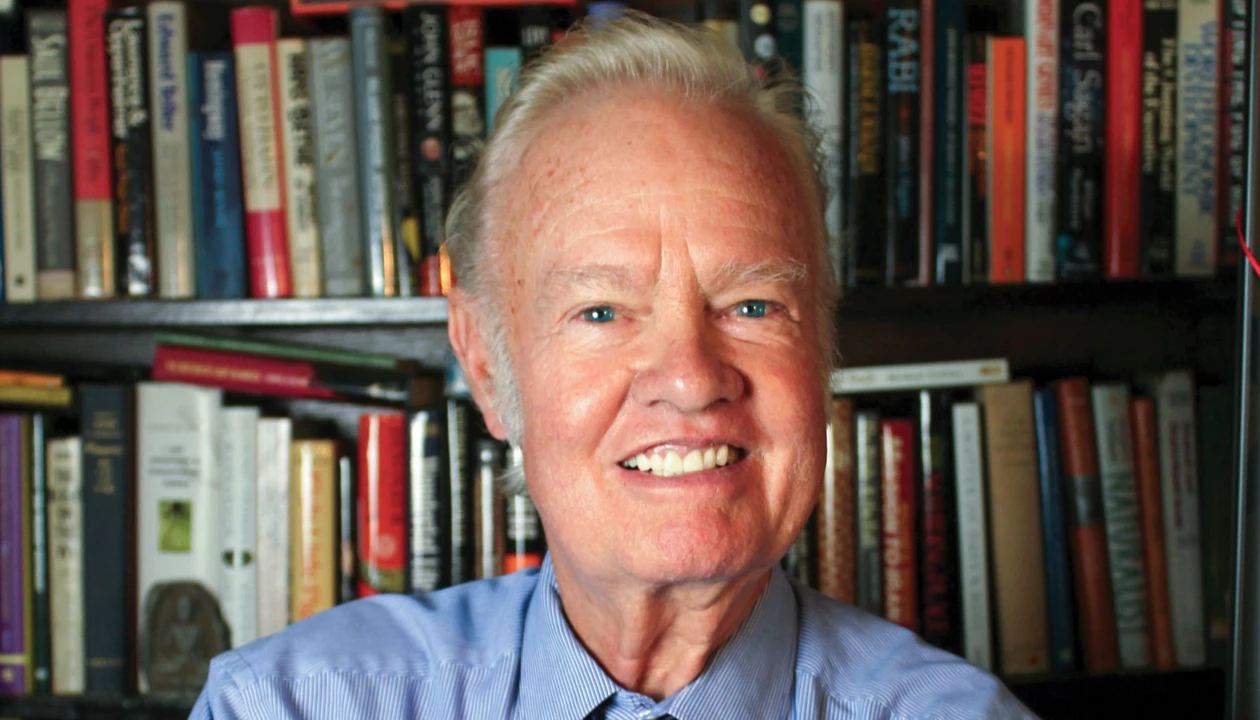
Mark Thiemens is awarded Magellanic Premium, the US’s oldest scientific prize
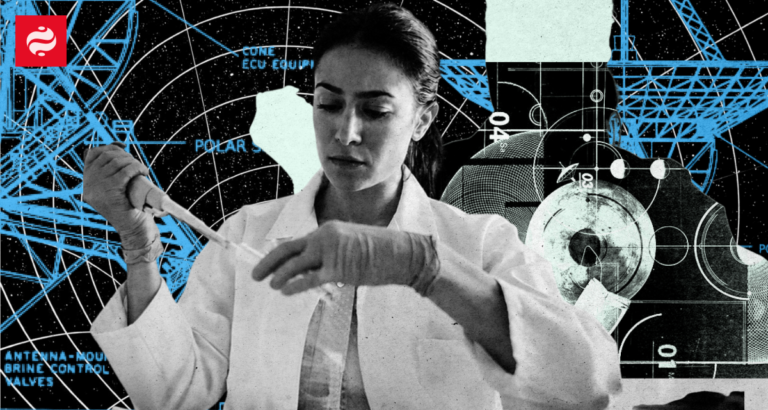
The American Philosophical Society (APS) has awarded Mark Thiemens, an atmospheric and quantum chemist and isotope geochemist at the University of California San Diego, the Magellanic Premium—the oldest scientific prize in the US. He is recognized for discoveries that have transformed how scientists understand the solar system and origins of life on Earth and which have strengthened capabilities for monitoring human impact on the environment. Thiemens, who has been an American Chemical Society member for over 40 years, is only the 43rd recipient of the award in its 240-year history.
“His groundbreaking discoveries have deepened our understanding of the natural world, including the origins of the planet itself, while also providing scientists with powerful tools to study and address some of the most urgent environmental challenges facing the planet today,” Patrick Spero, the CEO of APS, said in a press release (PDF).
Thiemens discovered mass-independent isotope fractionation (MIF), a breakthrough that has led to “fundamental insights into planetary evolution and novel tools for tracing modern global pollutants,” the award citation says.
“I had a chemical reaction that would work and fit the constraints. It would be based on symmetry laws rather than mass laws, the symmetry laws would replace the mass laws, and would potentially be the source of the anomalies.”
The award consists of a golden engraved medal and $20,000. It was presented to Thiemens at an APS symposium, “The Next 250: The Future of Democracy, Science, and Markets,” in London on July 13.
Discovering geology and becoming a professor
Thiemens began his studies at the University of Miami, where he was majoring in chemistry and physics. He recalls joining ACS as a student because there was always an affordable student rate, “and then I could get Analytical Chemistry and keep up with that.”
By his last year at Miami, he had taken all the physics courses and almost all the chemistry courses available, “except for the ones I didn’t like. And I was topped out with math, so I took a course in geology.”
It turned out to be one of the best courses he ever took, “just incredible,” Thiemens says. And still one of his favorite classes to this day. Thiemens was taught by a PhD student who was studying under Harold Urey—the physical chemist who received the 1934 Nobel Prize in Chemistry for the discovery of deuterium. “He introduced this section on isotopes and said ‘With isotopes you can measure—you can tell what the climate and temperature of the Earth was 400 million years ago, to within a 10th of a degree centigrade.’ ” At first Thiemens thought the statement was a joke, but it turned out his instructor was right. Thiemens quickly learned that you can’t study climate change if you don’t know the temperature, “and the only way you can get [the temperature] is from the ice. So that got me interested.”
Thiemens finished his PhD at Florida State University in 1977 and then found himself in Urey’s old laboratory at the University of Chicago. “Chicago is what really got me good, to the level where I could consider going places,” he says. After Chicago, he landed a position as a professor at the University of California San Diego, where he once again found himself in one of Urey’s old laboratories: “I had one little laboratory that was Urey’s, and then there was another [lab] next to it, and it belonged to a guy, I’m sure you’ve heard his name, Linus Pauling.” And so Thiemens inherited that lab too.
Putting Clarke’s Law to the test
Part of Thiemens’s work at Chicago was measuring isotopes in lunar samples for ancient solar wind. While there he became interested in meteorites, as he puts it “carbonaceous chonritic meteorites have a very weird pattern, especially their inclusions, which are the oldest minerals that precipitated from the solar system.” The Allende meteorite had a distribution of distinct oxygen isotopic compositions that couldn’t be accounted for with thermodynamics, kinetics, velocity, or gravity, where mass didn’t matter. “The theory was pure oxygen-16 had to be injected into the early formation of the solar system to account for the Clayton measurements. Oxygen-16 would be created by a supernova, fitting astronomical models,” Thiemens explains. The injection of supernova debris may have triggered the formation of the solar system, a widely accepted theory for how the solar system formed.
The supernova theory assumed that there cannot be a chemical process to account for the data. This was also used in other systems such as noble gases to define nuclear components. Thiemens was interested in the supernova model. Focusing on what couldn’t be accounted for, he suspected there was a chemical effect creating the oxygen isotope compositions. This interest prompted Thiemens to ask Bob Clayton, for whom he was working at the time, if it had ever been experimentally tested. His supervisor replied “No, I read Urey’s, Bigeleisen’s, and Mayer’s papers and they show chemical effects are mass dependent.”
While Occam’s razor is probably more famous, there’s another philosophical principal, Clarke’s first law, which reads, “When a distinguished but elderly scientist states that something is possible, he is almost certainly right. When he states that something is impossible, he is very probably wrong.” Given the perceived impossibility that the meteorite inclusions could not be anything but oxygen-16 additions, Thiemens set out across the country for a possible alternative explanation.
His drive in his Jeep from Chicago to his new laboratory in San Diego was a perfect amount of time to design an experiment. It had to be very cheap, since he didn’t have any funding. “I had a chemical reaction that would work and fit the constraints. It would be based on symmetry laws rather than mass laws, the symmetry laws would replace the mass laws, and would potentially be the source of the anomalies.” He bet his entire career on that experiment, “because I didn’t have enough cash to do anything else,” he says. Thiemens borrowed vacuum pumps and parts from the glass blower and colleagues to build the vacuum line he needed for the experiment and rebuilt Urey’s old mass spectrometer.
The experiment was the formation of ozone, and as luck would have it, it worked on the first try, “I saw the effect, and it was the same magnitude of effect, with the same isotope relations seen in the meteorites,” Thiemens explains. His findings were published in Science. This was the foundation for a range of fields using novel applications for chemical isotopic mechanisms. The study was the launching point for the search for quantum mechanical mechanisms that remain elusive today.
A field full of fun
When asked about his favorite part of his work, it’s an easy answer for Thiemens: “Being outside . . . and making stuff.”
From space he shifted focus to our own atmosphere: “I always wanted to go outside and fly balloons,” he says. Thiemens saw an opportunity with the National Center for Atmospheric Research through a graduate school friend who happened to fly balloon payloads; Thiemens learned ballooning in order to join him and to continue to find research applications on Earth. He did this for a few years, publishing a series of papers. At some point, Thiemens thought, “We got to go higher.” So ballons turned into rockets, which was the only way to grab samples from the top of the atmosphere. After doing some homework and with a little more luck, Thiemens found someone who had a rocket he could work with, “so I got into the rocket business,” he says.
This new approach meant building 70-foot-long rockets with sampling chambers that could go to the top of the atmosphere. Striving to go higher was a success, Thiemens was able to use isotopes to define the sources of greenhouse gases on Earth. He has been able to take samples from all over the world, including from the middle of the Indian Ocean, the South Pole, Greenland, and Mount Everest.
Finding humanity in science
Stated in his Magellanic Premium nomination, Thiemens’s work has uniquely bridged the deep history of Earth’s systems with the human-driven challenges of today. He may be biased, but Thiemens believes isotopic chemists are interesting people, mainly because their research connects to the planet, and therefore humanity. When someone asks a question like “Has there ever been a time when all the ice on the planet has melted?” Thiemens says, “That’s a good question, because sea level goes up like 25 feet. And the answer is yes, it’s happened at least twice, but you can only tell it from looking at isotopes.”
Isotope science is a really fun science in one sense, but it’s also an important science, especially as the climate continues to change. Studying isotopes can help answer questions like “Just how bad can it get?” or “Has it happened before?” And in the spirit of adventures, discoveries, and exploration in the future, Thiemens, who is a self-proclaimed space fanatic, believes the science will also matter as people continue to talk more seriously about a future where humans might be inhabiting space.