Meteorite That Crashed Into New Jersey Home Offers Chemical Clues on the Origins of Life
On July 16, 2024, residents across several states in the northeastern U.S. were taken aback when they witnessed a meteor hurtling at 32,000 miles per hour over their heads. The speeding space rock eventually broke off into pieces, disappearing from the skies. On that same day, one homeowner just so happened to get an out-of-this-world delivery — a fragment of the meteor had crash-landed smack dab in the middle of his home in Hillsborough, New Jersey.
Scientists have since scrutinized the fragment — referred to as the Hillsborough meteorite — to determine its origins. Now, the Hillsborough meteorite’s past is finally coming to light in a new Science Advances study, as reseachers have found that the rock contains organic compounds produced by concentrated salty fluids. Billions of years ago, asteroids delivered these kinds of molecules to the planet, giving rise to life on Earth.
“We are thrilled that nature delivered such a precious asteroid sample on our doorstep,” said Denton Ebel, curator of meteorites at the American Museum of Natural History, in a statement.
Read More: Meteor Over New England Triggers Boom Equal to 300 Tons of TNT
A Surprise Visit From a Meteorite

Daytime meteor (left), impact site, and a fragment of the Hillsborough meteorite.
(Image Credit: SETI Institute)
The July 2024 meteor streaked over Pennsylvania, New York, New Jersey, Connecticut, and Rhode Island, and, with knowledge of its path, scientists traced it back to its origin in the asteroid belt.
After the meteor faded from view at an altitude of 22 miles, a Doppler weather radar at Newark Airport detected a long cloud of falling pebbles stretching from Staten Island into New Jersey. The Hillsborough meteorite, one of the largest pieces to break off and also the only one recovered, plummeted from the end of this cloud and ultimately crashed into a house.
The owner of the home recounted the unforgettable scene: “I was at home at the time, heard a loud crash and found a hole in the ceiling of the master bedroom. I smelled a strong sulfur-like odor and saw many black fragments along with debris and black dust that covered my bed, carpet and surrounding areas.”
Altered by Water
Thanks to the homeowner’s efforts to preserve the meteorite by placing its pieces in glass jars, scientists have been able to examine the fragments in detail and classify the meteorite as a CM-type chondrite — according to a 2021 study in Geochimica et Cosmochimica Acta, these meteorites come from primitive water-rich asteroids formed during the early Solar System.

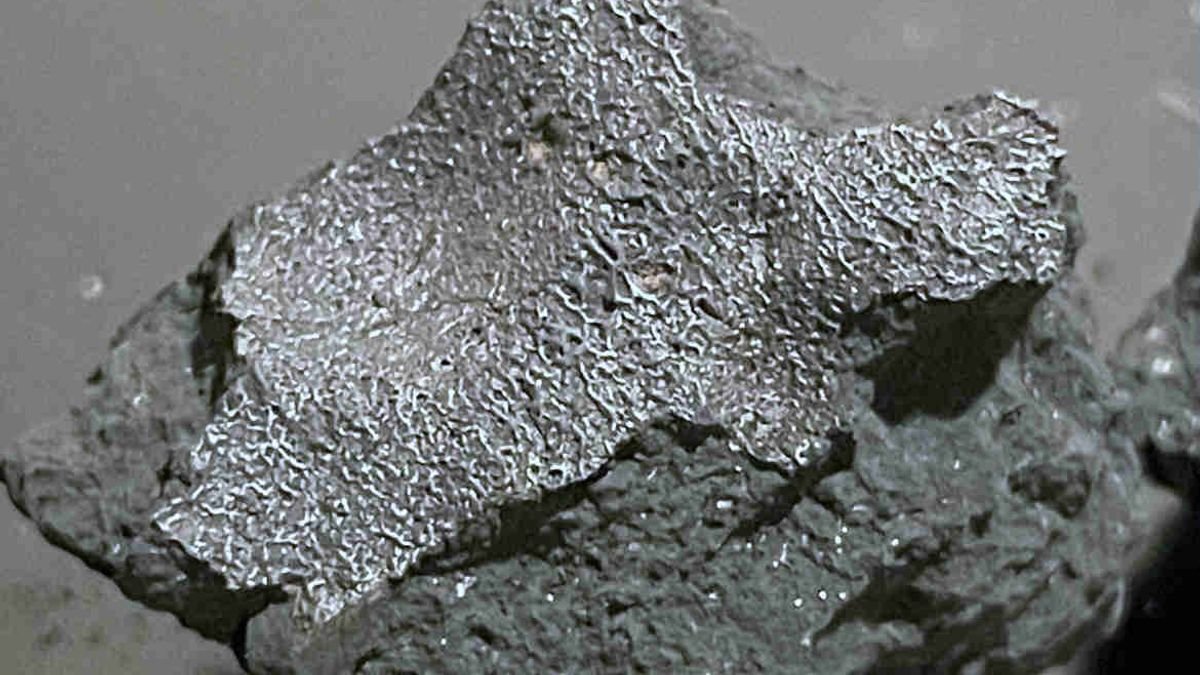
The Hillsborough meteorite is rich in salts and originated near the surface of its parent asteroid.
(Image Credit: SETI Institute)
CM-type (Mighei-like carbonaceous) chondrites resemble the type specimen Mighei, a meteorite that landed in Ukraine in 1889. Mighei, along with similar CM-type chondrites, contains a significant amount of carbon and relatively high levels of water, according to the American Museum of Natural History. They’re also similar to the water-rich near-Earth asteroids Bennu and Ryugu, targets of critical sample-return missions.
Researchers have classified the Hillsborough meteorite as a CM 1/2 meteorite, halfway between CM 1 and CM 2 meteorites — these two classifications concern the aqueous alteration of meteorites, in which melted water ice within them interacts with mineral particles to form secondary minerals. CM1 meteorites are significantly altered and rare (no falls of this type have ever been seen), while CM2 meteorites are less altered and much more common.
The researchers found that some Hillsborough meteorite fragments were altered by water on the meteorite’s parent asteroid to a greater degree than most CM2 meteorites, which is why they gave it the CM 1/2 classification.
The Salty Origins of Life
The researchers also identified salt-rich fragments that may have originated from a near-surface region of the meteorite’s parent asteroid where liquid water evaporated, causing salts to concentrate.
The briny fluids on the meteorite’s parent asteroid create an ideal setting for chemical reactions with minerals that can create molecules that are crucial for life; many of these organic molecules were found on the meteorite’s fragments, although the researchers aren’t yet sure if these were produced by brine chemistry or left behind by impacts with other bodies.
Regardless, examining the Hillsborough meteorite has broader implications: the parent asteroids of similar CM-type meteorites likely delivered amino acids, carboxylic acids, and other soluble organic materials that played a critical role in the emergence of life on Earth.
The Hillsborough meteorite fragments, some of which will now be curated at the American Museum of Natural History, could potentially shed light on the life-giving chemistry that occurs on space rocks.
Article Sources
Our writers at Discovermagazine.com use peer-reviewed studies and high-quality sources for our articles, and our editors review for scientific accuracy and editorial standards. Review the sources used below for this article: