Micro RGB vs. OLED: Can RGB Backlights Dethrone OLED for Picture Quality?

In 2026, nearly every TV manufacturer has jumped on what seems to be the next big thing in TVs: tiny red, green and blue LEDs. This new backlighting system is an evolution of the current technology which has been in use for 20 years. While an “LED TV” typically uses only blue LEDs paired with quantum dots, phosphors or color filters to illuminate an LCD, RGB Mini-LED (or Samsung’s Micro RGB) uses thousands of tiny RGB LEDs.
Not surprisingly, there are a bunch of benefits to using RGB LEDs. The marketing is full of superlatives about brightness and color. What these companies don’t love talking about are the downsides, which can be noticeable in practice. If you’re looking for the best TVs available today, it’s possible you’re shopping for either an RGB Mini-LED or an OLED, so it’s important to understand the pros and cons of both technologies to figure out what’s right for you. To help on that front, here’s how RGB Mini-LED works.
Backlights
All TVs on the market today, except for OLED, use light-emitting diodes to create light. This light is then manipulated by a liquid crystal (or LCD) layer to create the image you see. In the olden days, LCD TVs used fluorescent tubes to create light. This evolved to LEDs, first a few dozen, then hundreds and now thousands. Mini-LED is the latest evolution, with tens of thousands of LEDs arrayed across the back of the TV.

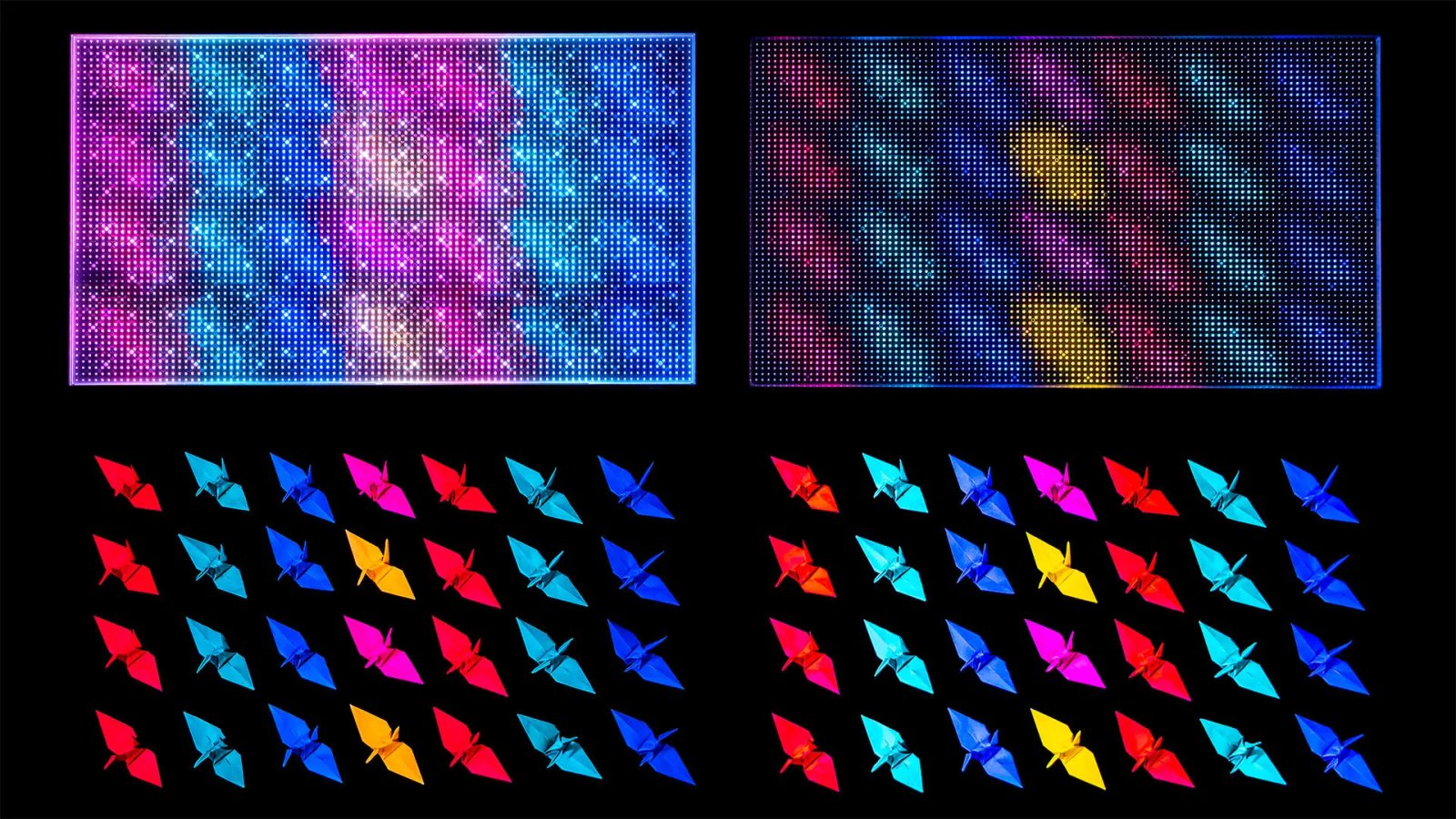
This is a photograph of two TVs showing the same content. The top TV has had its LCD layer removed. You’re looking directly at the LED backlight. Notice how the LEDs in the black parts of the image are off, while the LEDs behind the origami crane are lit up.
Geoffrey Morrison/CNET
The more LEDs the better, generally speaking, because the LCD layer can’t fully block the light. So it’s impossible to get the sort of per-pixel perfect blacks that are possible with OLED. Instead, LEDs are grouped in zones that are able to dim when the content needs it. The LEDs behind dark areas of the image are dimmed so that area is darker. With enough zones, this is harder to notice, but it can still be visible. For instance, in the image above, you can see how the lit LEDs don’t exactly match the outline of the crane. This mechanism is important for one of the potential downsides of RGB Mini-LED, as I’ll discuss later.

There’s also microLED, which, despite the name, is a fundamentally different technology. It doesn’t use LCD at all and is instead millions of direct-view LEDs. It’s currently far more expensive than Mini-LED, so it’s not really a competitor at the moment. I wanted to mention it to clarify that despite Samsung’s misleading marketing, Micro RGB is not microLED. It’s just the company’s name for RGB Mini-LED.
Color
To understand the pros and cons, we also need to talk briefly about how Mini-LED TVs create color. For many years, LED LCDs used single-color LEDs (these days, usually blue) to create light, and then some technology to convert a portion of that light into red and green. Often this tech is quantum dots, but on some TVs it’s phosphors. While seemingly convoluted, this is overall a pretty efficient, or at least cost-effective, way to create all the colors a TV needs to create a picture. As efficient as it is, starting with red, green and blue can theoretically be even more effective.

These two TVs have had their LCD layer removed. On the left is a “traditional” but recent backlight using blue LEDs. This would typically have a color conversion layer, often using quantum dots, to convert some of this blue light into red and green. On the right is an RGB backlight.
Sony
As the name implies, RGB Mini-LED uses red, green and blue LEDs. These are smaller than the LEDs from less expensive/older models, and are grouped closely together. So from a distance, when all powered on at the same time, they’ll appear to the naked eye as pinpoints of white light.
Pros
The marketing for RGB Mini-LED isn’t fluff, at least not entirely. The main benefits of using RGB LEDs are brighter colors. Most TVs are exceptionally bright right now; that’s barely a challenge for manufacturers anymore. The challenge is keeping colors vibrant as they get brighter. Ever try to sing the high notes of a song and notice your voice sounds weaker? That’s basically what can happen with some TVs. They can look very bright, but that brightness has paler versions of colors than what’s possible at lower brightness levels. A TV might be able to produce a deep crimson red at an average brightness level but when trying to produce that same color at high brightness, it might only be able to manage a dark pink.

A TV’s ability to do this is referred to as its color volume, a 3D evolution of the old metric of color space or color gamut. It’s not just how red a TV’s reds are (and greens and blues) but how red a TV’s reds are at different brightness levels. This can improve how realistic a TV looks across a wider variety of scenes in movies and shows. Using RGB LEDs is a way to have a large color volume, aka more vibrant colors at higher brightness levels.
At least in theory.
… And cons
There are some potential downsides, or at least more nuance to the color conversation. Earlier I mentioned backlight zones. Even with tens of thousands of LEDs, that’s not nearly enough to cover all of the over 8 million pixels in a 4K TV. With non-RGB backlights, the most common side effect of dimmable zones is a halo around bright objects on a dark background. A streetlight on a dark street, for instance, might appear against a gray background instead of the black on an OLED TV.

Four TVs: The top two have had their LCD layer removed, so you’re looking directly at the RGB backlight. On the right is Sony. On the left is an unidentified TV.
Geoffrey Morrison/CNET
With an RGB backlight, that halo could have a color, potentially impacting the color accuracy of nearby colors. The intensity of the colors also varies depending on the amount of color on screen. So a full screen of red, for instance, might look extremely vivid. But a few red pixels surrounded by other colors can’t appear as strong because the LEDs behind that part of the screen either can’t run as brightly without affecting the surrounding areas, or the blue and green LEDs must activate nearby to create the other colors, thereby washing out the red.
Called color crosstalk, this unintentional bleeding of colors can cause visible issues. Notice below how the faces in the images shift color depending on the background.

This illustration shows how colors created by an RGB backlight can have an unintended effect on nearby colors. Look closely at the changes in skin tones depending on the surrounding color. Note that Nanosys, where I got this image, makes quantum dots, a tech that’s used far more prevelently in other TV designs compared to RGB Mini-LED.
Nanosys
Here’s a more exaggerated diagram of what the different technologies would look like creating the same image.

This exaggerated illustration should give you an idea of what’s going on, though depending on the display you’re using to view it, it might be hard to see. Click to enlarge and perhaps fill your screen. On the left, because the green LEDs are active to illuminate the green square, some of that green bleeds into the white circle. The circles on the left and in the middle have a halo (a grayish black) because the backlight can’t only illuminate the circle. On the right, self-illuminating displays like OLED and microLED don’t have either issue, as they can completely turn off black pixels.
Geoffrey Morrison/CNET
Although solid-color backgrounds are rare, this limitation can affect plenty of real-world scenes. Imagine a multicolored bird in a nature documentary: Its feathers may not look as vibrant as the TV’s marketing suggests because small areas of color can’t appear as rich or saturated as larger swaths.

Note how the fine lines are affected by the nearby colored blocks.
Nanosys
LG Display, the division of LG that manufactures the panels that LG Electronics (and others) sell as TVs, has a whole video about this potential issue. Keep in mind, however, that LG’s main business is OLED, so it’s going to be biased against RGB Mini-LED.
The past is the future
Amusingly, at least to those of us who have been writing about TVs for a long time (too long, tbh), RGB LED backlights aren’t even a new idea. Over 20 years ago, Sony came out with Triluminos LED backlighting. The company transitioned away from it, and it’s not until recently that companies have revisited the idea, including Sony.
The marketing for RGB Mini-LED is pushing this as a new and next-gen TV tech. Arguably, it’s neither, but I’m not sure that matters. What matters is the end result. Companies not invested in RGB Mini-LED are quick to point out the drawbacks of the technology. The end result — how TVs look with actual content — is the actual point. Does color crosstalk, the potential for less color performance than what’s implied by specs and tests, colored halos or even halos in general really matter? From what we’ve seen so far, not as much as you might think. Every TV technology has pros and cons. RGB Mini-LED TVs tend to be brighter, have great color and perform better in bright rooms than OLED. OLED, on the other hand, has better native contrast and in a dark rooms can look even better. Both can create an incredible image, which is why we recommend both technologies for our picks for the best TV.
In addition to covering audio and display tech, Geoff does photo tours of cool museums and locations around the world, including nuclear submarines, aircraft carriers, medieval castles, epic 10,000-mile road trips and more.
Also, check out his books Budget Travel for Dummies and the bestselling sci-fi novel about city-size submarines. You can follow him on Instagram and YouTube.


![[Console] Nintendo Switch 2 Console + Mario Kart World Bundle (Grade A Refurbished) – $419.00 – Free shipping for Prime members](https://jobssz.com/wp-content/uploads/2026/07/QHllsodNdX_3hgRQSS6h5mdchz7ji7aIjg_Jn99vjq4.jpeg)