NASA Assigns Deniz Burnham to Soyuz MS-30: Her Oil-Rig Skills Target Moon and Mars Drilling
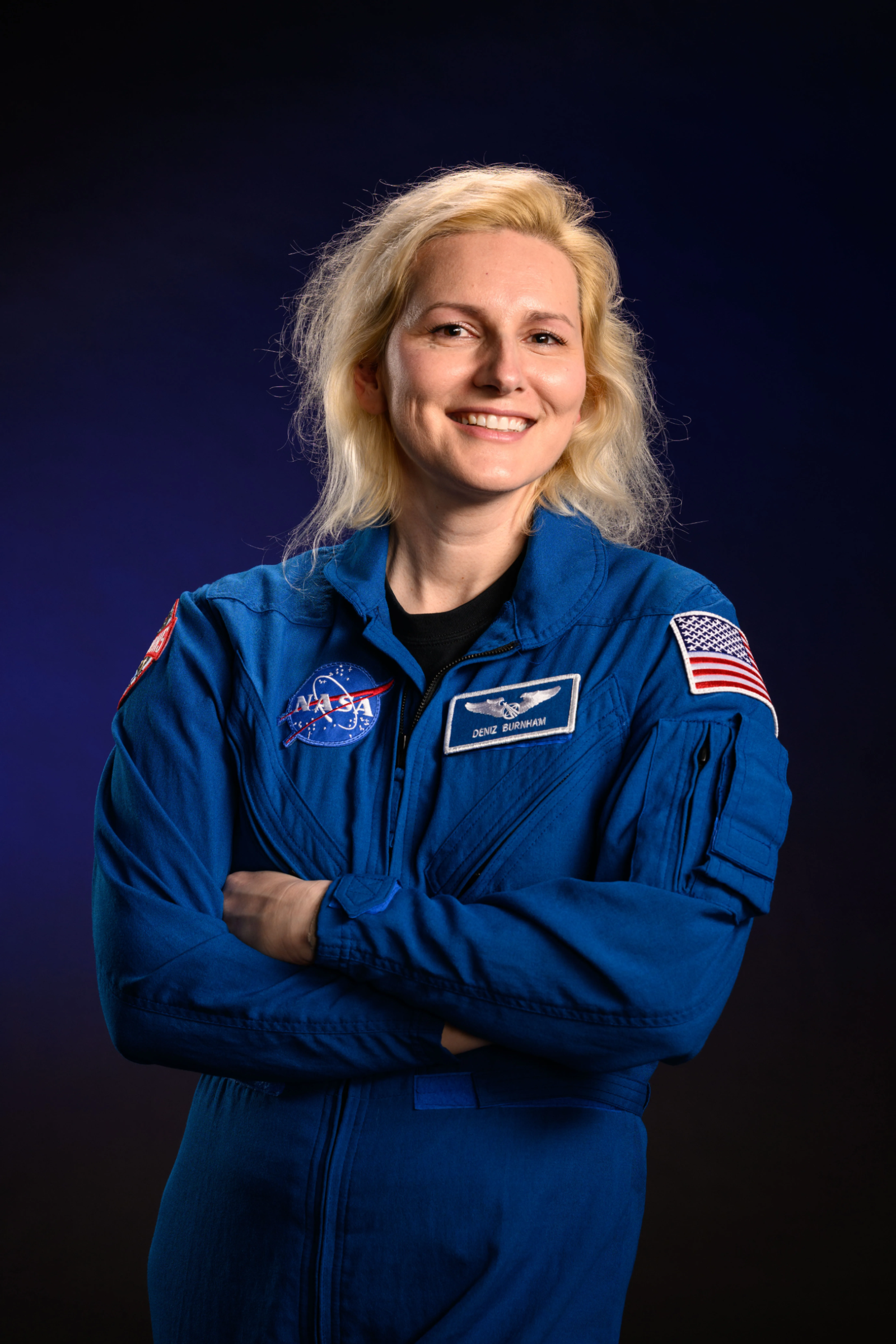
NASA announced Thursday that astronaut Deniz Burnham will fly to the International Space Station for the first time, assigned as a flight engineer for Expedition 76 aboard the Roscosmos Soyuz MS-30 spacecraft. Launch is targeted for March 2027 from the Baikonur Cosmodrome in Kazakhstan. The crew will spend approximately seven months aboard the orbiting laboratory — research aimed, per NASA, at preparing humans for future missions to the Moon and Mars.
What the announcement did not spell out is why that second sentence is more than boilerplate. Burnham spent more than a decade as a field engineer and well site leader on oil rigs across the Arctic, Alberta, Ohio, and Texas — reading downhole sensor data in real time to characterize subsurface formations, detect bit wear, and adjust drilling parameters to keep a drill string moving through conditions nobody had mapped in advance. Before she applied to NASA’s astronaut program, she also interned in the Drilling and Automated Sample Acquisition Lab at NASA’s Ames Research Center in Silicon Valley, where she served as a field engineer testing planetary drill prototypes at a Mars-analog site in Rio Tinto, Spain. The engineers she worked alongside at Ames were building the Drilling Automation for Mars Exploration (DAME) system — autonomous drilling hardware specifically designed to extract resources from planetary subsurfaces where no human hand can steady the drill string. That is the program Burnham’s mission says it will support. The career path between the oil rig and the rocket was not a detour.
Burnham was selected as part of NASA’s 23rd astronaut class in December 2021, reported for duty in January 2022, and graduated with her class on March 5, 2024. She joins a roster of Group 23 classmates who have already reached orbit: Anil Menon flew to the ISS in July 2026 on Soyuz MS-29 for his own debut mission. Burnham served as the backup flight engineer for MS-29 alongside Petelin and Borisov, meaning the three crew members of Soyuz MS-30 trained together as an integrated unit before the official prime-crew announcement.
Burnham’s Path: From Prudhoe Bay to Planetary Drilling
Born at Incirlik Air Base in Adana, Turkey, Burnham grew up in a military family that relocated frequently before she graduated from Vanden High School in Fairfield, California. She earned a bachelor’s degree in chemical engineering from the University of California, San Diego, in 2007, and a master’s degree in mechanical engineering from the University of Southern California in 2017. She was living in Wasilla, Alaska, at the time of her NASA selection — she had built the first phase of her career on oil rigs as far north as Prudhoe Bay on the Arctic coast.
Her commercial drilling career began as a field engineer on a remote rig at Prudhoe Bay, where she was responsible for all aspects of measurement and logging while drilling — the discipline of interpreting data streaming up from sensors embedded in the drill string, kilometers below the surface, to characterize the formation being penetrated. In 2011, she completed a 15-month intensive leadership program in Wyoming and Texas before taking on nine years of well site leadership across Canada, Ohio, and Texas, managing the full range of onsite drilling operations, including emission-reduction optimization.
She also served in the U.S. Navy Reserves as an engineering duty officer, and holds a private pilot certificate covering single-engine land and sea aircraft, instrument flight, and rotorcraft-helicopters — she also flies paramotors and paragliders.
Why an Oil-Rig Engineer Is Exactly Who NASA Needs for ISRU
NASA’s in-situ resource utilization (ISRU) program is the engineering architecture that turns long-duration lunar and Mars missions from logistically impossible to plausible. The central problem is weight: every kilogram of water, oxygen, and propellant launched from Earth adds cost and risk to deep-space missions. The solution is to extract those consumables from materials already at the destination — water ice in permanently shadowed lunar craters, water and CO2 in the Martian subsurface and atmosphere. Extracting subsurface resources, on any body, requires drilling.
The engineering challenge is this: on a planetary surface, the drill cannot be operated by feel. On Earth, Burnham’s job included listening and responding to the tactile and acoustic feedback that experienced drillers use to understand what is happening hundreds of meters down a borehole — a feel that cannot be transmitted across space. The autonomous drilling systems NASA and its partners are developing for lunar and Mars ISRU must instead encode that expertise as software: sensor-based decision loops that detect formation transitions, bit degradation, stuck-pipe conditions, and void-space encounters, and adjust parameters accordingly. That encoding requires someone who has actually done the analog thing — someone who has spent a decade in the field making exactly those calls, in real time, in conditions that punished guesswork.
Burnham’s 2017 internship at the Ames Drilling and Automated Sample Acquisition Lab connected her oil-rig expertise directly to that translation problem. She did not observe the lab’s work from the outside — she was a field engineer at the Rio Tinto, Spain Mars-analog site, supporting live tests of planetary drill prototypes as part of the Life-detection Mars Analog Project. Rio Tinto’s iron-sulfide-rich subsurface is one of the closest Earth analogs to the oxidized, mineral-dense conditions expected in Martian shallow regolith, and the project’s published findings in Astrobiology documented the first demonstration of fully automated, aseptic drilling in such conditions. Burnham was on the ground for that demonstration.
Artemis, the program that Burnham’s Expedition 76 mission will formally support, depends on ISRU reaching operational readiness before sustained crew presence on the lunar surface becomes feasible. NASA is developing technologies to drill into regolith-based water deposits at multiple locations on the Moon, Mars, and asteroids, and to process, transport, and store those resources. The timeline pressure is real: lunar ISRU demonstrations need to deliver validated results before the architecture for a permanent lunar base can be finalized. An astronaut who can train robotic drilling systems, recognize failure signatures in downhole telemetry, and improvise in conditions that deviate from nominal is not incidental to that program — she is part of it.
Her Crewmates: Petelin and Borisov Bring Tested Experience
Commanding Soyuz MS-30 will be Dmitri Petelin, a Roscosmos cosmonaut whose first mission is among the more consequential single-flight records in recent ISS history. Petelin launched on Soyuz MS-22 in September 2022 and was two days into preparation for a Russian spacewalk on December 15 of that year when ground controllers spotted a stream of frozen particles escaping from the spacecraft’s service module. Engineers found a 0.8-millimeter hole in the external radiator coolant loop — almost certainly caused by a micrometeoroid impact — that had drained the loop of all its fluid. With MS-22 unable to safely carry crew through atmospheric reentry, Roscosmos launched an uncrewed replacement vehicle, Soyuz MS-23, in February 2023. Petelin, along with commander Sergei Prokopyev and NASA astronaut Frank Rubio, spent 371 days in orbit before returning to Earth aboard MS-23 on September 27, 2023 — one of the longest missions in ISS history. During that extended stay, Petelin completed six spacewalks with Prokopyev totaling approximately 39 hours and 44 minutes of extravehicular activity.
Flight engineer Konstantin Borisov flew his first spaceflight on SpaceX’s Crew-7 mission in August 2023, spending 199 days aboard the station before splashing down in the Gulf of Mexico near Pensacola, Florida, in March 2024. That mission made him the third Russian cosmonaut to fly a Crew Dragon, as part of the same bilateral seat-exchange arrangement under which Burnham will ride a Soyuz — a framework that continues to produce its own symmetry: Russian cosmonauts on American rockets, American astronauts on Russian ones.
One of NASA’s Last Soyuz Billets
The Burnham assignment arrives in the context of a bilateral partnership that is operating against a fixed deadline. In April 2025, NASA confirmed it had extended the integrated crew seat-exchange agreement with Roscosmos into 2027. In July 2026, Roscosmos Director General Dmitry Bakanov stated that both agencies had agreed in principle to extend the arrangement through the ISS’s end of operations. The ISS is scheduled for a controlled deorbit at the end of 2030, with SpaceX under contract to build the deorbit vehicle. That means the window for any Soyuz-riding NASA astronaut is measured in years, not decades.
Soyuz MS-30, scheduled to dock at the station’s Rassvet nadir port in March 2027 and return in November 2027, will be operating against the ISS’s countdown. The station has been continuously inhabited for more than 25 years. Every mission from now through deorbit is also a data point in the Artemis preparation program it has formally taken on: long-duration microgravity physiology, life-support system performance, autonomous medical diagnostics, and surface-drilling expertise that, seven months from now, Burnham will carry up to orbit with her.
Liftoff is currently targeted for March 2027.
Frequently Asked Questions
Why does a decade on oil rigs matter for a NASA astronaut going to the ISS?
Burnham’s oil-rig career was not general engineering experience — it was specifically measurement while drilling (MWD), the discipline of reading real-time sensor data from downhole instruments to characterize the subsurface formation, detect equipment stress, and adjust drilling parameters before a problem becomes a failure. That is exactly the skill needed to develop, validate, and supervise the autonomous planetary drilling systems NASA’s Ames Research Center has been building for in-situ resource utilization (ISRU) on the Moon and Mars. Burnham already applied it at a Mars analog site in 2017, as a field engineer for the Life-detection Mars Analog Project at Rio Tinto, Spain, testing planetary drill prototypes alongside NASA engineers.
What is ISRU, and why does it matter for the Artemis program?
In-situ resource utilization is the practice of extracting usable materials — water, oxygen, propellant — from resources already present at a mission destination, rather than launching everything from Earth. For Artemis, the primary target is water ice in permanently shadowed lunar craters, which can be processed into hydrogen and oxygen for both life support and propulsion. Accessing that ice requires drilling, and drilling in an environment where no human can directly supervise the operation in real time requires autonomous systems that encode the diagnostic judgment of experienced drillers. NASA has framed Expedition 76 explicitly as support for future Moon and Mars exploration — the ISRU drilling connection is structural, not incidental.
When does Soyuz MS-30 launch, and how long will Burnham be in space?
Launch is targeted for March 2027 from the Baikonur Cosmodrome in Kazakhstan. Burnham, Commander Dmitri Petelin, and flight engineer Konstantin Borisov are expected to spend approximately seven months aboard the ISS as part of Expedition 76, with a planned return in November 2027.
How does the NASA-Roscosmos seat exchange work, and how much longer will it continue?
Under the integrated crew seat-exchange agreement, NASA astronauts fly on Russian Soyuz vehicles at no financial charge to either side, and Roscosmos cosmonauts fly on SpaceX Crew Dragon under the same arrangement. The deal ensures both agencies maintain trained crew aboard both segments of the station regardless of any single vehicle’s schedule. The arrangement was extended through at least 2027 and, following statements by Roscosmos Director General Bakanov in July 2026, is expected in principle to continue through the ISS’s scheduled deorbit at the end of 2030. Burnham’s MS-30 billet is one of the last the program will issue before the station that makes it necessary retires.