Nation’s robotics sector surges on rising applications

China’s robotics industry is rapidly expanding beyond laboratory concepts to become a crucial driver of economic development, industrial upgrading and consumer transformation.
Driven by a 10-trillion-yuan ($1.47 trillion) new consumer “blue ocean” market, domestic companies are accelerating efforts to integrate physical artificial intelligence into daily life. Unitree Robotics, a leading global shipper of quadruped and humanoid robots, has been actively exploring product and channel development for the general public to bring embodied intelligence to real-world scenarios.
“AI is entering industries, cities, and the lives of ordinary people at an unprecedented speed,” said Wang Xingxing, founder of Unitree Robotics. “We opened our first national direct-sale store in Beijing’s Wangfujing earlier this year not just to sell products, but to allow more people to closely interact with, experience and understand robots.”
Wang made the remarks at the Wangfujing Forum in Beijing. He noted that just like personal computers 30 years ago, robots are becoming essential secondary development tools for tech enthusiasts, while also entering family scenarios as educational mediums that allow children to access top-tier university lab technologies.
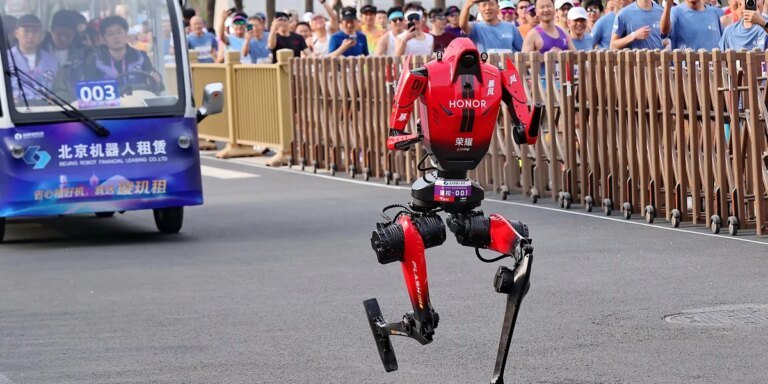
Furthermore, humanoid robots are providing new emotional and practical value in commercial exhibitions through performances, greetings and guided tours, Wang said. In the business-to-business sector, robots are increasingly utilized for automated industrial patrols and high-risk fire rescue operations.
By equipping robots with advanced sensors, they can handle repetitive, high-intensity tasks in complex environments. In hazardous, high-temperature or toxic areas, they serve as crucial forward reconnaissance and auxiliary operation tools, significantly reducing risks for humans while improving enterprise efficiency. Ultimately, they will serve as new productivity tools in factories, warehousing, agriculture and service industries to free humans from heavy labor.
Unitree’s financial data reflects this surging market demand. The company’s operating revenue skyrocketed from 159 million yuan in 2023 to 1.699 billion yuan in 2025, turning a net loss of 11 million yuan into a net profit of 278 million yuan over the same period. For the first half of 2026, the company expects revenue to have reached between 1.052 billion and 1.128 billion yuan, representing a year-on-year increase of 35.62 percent to 45.41 percent.
The rapid corporate growth aligns with a nationwide manufacturing boom supported by policies promoting wider factory-floor applications. According to the National Bureau of Statistics, China produced 143,608 sets of industrial robots in the first two months, up 31.1 percent year-on-year, while service robot production reached 2.54 million sets. Last year, total industrial robot output hit 773,074 sets, a 28 percent annual increase.
China views physical AI as a key future industry and a new economic growth engine. Data released by the International Federation of Robotics showed that China was the world’s largest industrial robot market in 2024, accounting for 54 percent of global installations with 295,000 units, far exceeding Japan’s 44,500 units and the United States’ 34,200 units.
This dominance extends to the emerging humanoid sector. According to research firm Omdia, global humanoid robot shipments reached approximately 13,000 units in 2025, with Chinese manufacturers contributing the vast majority. In absolute numbers, they far exceeded US enterprises such as Tesla and Figure AI.
The research, which covers both bipedal models and wheeled robots with human-like upper bodies, projects global shipments to surge to 2.6 million units by 2035. This exponential growth is driven by factors including advancements in AI models, dexterous hands and self-reinforcement learning, which enable robots to take on industrial, service, and eventually domestic roles.
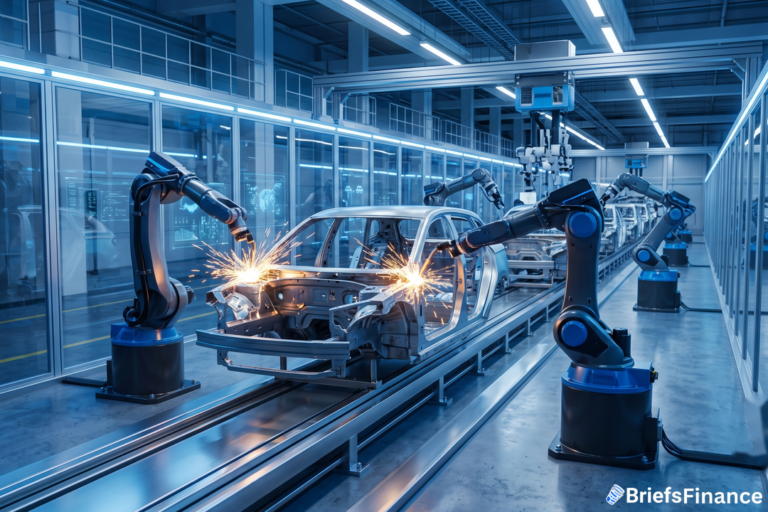
To capture this growing market, other technology giants and robot manufacturers are stepping up commercialization efforts for large-scale manufacturing applications. Smartphone and electric vehicle maker Xiaomi recently tested its self-developed humanoid robots in auto assembly tasks, running autonomously for three hours without human intervention, with founder Lei Jun planning large-scale factory deployment within five years.
Meanwhile, Shenzhen, Guangdong province-based UBTech recently announced a partnership with Siemens to streamline development and production processes, aiming to achieve a 10,000-unit manufacturing scale by the end of 2026.