NATO Explores the Future of Robotics at Penn’s GRASP Lab
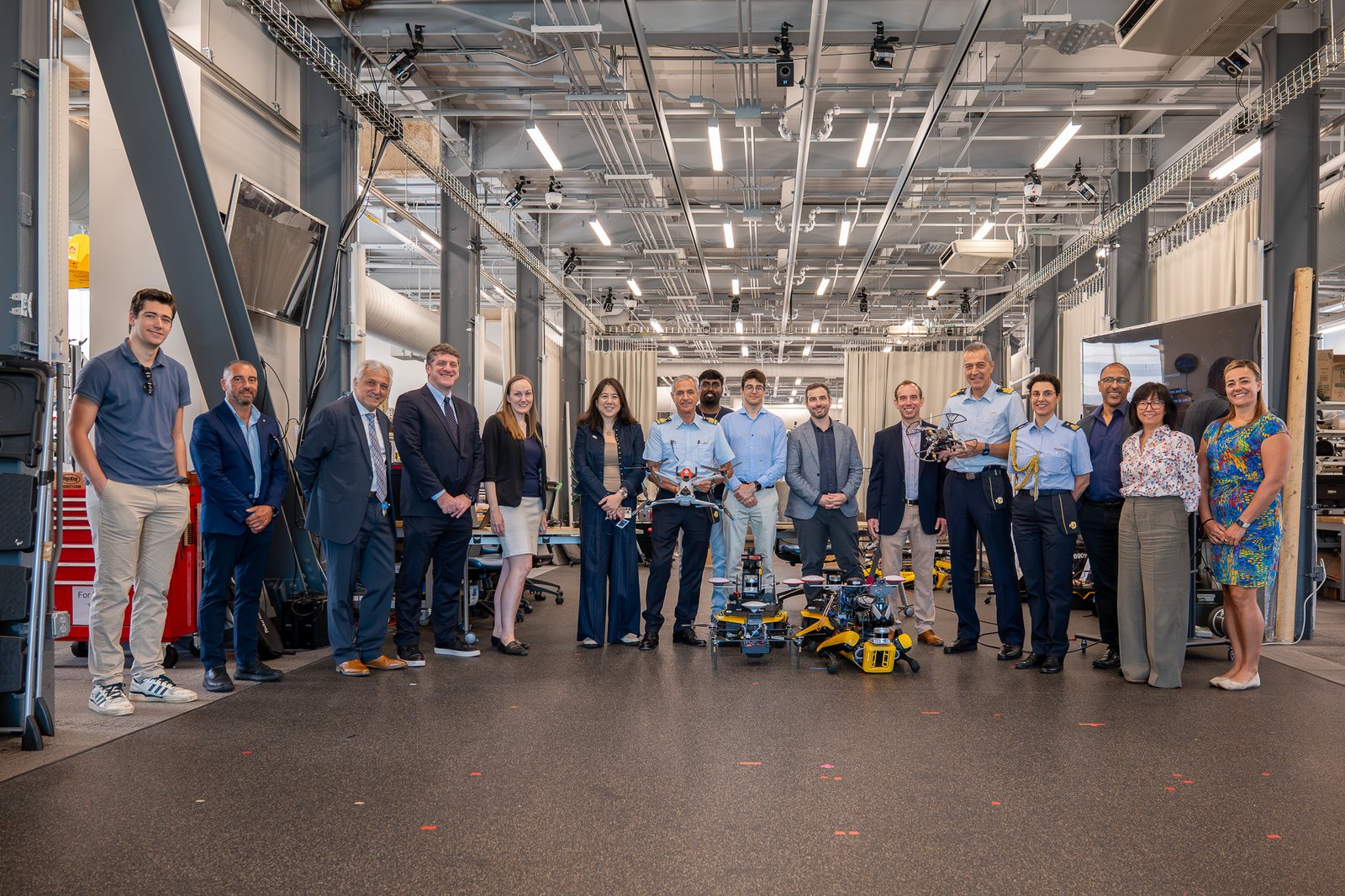
On June 11, 2026, a NATO Allied Command Transformation (ACT) delegation visited the University of Pennsylvania’s GRASP Lab to learn how Penn Engineering researchers are advancing robotics and autonomous systems with applications spanning disaster response, infrastructure and national security.
Together with Marco Di Gabriele, President of the Delaware Valley Chapter of the National Defense Industrial Association (NDIA), the delegation joined senior officials from the Italian Air Force and NATO, led by Deputy Commander ACT (DSACT) General Aurelio Colagrande and including Colonel Rosario D’Auria and Lt. Colonel Ivano Pennacchio. The visit introduced the delegation to the breadth of research underway at GRASP and highlighted the Delaware Valley’s growing role as a hub for defense innovation.
CJ Taylor, Director of GRASP and Raymond S. Markowitz President’s Distinguished Professor in Computer and Information Science, opened the visit with an overview of the Lab’s interdisciplinary approach to robotics research, highlighting collaborations across engineering disciplines and examples of Penn technologies that have successfully spun out into industry.
During the tour, GRASP faculty and students showcased research spanning autonomous aerial and ground robotics, swarm intelligence, search and rescue, underwater systems and AI-enabled decision-making.
 (Image: Sylvia Zhang)
“I was deeply impressed by what we saw at the GRASP Lab,” says General Colagrande. “The advances in autonomous robotics and UAV systems are technologically remarkable and operationally decisive. At ACT, we have the same imperative: to move faster, to experiment and to deliver capability at scale. Engagements like this are essential because they connect cutting-edge research with operational needs, ensuring we remain ahead of the curve.”
The visit took place following the 2026 NDIA Delaware Valley Aerospace Conference, a regional defense innovation conference that brings together leaders from academia, industry and government.
This year’s NDIA Conference highlighted work from the lab of Antonio Loquercio, Assistant Professor in Electrical and Systems Engineering (ESE) and member of GRASP. Presented by lab member Roberto Ligeralde (ENG’26, C’26), the research explores how autonomous drones can use artificial intelligence, specifically reinforcement learning, to develop advanced flying skills and racing strategies such as overtaking opponents or blocking their paths. Conducted with collaborator and fellow lab member Vineet Pasumarti, Ph.D. student in ESE, this approach has been shown to outperform traditional training methods in both simulations and real-world tests, particularly in more complex environments with obstacles. Ligeralde received the “Best Undergraduate Presenter” award for his conference presentation.
The NDIA event also featured Vanessa Chan, Penn Engineering’s Vice Dean of Innovation and Entrepreneurship and Jonathan and Linda Brassington Practice Professor in Materials Science and Engineering, who participated in a panel discussion on the topic of building a stronger regional ecosystem for robotics and autonomous systems.
“Breakthrough technologies don’t move from the lab to real-world impact in isolation,” says Chan. “They require trusted partnerships among universities, industry and government. Bringing international defense leaders together with Penn researchers creates the relationships that accelerate innovation while helping ensure that new technologies are developed to address the challenges society is facing.”

(Image: Sylvia Zhang)
Visits to leading-edge facilities like the GRASP Lab connect students, faculty and industry professionals across the globe in ways that allow Penn Engineering’s innovation in robotics and AI to come full circle and be applied to technologies that advance industry, public service and national security.
“At NDIA Delaware Valley, we see tremendous value in connecting academia, industry and military stakeholders — both domestic and international — to strengthen our regional defense ecosystem,” says Di Gabriele. “Facilitating collaboration with leaders such as NATO’s DSACT helps create meaningful opportunities for innovation, cooperation and long-term growth for our members.”
Learn more about the work being done at the GRASP Lab here.