Naver Aims to Become ‘Android of Robots’ With No-Code Platform

Naver, which has identified robot operating system (OS) platform technology as a new growth driver, has developed a platform that allows even non-developers to design robot services directly. The move marks an ecosystem expansion following the launch of a large-scale integrated robot control platform and a web-based robot OS. Analysts say Naver is aiming for the status of “Android of robots,” ensuring that any robot hardware passes through its platform in preparation for the commercialization of physical AI.
Naver Labs Europe Develops ‘No-Code, Low-Code’ Robot Service Design Solution
According to the information technology (IT) industry on the 1st, Naver Labs Europe, the R&D subsidiary of Naver, recently developed a platform that enables robot services to be designed through no-code and low-code methods. Last month, it filed a trademark application with the Korea Intellectual Property Office under the name “ARCBRAIN Flow,” and it is also pursuing patent procedures in Europe.
ARCBRAIN Flow is a solution that easily adjusts Naver’s robot control system “ARC Brain” for each site. Non-developers can combine various functions such as robot routes and delivery completion notifications to create customized robot services.

Focused on Robot Management Platforms for a Decade… Choi Soo-yeon: ‘Proud of World-Class Level’
The development of ARCBRAIN Flow is seen as raising the level of completion of Naver’s robot OS ecosystem “ARC” by one step. Naver established Naver Labs in 2017, more than a decade ago, for the purpose of physical AI and robot research, and has developed various robot management technologies.
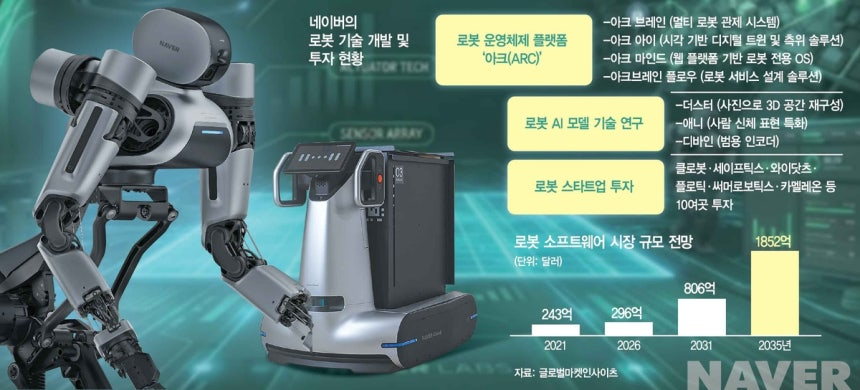
These include the cloud-based robot control system ARC Brain, the vision-based positioning technology “ARC Eye” that can identify location without GPS, and the web-based robot OS “ARC Mind.” Naver has continued demonstrations of delivery services and more by applying these technologies to its self-developed autonomous driving robot “Rookie” at its second headquarters, 1784, in Seongnam, Gyeonggi Province.
These technologies and demonstration experiences are also the source of the confidence expressed by Naver CEO Choi Soo-yeon at last November’s earnings conference call, when she said, “We concentrated our core competencies on developing the software called ‘ARC,'” and “We are proud that Naver’s robot software technology is at the world’s highest level.”
Expanding ARC’s Versatility With ARCBRAIN Flow… Reviewing Application at Japan Site
However, this system had the limitation of requiring services to be redesigned once outside 1784, a robot-friendly building. This means that to increase the versatility of Naver’s robot OS, robot services must be easily provided even in ordinary buildings, and this was a weak point. The answer that Naver Labs researchers came up with to solve the problem is precisely ARCBRAIN Flow. A Naver official explained, “The purpose (of ARCBRAIN Flow) is to provide customized services tailored to customer demand at each site,” adding, “We made it possible (for solution users) to control services as easily as moving shapes with a mouse in PowerPoint.”
Naver is also reviewing the application of ARCBRAIN Flow at “Tokyo Midtown Yaesu,” a large-scale complex building in Tokyo, Japan, which is the first export case of its smart building operation model. Naver focused on route design and more so that robots could move around smoothly at Midtown Yaesu, which was designed without robot operation in mind. When ARCBRAIN Flow is introduced, service operations such as robot delivery are expected to become easier.

Robot Software, Naver’s New Growth Driver… Concentrating Development and Investment
Some forecast that if the ARC platforms settle into the market in the future, Naver could be reborn as the “standard robot platform” of the physical AI era. Just as Google’s Android dominated the mobile ecosystem by connecting smartphones from various manufacturers under a single operating system, analysts say Naver is likewise aiming to build an open ecosystem that connects robots and services from various manufacturers with the ARC platform at the forefront, targeting the standard platform of the physical AI era.
At present, the large spaces where the ARC OS operates as a full stack are limited to the 1784 headquarters and Tokyo Midtown Yaesu, but as robots become commercialized, demand companies and spaces could increase. According to market research firm Global Market Insights, the robot software market is projected to grow from 29.6 billion dollars this year to 80.6 billion dollars in 2031 and 185.2 billion dollars in 2036.
Naver’s distance from the global robot hardware competition is also to concentrate on developing software and platform capabilities. Naver too possesses its own robots such as Rookie and is developing humanoid robots, but the main purpose is technology demonstration rather than mass production. Instead, Naver is focusing intensely on robot platforms and, further, on research into the AI models that underpin them as well as startup investment. “DUSt3R,” a 3D reconstruction AI model developed by Naver Labs Europe, has also drawn derivative research from global big tech firms such as Meta and Nvidia.
The key is the adoption rate. Lee Sung-yup, a professor at Korea University’s Graduate School of Technology and Innovation Management, said, “The key to a robot OS ultimately comes down to how many companies adopt it,” adding, “Since many robot manufacturers also develop their own control software, Naver needs to enhance the demonstration experience and full-stack OS competitiveness that only it possesses.”