NERC Flags AI Data Center Grid Risks in Report
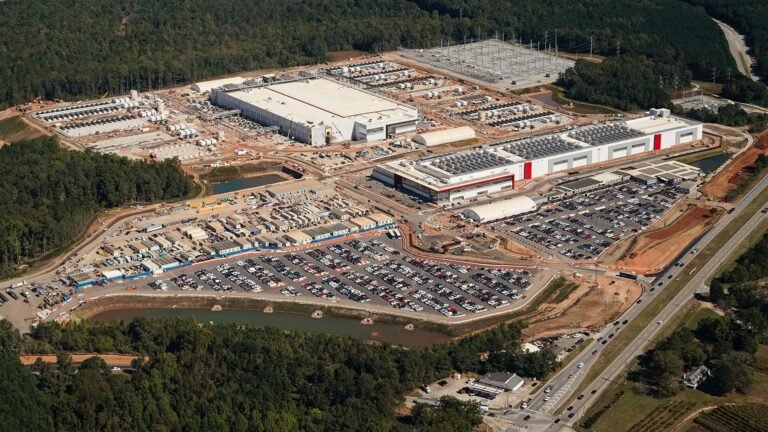
Gigawatt-scale customer-initiated load drops at hyperscale data centers are emerging as a new reliability challenge for North American grid operators. In its 2026 State of Reliability report, the North American Electric Reliability Corporation (NERC) documents several 2025 incidents in which more than 1 GW of data center demand disconnected within moments of transmission disturbances.
Although the bulk power system remained reliable in 2025, NERC says the events point to a shift in reliability planning as AI-focused campuses grow larger and cluster in key regions. This year’s report devotes a section to computational loads, detailing new modeling guidance, operational recommendations, and standards work to better understand how large data centers behave during grid disturbances.
Notable examples include a February 2025 event that shed about 1,800 MW of data center load after a transmission fault and a June 2025 event involving roughly 1,300 MW. NERC documented additional data center load reductions ranging from about 200 MW to more than 500 MW, and says that the Electric Reliability Council of Texas (ERCOT) experienced nine cryptocurrency mining load-loss events exceeding 100 MW during the year.
“As the size of individual large load facilities increases and if large load facilities are located near one another, the sizes of these large load events will likely increase,” the report states. “This could lead to measurable frequency or voltage stability issues.”
Unlike traditional industrial demand, large computational loads can disconnect rapidly during transmission disturbances. As individual campuses approach the gigawatt scale, those abrupt changes become system events that planners and operators must model and coordinate, not simply forecast as demand.
Computational Loads Become an Operational Issue
The Electric Power Research Institute (EPRI) said the events reflect a longstanding technical issue that has become materially more important as AI campuses have grown.
“The customer-initiated load reduction … is due to the inability of existing equipment in data center facilities (both AI and non-AI) to ride through normally cleared grid disturbances,” said Parag Mitra, senior principal technical leader at EPRI. “While in the past these events were manageable, the rapid increase in data center load capacity has magnified the issue to the point that it affects grid reliability.”
Mitra said utilities are making progress in developing computational load models, but they still lack both the detailed operational information needed to accurately represent large data centers and standardized methods for validating those models.
The report lands as hyperscale cloud providers increasingly acknowledge that electricity availability and grid coordination have become strategic factors in AI expansion. Through EPRI’s DCFlex initiative, utilities, hyperscalers, data center developers, and technology providers are working to improve operational coordination and flexibility as large computational loads continue to grow.
New Models and Rules
NERC’s response extends beyond documenting incidents. During 2025 and early 2026, the organization issued industry alerts, developed guidance for modeling computational loads, advanced standards work, published a technical reference for modeling data centers in transient stability studies, and endorsed the PERC1 performance model for representing data center behavior during grid disturbances. The report also highlights draft Rules of Procedure establishing a new registered entity category for computational load facilities.
Vikhyat Chaudhry, co-founder, CTO, and COO of Buzz Solutions, said the report reflects a broader change in how utilities must view hyperscale campuses.
“The fact that we’re already seeing customer-initiated load reductions at the gigawatt scale is a clear signal that AI data centers are becoming active participants in grid operations rather than passive consumers of electricity,” Chaudhry said. “A single AI campus can now represent the equivalent demand of a city, which fundamentally changes how utilities plan, monitor, and operate the grid assets.”
Chaudhry said utilities also need better operational visibility into both large computational loads and the infrastructure that serves them as AI demand continues to accelerate. Earlier coordination between utilities and hyperscale developers, combined with better operational data sharing, will become increasingly important as new campuses connect to the grid, he said.
Conventional Generation Adds Pressure
The report also points to mounting strain on the conventional generation fleet that underpins much of North America’s electricity supply.
Weighted equivalent forced outage rates climbed to 9.2% in 2025, above the historical 7%–8% range. Coal plants accounted for the largest increase in unavailable generation, followed by combined-cycle natural gas units. Rather than a single weather-related event, NERC found a broader increase in outages throughout the year. The organization recommends that utilities and regulators consider whether reserve margin requirements should be increased to account for the reduced availability of conventional generation.
Planning for Behavior, Not Just Demand
NERC’s assessment suggests AI infrastructure is changing more than electricity forecasts. Historically, utilities focused on how much power large customers would consume. Now planners must also account for how computational loads respond during disturbances, how those responses affect system frequency and voltage, and what operational coordination is required before facilities connect to the grid.
Whether AI data centers ultimately become a greater reliability challenge or a more flexible grid resource will depend on how quickly utilities, hyperscalers, and standards bodies close the modeling, data-sharing, and operational gaps identified in the report. For now, NERC’s message is clear: understanding the behavior of large computational loads has become as important as forecasting their demand.