No talent, no sovereignty: The blind spot in Europe’s Tech strategy
Europe is caught in a strategic autonomy paradox. While it may have the lead in writing tech-sovereignty frameworks, it invests only a fraction of what the tech heavyweights are pouring into the sector.
The European Commission has reported that the EU invested only 4% of what the US spends on AI. In venture capital, about €37.57 billion ($43 billion) was invested in AI in the EU in 2024, compared with €255.3 billion ($292 billion) in the US and €77 billion ($88 billion) in China.
Then there’s the talent question. Research on AI workforce movement suggests that European countries are losing significant AI talent, both national and international, to the US. This begs the question – how does Europe become the AI continent it wants to be if the people needed to build that future are treated as a secondary concern?
Europe’s sovereignty bet
Europe has been active on regulatory and infrastructure sovereignty. GDPR shaped the global privacy debate. The AI Act created the first comprehensive legal framework for artificial intelligence.
The Chips Act was designed to strengthen semiconductor capacity. The AI Continent Action Plan now aims to mobilise €200 billion for AI development, including €20 billion for up to five AI gigafactories.
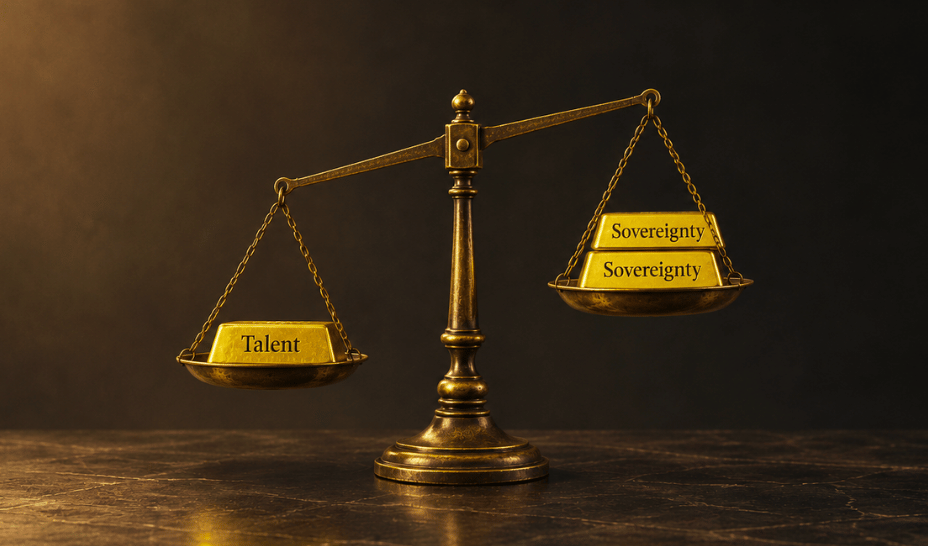
At the same time, Europe still struggles to retain some of the talent it trains and attracts. Sovereignty cannot be regulated or subsidised into existence. People have to build it. Researchers, engineers, founders, and operators who decide where to spend the most productive years of their careers.
The assumption behind much of Europe’s tech policy seems to be that better infrastructure will attract the talent needed to build on top of it. In practice, skilled people create the demand for better infrastructure.
Europe trains talent, then watches them leave
Europe has a strong base to build from. It had 2.21 million full-time equivalent researchers in 2024. The EU also spent €403 billion on research and development that year. In academic AI output, Europe remains competitive.
The EU produces 22% of global AI research journal articles, compared with 17% from researchers based in the US. Yet, research strength does not automatically lead to global category leadership.
A 2024 Interface report found that European countries are losing significant AI talent to the US. Germany attracts AI professionals from countries such as India, but also loses many to the UK, Switzerland, and the US. France loses more AI professionals than it gains.
Europe has the universities, the research base, industrial depth in manufacturing, energy, mobility, healthcare, and financial services.
Still, its talent system does not match the urgency of its sovereignty agenda.
Regulation opens some doors while closing others
Privacy, competition, and AI governance are a part of Europe’s soft power, but they have a reputational cost. Europe is often seen as a place where compliance arrives before innovation. That perception affects decisions by founders and senior technologists who have other options.
The recent scrutiny of Revolut’s European operations illustrates the tension. The European Central Bank temporarily curbed Revolut’s ability to launch new products in the European Economic Area until deficiencies in approval processes were addressed.
Financial regulation is necessary, especially in sensitive sectors. The wider message is that while Europe offers market access, the regulatory friction is still a real cost of doing business.
For experienced founders, regulation itself is not always a deterrent. Many value legal clarity, especially in sectors such as AI, FinTech, HealthTech, MedTech, DefenceTech, and energy. The bigger problem is process without speed, clarity, or coordination across borders.
The talent window is open
Europe is by no means a lost cause, though. It can make use of the talent window that the US has left open. US immigration uncertainty has made long-term planning harder for some students, researchers, and companies. F-1 student visa issuance fell by 22% in May 2025 compared with May 2024. There’s also been lower H-1B filings by major technology companies in late 2025.
Europe has started to respond. In 2026, the European Commission adopted its first EU Visa Strategy and issued a recommendation on attracting talent for innovation. The package focuses on highly skilled professionals, students, researchers, and innovative entrepreneurs.
It encourages member states to simplify procedures and reduce processing times. The EU-INC proposal points in the same direction by permitting entrepreneurs to register a company in any member state within 48 hours under a harmonised corporate framework, with a proposed maximum fee of €100.
While both initiatives are useful, they remain limited. The Visa Strategy depends heavily on member-state implementation.
EU-INC still requires approval and has no confirmed implementation date. Immigration pathways, processing times, tax rules, employment rules, and company procedures still vary significantly across Europe.
Treat talent as strategic infrastructure
Europe does not need to copy the US or China. It does need a more coherent answer to a basic question every international tech professional eventually asks: Why here?
The answer has to be practical. Faster visa routes for qualified founders, researchers, and senior operators. Clearer paths for international graduates to stay. Better cross-border hiring rules. Stronger university-industry partnerships. More growth capital for companies emerging from European research. Less administrative drag for founders building across more than one member state.
Strategic autonomy will depend on chips, data centres, AI factories, regulation, and investment funds. It will also depend on whether Europe can attract, retain, and empower the people who make those assets productive.
Talent is the operating base of technological independence. If Europe wants sovereignty in AI and other strategic technologies, it has to compete for builders with the same seriousness that it brings to regulation.