Nuclear Batteries and Laser Power: NASA Picks 37 Companies to Build Moon Base Tools
SpaceX’s Starship — the rocket NASA is counting on to land astronauts on the Moon — is lifting off tonight on its thirteenth test flight. But the engineering problems Starship cannot solve on its own are the ones 37 American companies just got recruited to crack, according to Starship Flight 13 launch details.
NASA selected those 37 companies — 41 total proposals — under the 2025 Announcement of Collaboration Opportunity, or ACO, announced June 26. The program hands selected companies access to NASA’s wind tunnels, thermal vacuum chambers, hypervelocity test ranges, and engineers — at no cost to the agency in cash — to accelerate development of technologies the Moon Base will need on a concrete near-term schedule. Artemis IV, the first planned crewed lunar landing, is targeted for early 2028.
Together, these 37 companies form the supply chain that will determine whether the hardware exists when NASA needs it. The problems they are working on are not speculative: the Moon’s two-week-long night drops temperatures in permanently shadowed regions near the south pole as low as minus 334°F, killing every solar-powered robot that ventures there. Wiring power across the crater-scored, abrasive-dust-covered lunar surface is impractical. And returning hardware from orbit without burning it up requires reentry guidance that has never been validated at the speeds involved. The 37 companies selected by NASA are, in effect, the companies that will solve those problems — or they won’t be solved in time.
How ACO Works: NASA’s In-Kind Model Explained
The ACO is not a grants program. No cash changes hands. Instead, NASA commits the estimated equivalent of $30 million in agency resources — test facilities, hardware, software, and the time of its engineers — and the 37 selected companies contribute an additional $32 million in matching effort, per NASA’s in-kind partnership structure. Each company signs a Space Act Agreement (SAA), the legal vehicle NASA has used for non-reimbursable commercial partnerships since the original 1958 Space Act, and the two parties negotiate individual performance periods expected to run twelve to twenty-four months.
The model deliberately serves a complementary purpose to NASA’s Tipping Point solicitation, which does provide direct cash and can reach tens or hundreds of millions of dollars for individual companies. ACO’s advantage is breadth: in-kind support scales across more companies than the budget would allow if every selection required a check. Since 2015, more than 110 ACO projects have been supported through the mechanism. Former ACO participants that have since won major NASA contracts include Intuitive Machines, Astrobotic, and Blue Origin, whose Blue Moon Mark 1 lander testing at NASA Johnson Space Center proceeded through a reimbursable Space Act Agreement using a structurally identical “front door” model documented on NASA’s ACO boost commercial space tech page.
The 2025 round is the most expansive in the program’s history in terms of company count and breadth of technology priorities. NASA framed the selections around five domains: space transportation engine elements, guidance and navigation systems, landing technologies, in-space servicing and assembly, and energy management.
Nuclear Batteries: Solving the Moon’s Longest Engineering Problem
The most consequential technology gap the selections address is power during the lunar night. At the Moon’s south pole — the location of the planned Moon Base — the Sun stays low on the horizon, and some crater rims receive near-continuous illumination. But the permanently shadowed regions within those craters, which are scientifically valuable and may harbor water ice, have never seen sunlight in billions of years, as confirmed by NASA’s Moon science resources. Any rover or instrument that enters one loses solar power entirely.
Seattle-based Zeno Power Systems is working on the solution under its ACO partnership: irradiation testing of the Sunpower Robust Stirling Convertor organics — the key pre-qualification step for what would become the first radioisotope Stirling generator flown in space, as detailed in Zeno Power’s Harmonia design review announcement.
The underlying technology converts the decay heat of americium-241 into electricity using a free-piston Stirling engine — a closed thermodynamic cycle in which heated helium drives a reciprocating piston that powers a linear alternator. The design operates without lubrication or bearing contact; gas bearings maintain non-contacting motion of internal components, making the system viable for the multi-year life spans lunar operations require, as described by NASA Glenn’s dynamic energy conversion program.
Critically, the Stirling approach is three to four times more efficient than the radioisotope thermoelectric generators NASA has used on deep-space missions like Voyager and Curiosity — approximately 20% electrical conversion efficiency compared to roughly 6% for legacy RTGs, per NASA Glenn’s dynamic energy conversion research. That matters because the supply of plutonium-238, the traditional fuel for RTGs, is constrained. Zeno is using americium-241 instead, sourced from recycled nuclear materials, as a more accessible alternative.
Zeno completed the Final Design Review for its Harmonia Radioisotope Power System for Artemis on April 21, 2026, confirming the system design meets all performance requirements and delivers 3.5 times the originally specified power output. A terrestrial demonstration of an electrically heated Stirling generator integrated with a lunar lander simulator is planned for early 2027. The goal: achieve Technology Readiness Level 6 — the threshold at which hardware can be considered for flight qualification — for the converter, as reported by the ANS milestone report on Harmonia.
The ACO’s irradiation testing component will expose the converter’s organic materials and mechanical components to simulated space radiation loads — a critical pre-qualification step that validates whether the system’s materials will maintain integrity after years in the lunar radiation environment. No Stirling radioisotope generator has ever flown in space; a 2013 budget cut canceled the program’s predecessor, the Advanced Stirling Radioisotope Generator history, before it reached a mission. The Harmonia program represents the first serious path to flight since then.
Laser Power Beaming: Wiring the Moon Without Wires
Lockheed Martin’s ACO project takes a different approach to the same energy problem. The defense and aerospace giant is developing a wireless power transfer system built around fiber lasers and a space-based heat rejection subsystem, targeting the power challenge in the permanently shadowed regions where solar arrays cannot reach.
The core mechanism: diode-pumped fiber lasers convert electrical energy into coherent laser light at wavelengths around 1,064 nanometers, with electrical-to-optical conversion efficiencies exceeding 50%. The beam is transmitted line-of-sight to a photovoltaic receiver — specialized gallium arsenide cells optimized for the laser’s wavelength rather than sunlight — which converts the light back into electricity.
The key engineering challenge is heat rejection. A laser receiver operating in vacuum generates waste heat with nowhere easy to go: unlike on Earth, convection is impossible on the lunar surface, and conductive and radiative cooling must handle the entire thermal load. NASA’s description of Lockheed Martin’s ACO project confirms the work specifically includes a space-based heat rejection system to address that constraint. If validated, the technology enables a modular power architecture: a single solar array on an illuminated crater rim could beam energy wirelessly to assets kilometers away in permanent shadow — eliminating the need to run cable across rough, abrasive regolith where maintenance is nearly impossible.
The alternative — microwave wireless power transfer — requires bulkier hardware and larger antennas at lunar scales, making fiber laser optical power beaming the lighter and more scalable option for the Moon Base’s distributed infrastructure.
Reusable Rockets: Stoke Space and the EDL Challenge
Kent, Washington-based Stoke Space Technologies, founded by veterans of Blue Origin, is developing Nova — a fully reusable medium-lift rocket with one of the most unusual second-stage architectures in the industry, as described on Stoke Space’s NASA ACO partnership page. Under the ACO, Stoke and NASA will collaborate on entry, descent, and landing technologies for the Nova upper stage, drawing on NASA Ames Research Center’s hypervelocity free-flight test capabilities and the agency’s aerodynamics and guidance, navigation, and control expertise.
Nova’s second stage reentry design solves the heat shield problem differently than any existing vehicle. Rather than ceramic tiles (like Space Shuttle) or ablative carbon (like Dragon), Nova’s second stage uses an actively cooled metallic heat shield: liquid hydrogen flows through the shield during reentry, using the same propellant plumbing that feeds the Andromeda 2 engine. The LH2 absorbs the reentry heat before being vented, protecting the structure without heavy ceramic tiles or ablative material that must be replaced after each flight, as detailed in NASASpaceFlight’s Stoke Nova update. The result is a reusable upper stage designed for rapid turnaround.
NASA Ames’ hypervelocity free-flight facility can simulate atmospheric reentry at Mach 7 to Mach 28, providing aerodynamic data on shock wave behavior, heat transfer rates, and gas dynamics at the conditions Stoke’s vehicle will encounter. That data is the specific resource Stoke cannot access commercially — it is unique to NASA’s infrastructure. The ACO makes it available to Stoke without a cash transaction.
Stoke’s first stage completed proto-qualification in June 2026 at its Moses Lake, Washington test site, per the NASASpaceFlight Stoke Nova Stage 1 report, with a first orbital launch from the historic Cape Canaveral Launch Complex 14 — John Glenn’s launch site — targeted for later in 2026.
The broader implication is economic: a fully reusable medium-lift rocket with a returnable upper stage lowers the per-kilogram cost of bringing hardware to orbit and back, which is directly relevant to in-space manufacturing and the Moon Base’s cargo return requirements. Prior ACO work with SpaceX helped inform the propellant transfer analysis that underpins Starship’s Human Landing System design, as documented on NASA’s ACO boost commercial space tech page.
In-Orbit Servicing and Dust: Two More Problems to Crack
Not every ACO project targets the Moon’s power or reentry challenges. Two others illustrate the breadth of the engineering gaps the 2025 cohort addresses.
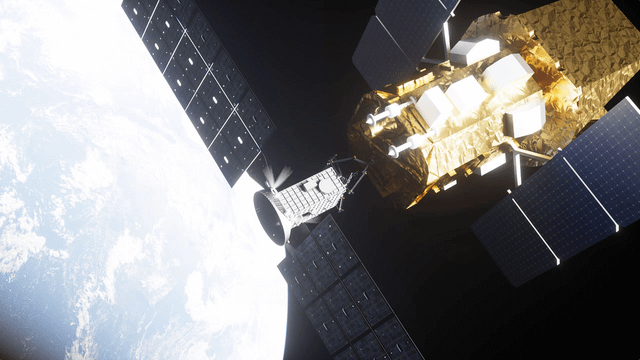
Kall Morris Inc., through its Asteria payload attachment system, is advancing a non-destructive, controlled-release adhesive technology that can dock to existing satellites without pre-installed hardware, as confirmed in NASA’s ACO project descriptions. Most satellites in orbit today were not designed to be serviced; Asteria’s approach treats the satellite’s existing exterior surface as the docking interface, enabling maneuvering, object tracking, asset protection, data collection, and life extension — all without modifying the target spacecraft. The growing on-orbit servicing market, which encompasses refueling, repair, and configuration change, has no standardized physical interface; Asteria sidesteps the problem entirely.
Moonprint Solutions, one of the smaller businesses in the cohort, is proposing flexible isolation covers that protect hardware from the Moon’s regolith — among the most abrasive particulates in the solar system, per the NASA press release covering the Moonprint Solutions dust cover work. Lunar dust is electrostatically charged, sub-micron in size, and jagged in structure; it adheres to solar panels, fouls mechanisms, and degrades optical surfaces. Moonprint’s covers are designed to conform to complex shapes — rover joints, robotic actuators, hoses — allowing them to shield a wide range of articulated hardware on both the Moon and Mars.
Five Washington State Companies and the Aerospace Hub They Represent
Five of the 37 selected companies are based in Washington State, a concentration that drew a statement from Sen. Cantwell on Washington’s aerospace role, ranking member of the Senate Commerce Committee. “This recognition by NASA reflects the strength of Washington’s leadership in aerospace manufacturing and innovation across the full space supply chain,” Cantwell said.
The Washington contingent spans the full range of the ACO’s technology priorities: Aerojet Rocketdyne in Redmond, working on Hall Current Thruster affordability improvements for electric propulsion; Blue Origin in Kent, conducting a Space to Surface Deceleration Capabilities Assessment; Starcloud in Redmond, demonstrating high-performance computing for in-orbit autonomy and deep-space exploration; Stoke Space in Kent, advancing Nova’s reentry capabilities; and Zeno Power in Seattle, advancing nuclear battery qualification.
Taken together, the five span propulsion, power, reentry, and computing — the four most technically demanding layers of the Moon Base infrastructure stack.
ACO’s Track Record as a Stepping Stone
The ACO’s significance for the 37 selected companies extends beyond the immediate technology partnership. NASA’s ACO track record documentation shows that prior ACO participation has historically functioned as a pipeline into larger, funded contracts.
Blue Origin used multiple ACO agreements to mature the Blue Moon Mark 1 lander design — receiving technical assessments and facility access at multiple NASA centers — before winning the Human Landing System contract for Artemis crewed missions. SpaceX used ACO analytical support to validate propellant transfer methods between two Starship vehicles in low Earth orbit, work that directly informed the Starship HLS design now slated to carry Artemis astronauts to the lunar surface, per NASA’s ACO boost commercial space tech page. Advanced Space matured the Cislunar Autonomous Positioning System through ACO, then launched it to the Moon on CAPSTONE in 2022.
The 2025 cohort’s 37 companies are now positioned to follow the same trajectory. As the Moon Base program accelerates through a $30 billion, 11-year architecture targeting a permanent outpost on Shackleton Crater’s rim by 2036, the companies that have validated their technologies through ACO partnerships gain a demonstrated relationship with NASA — and a NASA-reviewed technology maturity record — that strengthens their position in future contract competitions, as covered in depth by TechTimes’ Moon Base architecture coverage.
The agency estimates that over the next twelve to twenty-four months, it will provide $30 million in resources to the cohort while those companies contribute $32 million of their own, for a combined $62 million in invested effort aimed at the specific engineering shortfalls that stand between today and a functioning Moon Base.
How Does the ACO Fit the Moon Base Timeline?
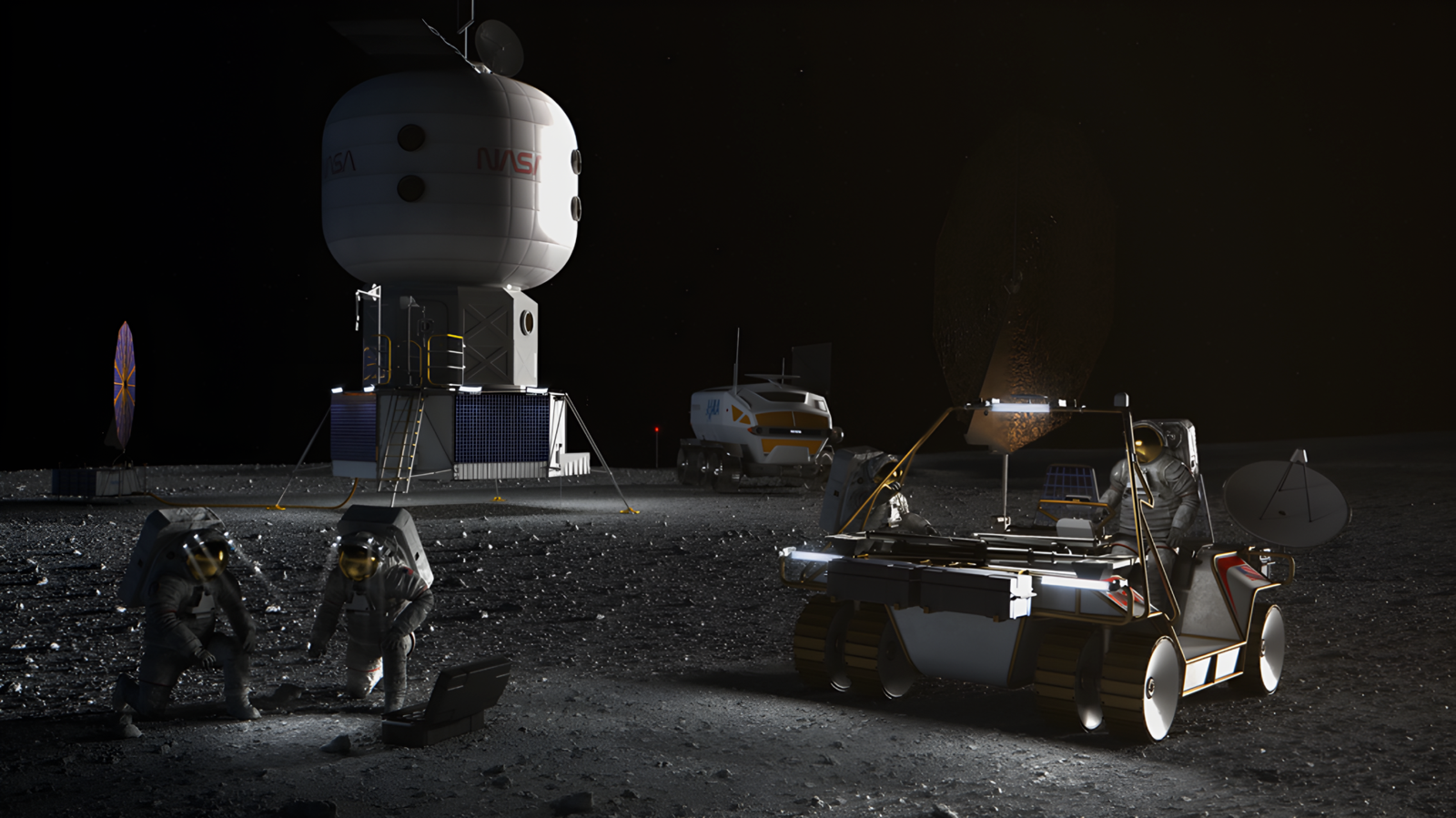
The timing is not coincidental. In March 2026, NASA Administrator Jared Isaacman unveiled a three-phase $30 billion Moon Base architecture targeting continuous human habitation of Shackleton Crater by 2033 and a permanent nuclear-powered outpost by 2036. Phase 1 alone calls for roughly 25 launches by the end of 2028, per TechTimes’ Moon Base architecture coverage. The ACO’s twelve-to-twenty-four-month performance windows align exactly with the pre-2028 window in which Moon Base Phase 1 infrastructure must be ready.
Artemis IV — the first crewed lunar landing under the current architecture, targeted for early 2028 — will use either SpaceX’s Starship Human Landing System or Blue Origin’s Blue Moon Mark 2 lander, depending on which vehicle successfully completes its uncrewed demonstration. Both companies have ACO history. The ACO’s 2025 cohort is building the systems those vehicles will depend on once they land: the power to survive the night, the laser grid to distribute that power, and the reusable upper stages that make continuous resupply economically feasible.
As Starship Flight 13 lifts off tonight at 6:45 PM ET from Starbase, Texas — the thirteenth test of the rocket NASA is counting on to carry astronauts to the Moon — the 37 companies in the 2025 ACO cohort are building the environment it will land in.
Frequently Asked Questions
What is NASA’s ACO program and how is it different from a normal government contract?
The Announcement of Collaboration Opportunity (ACO) is a no-cash partnership mechanism. Instead of paying companies directly, NASA contributes the equivalent of $30 million in agency resources — test facilities, hardware, software, and engineer time — and selected companies match with their own investment. The legal vehicle is a Space Act Agreement, a non-reimbursable instrument NASA has used since 1958. Companies gain access to capabilities — like NASA Ames’ hypervelocity free-flight test range or Glenn Research Center’s nuclear power expertise — that cannot be purchased commercially at any price. The ACO differs from NASA’s Tipping Point solicitation, which does provide direct cash funding, sometimes in the hundreds of millions of dollars per company.
Why does the Moon’s two-week night matter so much, and how are these companies solving it?
At the lunar south pole, the target of the Moon Base, the Sun stays low on the horizon and some areas — permanently shadowed regions inside craters — never see sunlight at all, with temperatures as low as minus 334°F. Every solar-powered robot that ventures into those areas loses power and dies. Zeno Power’s nuclear battery, which converts the decay heat of americium-241 into electricity via a Stirling engine, provides power that is independent of sunlight — extending lunar surface mission life from weeks to potentially years. Lockheed Martin’s fiber laser wireless power transfer system offers a complementary approach for assets that need power at a distance from a nuclear or solar source but cannot run cables across the Moon’s rough, abrasive regolith. Together, these two technologies address the “lunar night survival” problem from both the generation and distribution sides, per Zeno Power’s Harmonia design review and NASA’s description of Lockheed Martin’s ACO project.
Have nuclear batteries like this ever flown in space before, and when could one reach the Moon?
No Stirling radioisotope generator has ever flown in space. The predecessor program, NASA’s Advanced Stirling Radioisotope Generator, was canceled in 2013 for budget reasons before it reached a mission. Zeno Power’s Harmonia system is the most advanced current effort to change that: it completed Final Design Review in April 2026 and is targeting a terrestrial demonstration in early 2027. If that demonstration achieves Technology Readiness Level 6, the system could be flight-qualified for lunar missions in the late 2020s, potentially in time to support Moon Base operations before the first crewed landing, as detailed in Zeno Power’s Harmonia design review and confirmed by the ANS milestone report on Harmonia.
What is the ACO’s track record, and does getting selected actually lead to bigger NASA contracts?
The historical pattern is encouraging. Blue Origin used ACO agreements to mature the Blue Moon Mark 1 lander before winning the Human Landing System contract for Artemis crewed missions. SpaceX used ACO analytical support to validate the propellant transfer architecture behind the Starship HLS design. Advanced Space matured the Cislunar Autonomous Positioning System through an ACO and then launched it to the Moon. Since 2015, NASA has supported more than 110 ACO projects, and the companies that have gone on to win subsequent major contracts consistently cite the ACO’s facility access and expert validation as a material factor in their technology readiness, per NASA’s ACO boost commercial space tech page.