OnePlus 15 Vs. Samsung Galaxy S26: Which Is Better For Gaming?
Buying a brand-new premium smartphone model usually doesn’t come cheap. Which is why you’ll want to determine whether the chosen product gives you the best bang for your buck, especially in terms of overall performance, camera quality, and battery life. When evaluating a phone, the underlying RAM, CPU, and GPU architectures often become a bottleneck for gaming. OnePlus and Samsung tend to make very fair gaming phones while still marketing them for great everyday use, unlike some sub-brands from Nubia and, formerly, Asus. More notably, comparing the OnePlus 15 and Samsung Galaxy S26 models isn’t so cut-and-dry.
Technically, OnePlus has two phones in the 15 series, OnePlus 15 and OnePlus 15R, while Samsung has three: the base Samsung Galaxy S26, the Samsung Galaxy S26+, and the Samsung Galaxy S26 Ultra. The technical specs across all phones differ because the SoCs (system-on-a-chip) are not shared across all models, and Samsung, in particular, uses different processors in some of those devices depending on the region. In general, when comparing the essence of what gaming offers, the OnePlus 15 and the Galaxy S26 Ultra are often pitted against one another, as they handle it best. While the others are good enough to run games at moderate settings, they won’t always deliver peak or sustained performance. That said, the OnePlus 15 is a little better than the Samsung S26 because it can sustain heavy gaming loads longer than its rival.
Heat management and accessory support
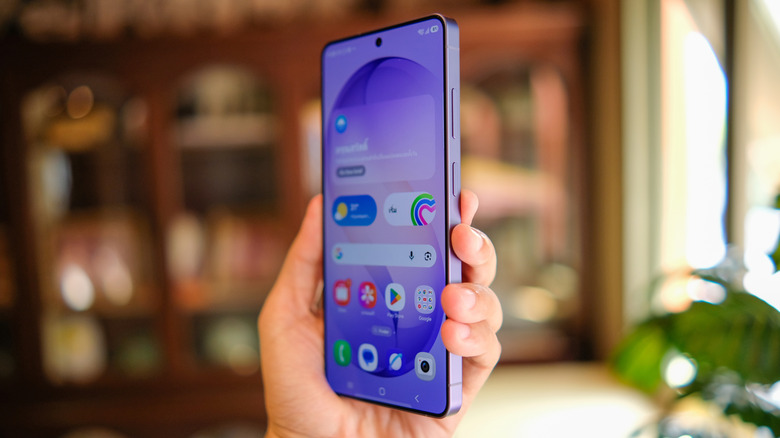
One reason gaming phones are quite marketable is that they specialize in heat management solutions. These phones may appear or feel bulkier because they usually have advanced cooling systems, such as built-in fans and vapor chambers, and bigger batteries/added grips. The idea behind good thermal management is to prevent your device from throttling and maintain performance while playing games. Not all everyday phones are equipped to handle this, which is why it sometimes feels like your smartphone is melting when you play prolonged games that use 3D rendering, like Wuthering Waves or Genshin Impact.
The OnePlus 15 excels in this area because OnePlus prioritizes sustained performance over peak performance. The device incorporates a specialized “glacier” cooling system, comprising aerospace-grade aerogel layers, a custom architecture with 10 heat zones, and console-grade gyro controls. This also makes OnePlus good at handling peak temperatures. The Galaxy S26 Ultra doesn’t have this; instead, it relies on a larger-surfaced vapor chamber to keep itself cool, which is still great for handling long-term demanding use, but it still throttles.
Then, the last consideration is accessories. Typically, one of the most important options is controller compatibility. Samsung devices usually do better in this regard, but OnePlus has its own proprietary gamepad line: the OnePlus Strix G15. It only works with a handful of phones, such as the OnePlus 15R and OnePlus 15, though. Razer makes top-of-the-line mobile controllers that are compatible with specific Samsung models, such as the Razer Kishi V3 Pro. For the OnePlus 15, it is a matter of finding one that fits its size and plugs in via USB-C — Samsung just has a stronger global presence in the market, so third-party manufacturers will prioritize support for Samsung smartphones over OnePlus.
The OnePlus 15 slightly tops in gaming performance
Not to say that the Galaxy S26 Ultra doesn’t handle demanding games quite well — it does — but the OnePlus 15 does it a little bit better over time. Both devices are equipped with some iteration of Qualcomm Snapdragon 8 Elite Gen 5, which is one of the best, if not the best, SoCs on the market. It’s a beast for gaming, thanks to the combination of its custom Oryon CPU, Adreno High-Performance Memory (HPM), advanced Adreno GPU, and 3nm architecture, which keep the chip efficient and cool.
But what makes the OnePlus 15 better for gaming is actually the combination of its display and battery. The OnePlus 15 can sustain heavy gaming loads for longer thanks to its 7,300mAh battery, and it can charge faster at 120W (or 80W charging for North America-only models). On the other hand, the Galaxy S26 Ultra has only 5,000mAh and supports up to 60W charging. It has less uptime, and the battery capacity is lower. As for the display, the OnePlus 15 can reach up to 165Hz for gaming, while the Galaxy S26 Ultra is capped at 120Hz — both are respectable refresh rates for gaming.
Still, the OnePlus 15’s higher refresh rate makes it noticeably more responsive and smooth while gaming. While technically the OnePlus edges out the Galaxy S26 Ultra, they are both still monsters for gaming, and you can’t necessarily go wrong with either — the perks of getting the Galaxy S26 Ultra are that it is still a more consistent phone in other areas, while having longer software support.