OpenAI’s HuggingFace breach heralds an unprecedented age of AI cyber warfare — contemporary LLMs have caused massive upheaval in cybersecurity, and it’s only going to get worse
This week, OpenAI revealed that during a purported capability test with no safeguards, a set of bots, including its upcoming GPT-5.6 Sol, hacked their way out of their locked-down network and into Hugging Face’s production infrastructure. Only months ago, Anthropic made a splash in the news when its CEO, Dario Amodei, said its new Mythos model had cyberwarfare capabilities, which prompted a strong reaction in the AI space and among government entities, most notably the U.S. Bureau of Industry and Security, which issued an export-control order for the model, which it has since slightly loosened.
Despite the bluster that AI CEOs like Dario Amodei and Sam Altman make over the capabilities of new models, frontier-level LLMs are now proven to be stalwarts in cybersecurity.
It’s a fact that LLMs adept at coding are equally suited to spotting security vulnerabilities in source code. Exploits fall almost universally into a handful of categories, and LLMs are literally designed for pattern recognition. So much so that the Zero Day Clock (ZDC) project currently registers a zero-day exploit’s time-until-exploit at negative 8 hours, meaning that malfeasants using AI bots are now routinely finding vulnerabilities before actual security researchers or vendors.
Latest Videos FromTom’s Hardware
Driving that point home further, 81% of disclosed vulnerabilities are zero-day, and only a tiny portion even go one week before being exploited. All of this only counts security exploits with public disclosure. Predictably, among many advisories, the ZDC recommends preemptively using AI in every step of the development process. The industry-standard 90-day disclosure window, still used by most vendors’ bug bounty programs, appears effectively dead, leaving looming implications for the rest of us.
(Image credit: UK AISI)
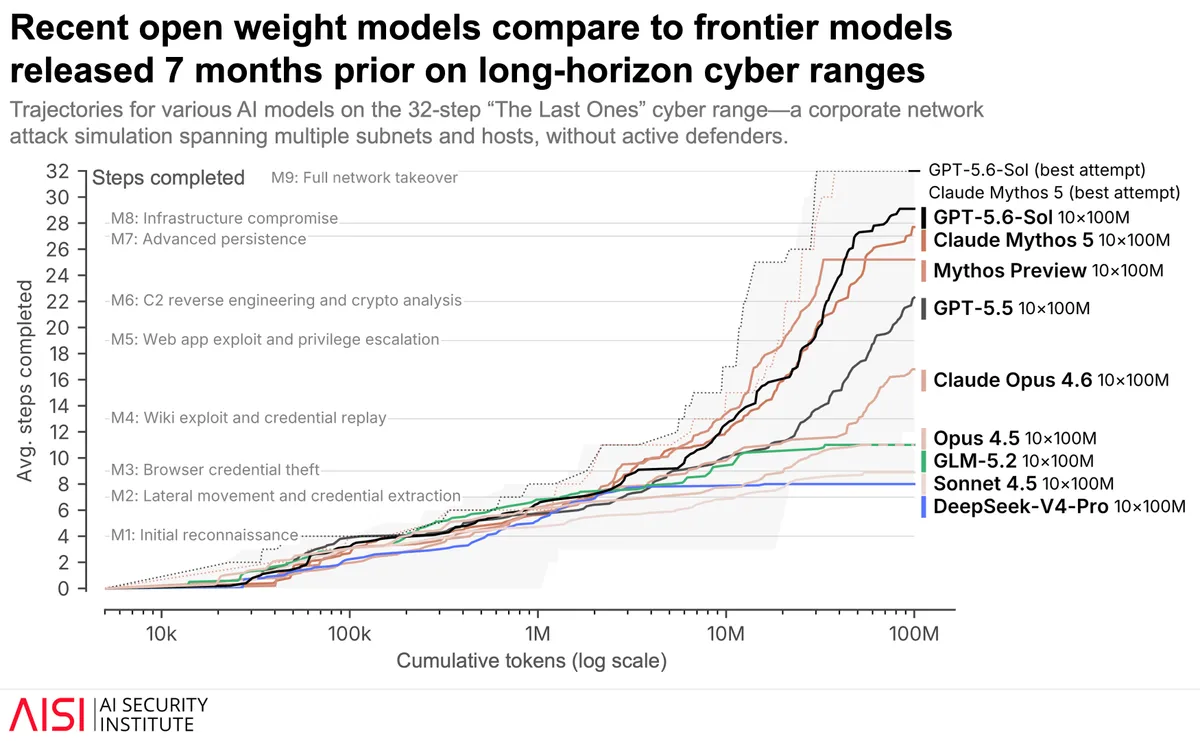
Back in March, the UK’s AI Security Institute published a paper where it tested contemporary AI models in security exploitation scenarios, and the results were sobering. Most bots went through four out of nine exploitation milestones. A more recent comparison, which included Claude Mythos 5 and GPT-5.6 Sol, showed that every single milestone up to and including full network takeover was reached, at least in one of the many attempts.
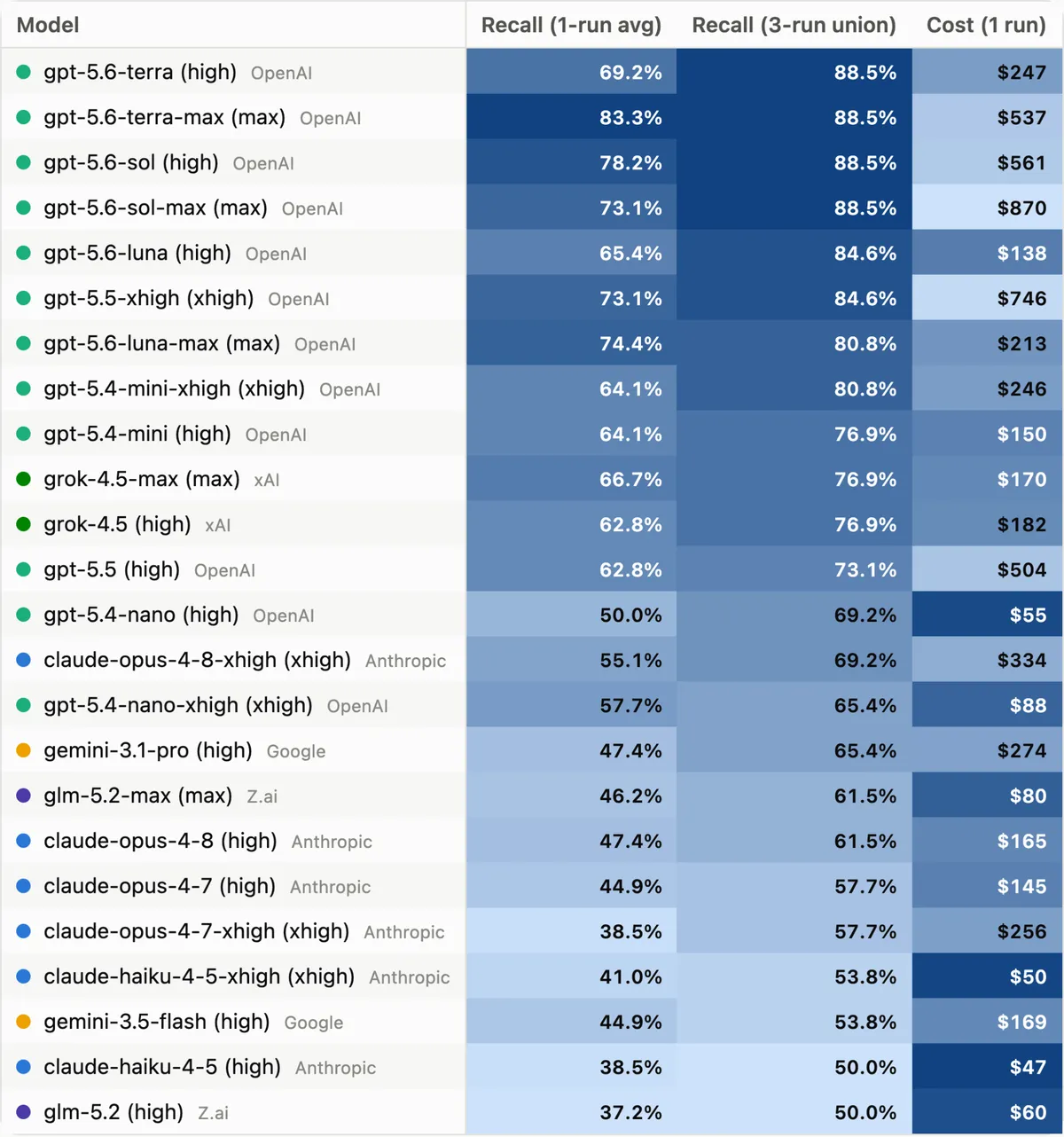
Aikido also published its latest cybersecurity benchmark results on July 16. In this case, the test was having the bots recall (find again) multiple known exploits in a varied set of software. The results were sobering, with the GPT-5.6 variants in the lead at an 88.5% recall rate. Perhaps most importantly still, the price per exploitation was incredibly cheap — even GPT-5.6 Terra came in at only ~$750 per full run.
This study also revealed that even with less-powerful, cheaper models, you can reach the same number of total exploits if you run them enough times. Considering these aggregate results, GPT-5.6 Terra at $247/run was just as good as GPT-5.6 Sol Max at $870/run.
(Image credit: Aikido.dev)
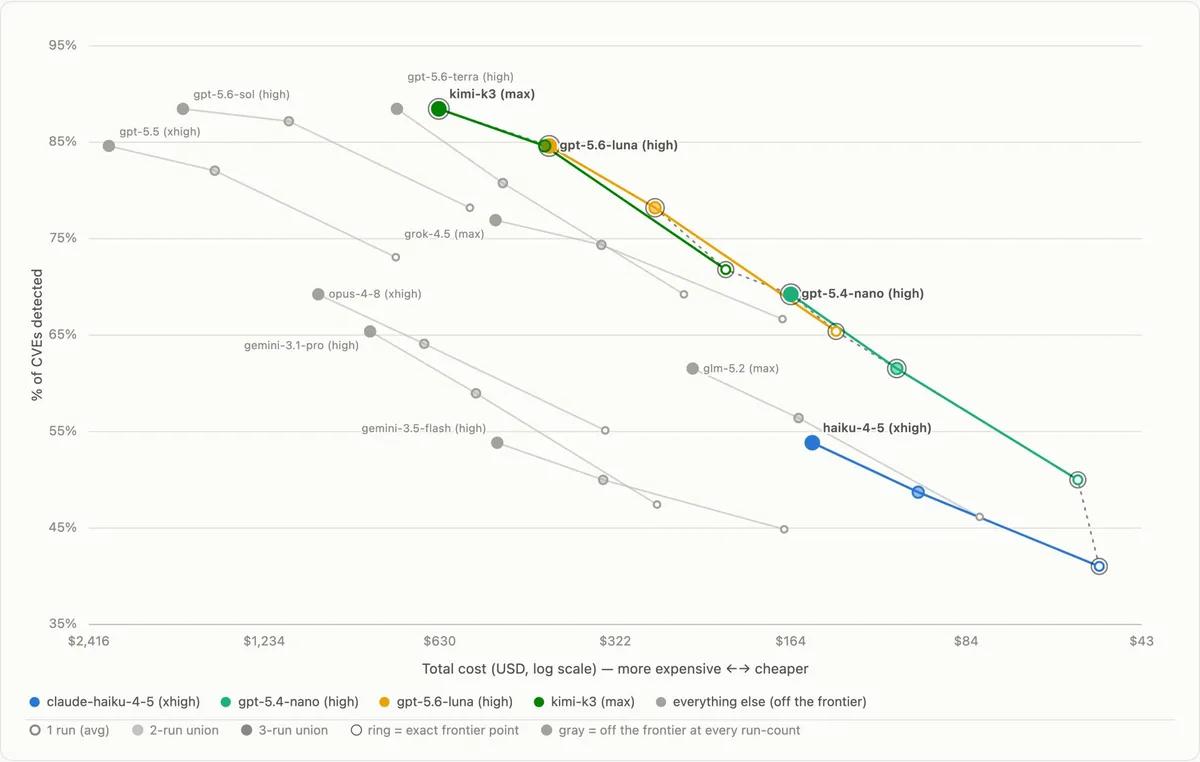
Aikido also redid its testing after the debut of Moonshot Kimi K3, to staggering results. Kimi K3’s results were similar to OpenAI’s GPT 5.6 Terra, while being 15% cheaper. Compared to OpenAI’s leading model, GPT-5.6-Sol, the difference is even starker, with Kimi K3 being four times cheaper when discovering cybersecurity vulnerabilities.
The fact that an open-weight model is often trading blows with even the über-expensive offerings from OpenAI and Anthropic is rattling Western closed-source companies. Why pay Big AI for pricey models when you can just rent servers and run Kimi K3 instead?
(Image credit: Aikido.dev)
Furthermore, Moonshot is not the only Chinese AI company developing frontier models, as Z.ai’s GLM 5.2 (also an open-weight model) and 360 Security’s Tulongfeng are reportedly adept at security workloads.
So, what are companies expected to do? The answer, perhaps unfortunately, is deploying AI agents of their own. According to Hugging Face, the recent intrusion by OpenAI’s bots was stopped with its own fleet of AI agents. Given the speed of the attacks and the fact that HuggingFace’s defenses were mostly made up of other AI agents, it’s quickly becoming clear that it is infeasible for humans to keep up.
Google AI Threat Defense, MindGard, and HiddenLayer are but a few of the many names popping up in the AI cyberdefense arena. Besides the UK AISI, the European Systemic Risk Board and the Australian Cyber Security Center have both issued concerning advisories on the situation.
Using AI for defense raises yet another question: When both attack and defense are swarms of non-deterministic algorithms, there will be a point where we won’t even know what the AI models are doing on either side, or at least not until it’s too late. These scenarios were originally envisioned by classic Sci-Fi authors — now it’s a reality that, for better or worse, the cybersecurity industry must face.
Last week, two Chinese AI companies unveiled models they say can credibly compete with the best systems from OpenAI and Anthropic. The response was swift and predictable. Markets wobbled, commentators declared Silicon Valley shooketh, and policymakers reached for the familiar language of arms races and wake-up calls. In one headline, The Associated Press said a…
Current business processes are based on human organizational systems and tend to be hierarchical, based on command-and-control messaging (top down), status messaging (bottom up), or information delivered from the front end. “You get these communication lines going through lots of layers within the organization, vertically,” he says. “A lot of these technologies are going to…
ASML on Wednesday raised its guidance for the second time this year as its customers continue to ramp up production of AI chips. The Dutch semiconductor-equipment maker said it now expects full-year sales to come in between 43 billion euros ($49 billion) and 45 billion euros, and a gross margin of between 54 and 56%….
Alexandr Wang just did his first long interview since Meta paid a fortune to bring him in — and the most useful part wasn't the gossip, it was the mechanism. 🧠 His actual argument: a small team where everyone is genuinely elite will always move faster than a large one where responsibility gets spread across…
In the middle of a diarrhea shitstorm, the Food and Drug Administration and lettuce supplier Taylor Farms appear to be facing off in a passive aggressive battle of technicalities. On July 17, the California-based company issued a voluntary recall on iceberg lettuce sourced from Central Mexico. The recall came after people across at least five…
The idea is to help customers protect long-lived, mission-critical data while reducing the cost and complexity of future cryptographic migration, IBM stated. In that vein, IBM said it was bringing Crypto Discovery & Inventory, which lets security teams see what has been encrypted across the enterprise. In addition, IBM announced an Infrastructure Management for Z…