Physical AI makes industrial robots easier to deploy
The article discusses how physical AI is helping manufacturers by narrowing the gap between desired automation and current capabilities. Evan Beard, co-founder of Standard Bots, highlights that physical AI allows robots to learn through demonstration, bypassing traditional programming. This advancement enables the automation of complex tasks that were previously considered difficult for robots.
U.S. manufacturing employment has fallen from nearly 20 million workers in 1979 to about 13 million today. Standard Bots co-founder and CEO Evan Beard put that figure in front of the House Science, Space, and Technology Committee’s Subcommittee on Research and Technology in April 2026, during a hearing titled ‘Robots Made in America: Advancing U.S. Leadership in Manufacturing and Automation.’ His argument: robots have to get easier to deploy before that trend can turn.
Beard, who founded Standard Bots in 2017 alongside James Cordle and David Golden, spoke to the Association for Advancing Automation’s Automate publication about where physical AI fits into that picture. The core problem he describes is familiar to any operations team that has priced out an automation project: the robot itself is only part of the cost. Programming, integration, and the time required to retrain a system when a product changes are often what make projects unworkable.
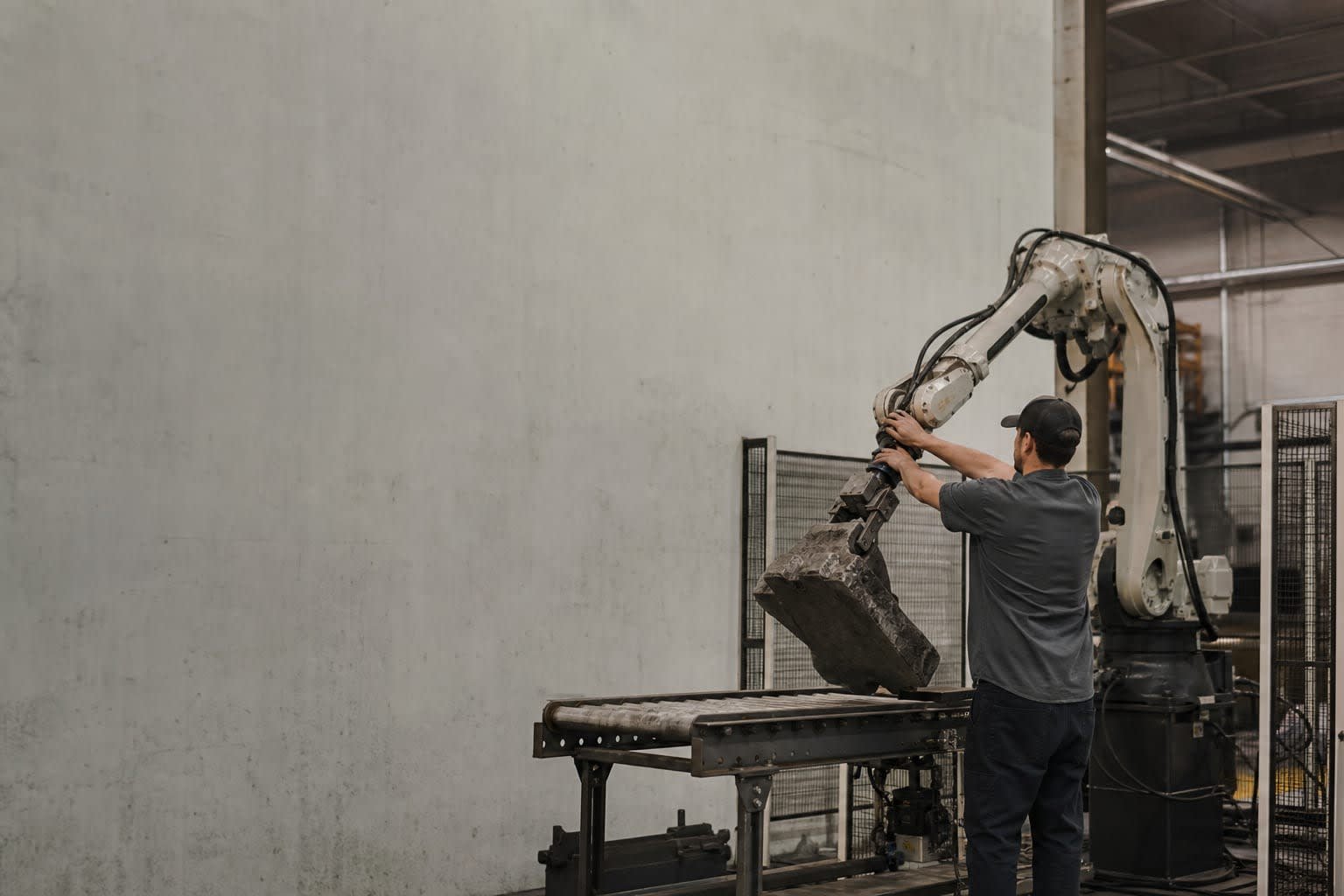
Physical AI is his proposed answer to the programming and retraining problem. Instead of writing code for every motion, an operator guides the robot through a task using a handheld device or via teleoperation. The robot records the movement and converts it into training data for an AI model, which then runs the task autonomously. Beard draws a direct line from large language model advances to this capability, telling Automate that the same progress behind tools like ChatGPT is now reaching the physical world.
Two buckets: known applications and ‘impossible jobs’
Beard organizes the automation opportunity into two distinct categories. The first covers jobs where robots are already proven: machine tending, welding, palletizing, painting. Standard Bots is competing in those markets, but on the premise that deployment should be cheaper and faster than it has been.
The second category is what he calls impossible jobs. These are tasks manufacturers have been told by integrators are either not technically feasible or not economically justified once integration costs are included. Variation is usually the reason. A robot programmed for one specific object, surface, or orientation often cannot handle small deviations without reconfiguration.
Beard described an automotive example to illustrate how physical AI changes the math. A task needed to be completed within a one-minute station time, a cycle-time constraint that had historically ruled out automation. Using the demonstration-based approach, the robot learned the job, identified the relevant work area, and completed the task within the required window. The same principle, he argues, applies to handling new object sizes or shapes the robot has never seen, because the underlying AI model can extrapolate rather than fail.
There’s this other bucket of tasks. These are the tasks that if you call your integrator, you say, ‘Hey, can you do this?’ This is just not possible, or it’s going to be so dramatically cost-prohibitive that you wouldn’t even consider it., Evan Beard, co-founder and CEO, Standard Bots, via Association for Advancing Automation
Domestic manufacturing and the support question
Standard Bots manufactures its robots in the United States. Beard frames this not only as a supply chain or policy point but as a practical service consideration. An American-made robot, he told Automate, comes with an American support team that can be reached when something goes wrong on the floor. For operations leaders managing uptime, that distinction has a direct cost implication.
That perspective carried into his April testimony, where he appeared alongside A3 President Jeff Burnstein. Both argued for a more coordinated national robotics strategy, pointing to other countries that established robotics policies earlier and now hold dominant positions in the global market.
Beard also framed the accessibility problem in terms of scale. The industries and tasks that most need automation, by his account, are still largely untouched. Most manufacturers have at least one process they would automate if the cost, complexity, and risk were manageable. Physical AI’s value proposition is that it lowers each of those three barriers at once.
What this means for your team
- Audit your ‘impossible jobs’ list: tasks previously rejected because of variability, cycle-time constraints, or integration cost may now be viable candidates for physical AI-enabled robots. Bring specific examples to vendor evaluations.
- Ask vendors about demonstration-based programming in your RFP process. Request documented cycle times for changeover and retraining when a product variant or process step changes.
- Factor in domestic support availability when comparing total cost of ownership. Response time for on-floor technical issues affects uptime and should appear in your vendor scoring criteria.
- Watch the policy environment. Congressional attention on domestic robotics manufacturing, as seen in the April 2026 hearing, may affect incentive programs, procurement preferences, or sourcing requirements relevant to your capital planning.
![I built IMGNet – a face verification model that identifies people using sign patterns, not cosine similarity [R]](https://jobssz.com/wp-content/uploads/2026/07/otbyst8xt8ch1.png)