Poor AI Design Becomes Expensive AI

The biggest AI costs of 2026 aren’t sitting in your API invoice. They’re hiding in architectural decisions nobody is measuring.

There’s a meeting happening in companies everywhere right now, and it follows the same script.
Finance pulls up the AI spend. It has doubled — maybe tripled — over two quarters. Usage, meanwhile, has grown modestly. The engineering lead is asked a simple question: where is the money going? And the honest answer, more often than anyone wants to admit, is: we’re not entirely sure.
That uncertainty is the real problem. Most companies are measuring the wrong AI costs, and it is quietly destroying their ROI. They track API pricing, model rates, token costs per call — the visible numbers. But the biggest AI expenses in 2026 are not coming from APIs. They are coming from hidden architectural decisions, made early, compounding silently, and showing up months later as a bill nobody can explain.

The Bill Nobody Can Explain
When AI costs spike, the instinct is to blame the model. It’s the most visible line item, so it becomes the suspect. Teams downgrade to cheaper models, cap usage, ration access — and the bill barely moves.
That’s because the model was never the main driver. The system around it was.
Think of it this way: the model is the engine, but architecture is the route. A fuel-efficient engine driven in circles still burns more than a modest one driven straight. And most AI systems today are driving in circles — by design, not by accident. Somebody made a reasonable-sounding decision months ago, and that decision has been billing the company every single day since.
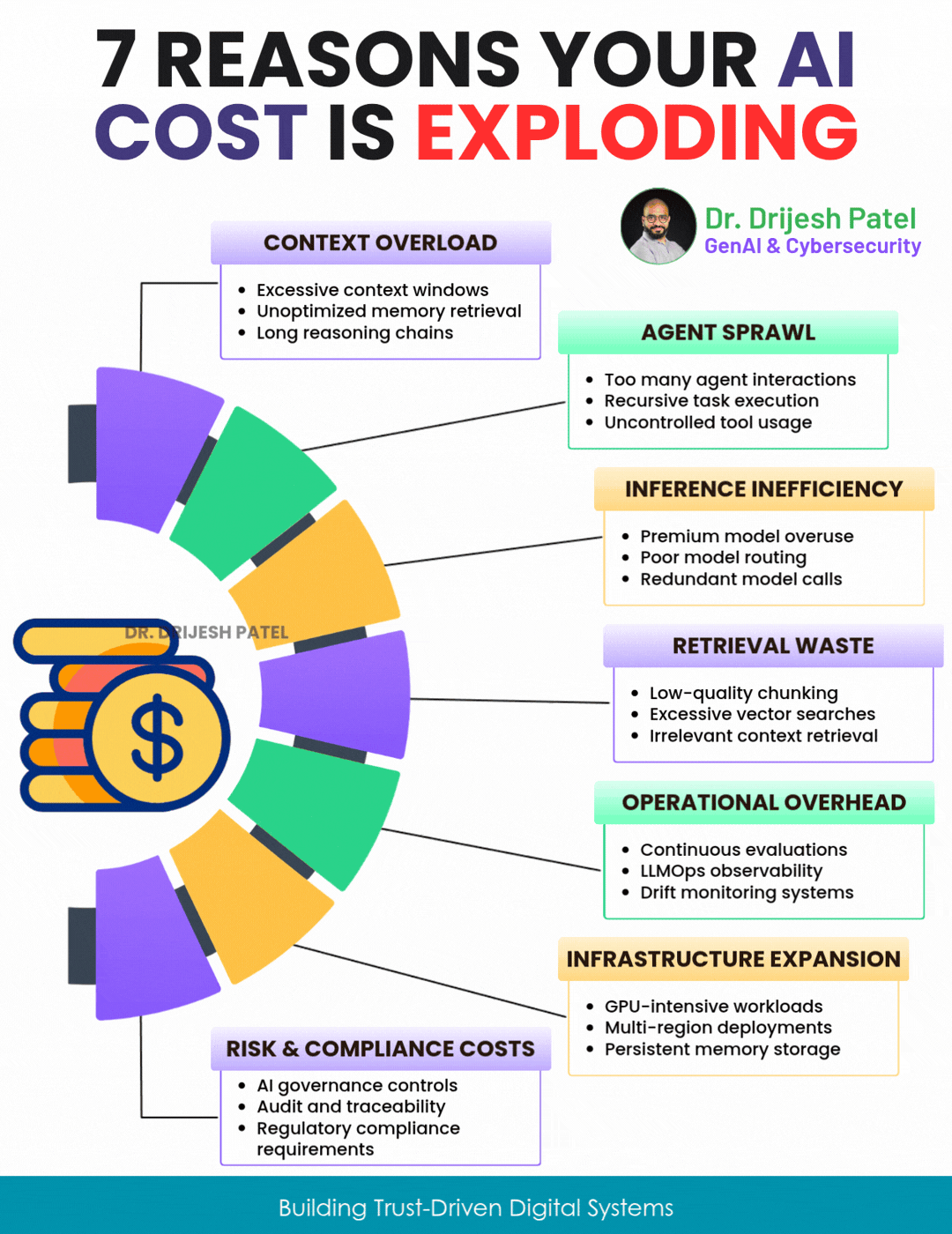
The seven biggest sources of that hidden spend fall into two families: costs you pay on every single request, and costs that never even say “AI” on a line item.

Where the Compute Actually Goes
The first cluster of hidden costs lives inside every single request your system makes.
Context overload is the quietest one. It feels safe to stuff the prompt — more documents, more history, more instructions, just in case. But every token of context is paid for on every call, and “just in case” context gets re-sent thousands of times a day. More context means more tokens, and more tokens mean higher inference spend — linearly, forever, on every request.
Agent sprawl multiplies that. Multi-agent workflows are powerful, but each agent hop is another full inference pass, often carrying that same bloated context along with it. A task that could be one well-designed call becomes five agents deliberating — and you pay for the deliberation. The workflow diagram looks elegant. The invoice does not.
Inference inefficiency is the most common of all: using your most expensive model for everything, because it was the default when the system was built. Classification, extraction, routing, formatting — jobs a smaller model would handle at a fraction of the price — all flowing through the flagship. Nobody decided to overspend. Nobody decided not to, either.
Each of these looks like a small engineering shortcut. Together, they’re the difference between an AI system that scales and one that becomes a budget crisis.
The Costs That Don’t Show Up on the Invoice
The second cluster is easier to miss, because it never appears as a line item labeled “AI.”
Retrieval waste hides in your RAG pipeline. Poorly designed retrieval pulls too many chunks, re-embeds too often, and searches too broadly — increasing both compute and search overhead while actually making answers worse. You pay twice: once in infrastructure, once in quality.
Operational overhead arrives after launch. Evaluations, observability, monitoring — the machinery required to trust an AI system in production — all carry ongoing costs that pilots never surfaced. Skipping them isn’t savings; it’s deferred spend with interest.
Infrastructure expansion compounds underneath everything: GPUs, storage, and scaling commitments that grow with the system’s inefficiencies. An architecture that wastes tokens also wastes the hardware serving them.
And risk and compliance is the cost that only grows. Governance, audits, and regulatory controls are not a one-time checkbox — they’re continuous investment, and every architectural shortcut you take early makes them more expensive later.
None of these show up when a team estimates “AI costs” at the start of a project. All of them show up in production.
The Companies Getting It Right Aren’t Cutting Usage
Here’s the pattern worth paying attention to: the companies actually reducing AI costs are not the ones rationing prompts or freezing rollouts. Cutting usage buys a quarter of relief, and then scale returns and the bill climbs right back.
They are fixing architecture.
They trim context to what each request genuinely needs. They collapse agent chains into fewer, better-designed steps. They route work to the smallest model that can do the job, reserving the expensive ones for the problems that deserve them. They redesign retrieval to fetch less and rank better. They treat evaluation and monitoring as part of the system, priced in from day one — not a surprise discovered in month six.
None of this reduces what AI does for the business. It reduces what AI wastes while doing it. Usage keeps growing; cost per outcome falls. That’s the only version of AI cost reduction that doesn’t also reduce value.
Design Is the Real Pricing Model
The uncomfortable truth underneath all seven of these costs is a single sentence:
In production, system design determines cost more than model choice.
Model prices will keep falling — they have been for years. Architecture debt does the opposite: it compounds. The team that obsesses over which model is 20% cheaper, while re-sending bloated context through five-agent chains, is optimizing the decimal points and ignoring the multiplier.
So before the next meeting where finance asks where the AI money is going, ask a different question first: not “which model are we using?” but “what does our architecture force us to pay for on every single request?”
Poor AI design becomes expensive AI. The good news is that the inverse is just as true — and unlike model prices, your architecture is entirely within your control.