President Lee Jae-myung to Create ‘Future Response Fund’ from AI Semiconductor Windfall Tax Revenue — BigGo Finance
President Lee Jae-myung has formalized plans to create a “Future Response Fund” that will convert the massive additional tax revenue anticipated from the artificial intelligence (AI) semiconductor boom into strategic investment resources for the nation’s future. The strategy aims to secure national growth engines by aggressively deploying the government’s fiscal capacity during a critical window when the global AI hegemony race is accelerating.
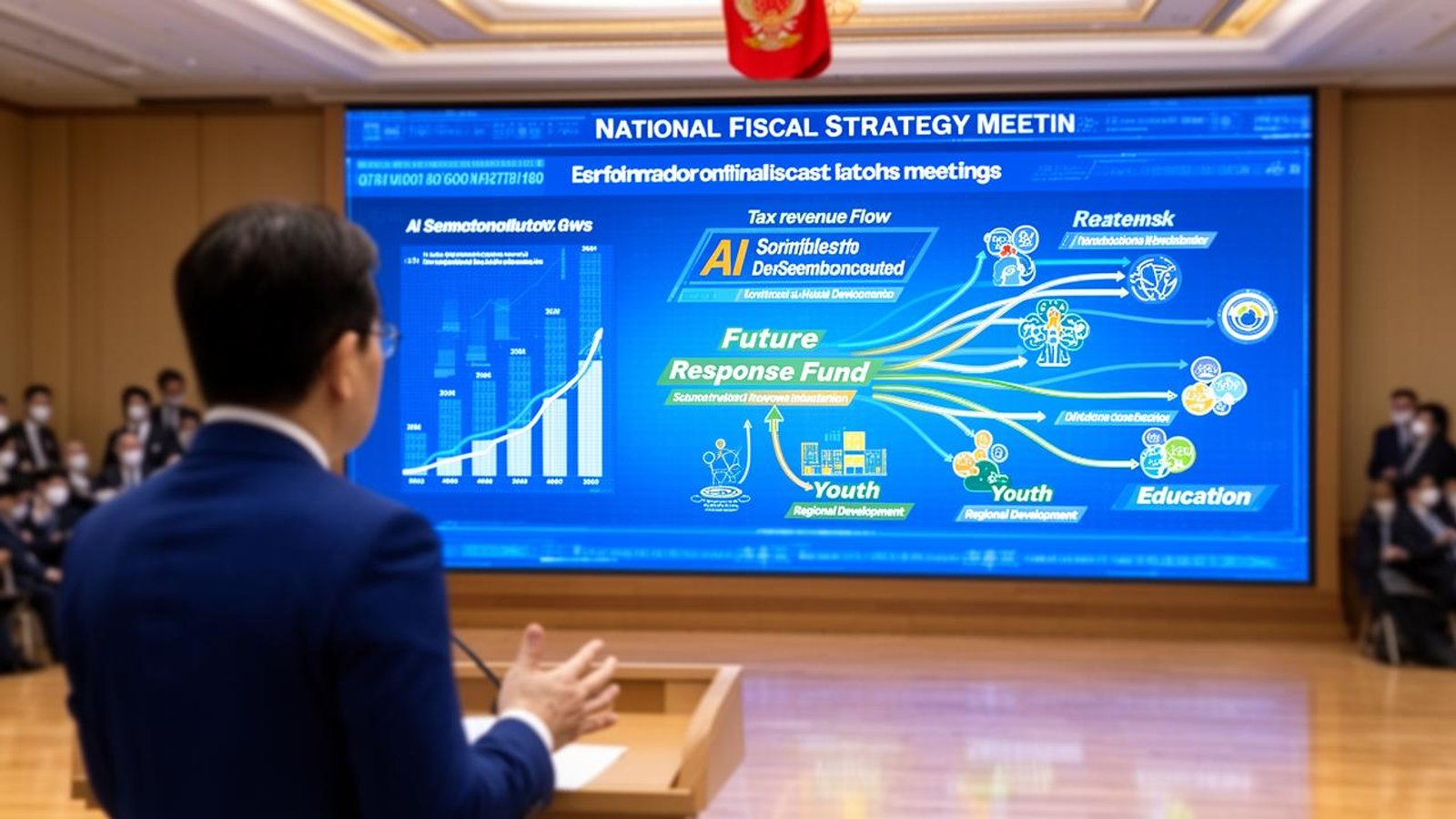
President Lee presided over the 2026 National Fiscal Strategy Meeting at the Blue House’s State Guest House on the afternoon of July 13. “Fueled by the semiconductor mega-boom triggered by the AI revolution, we forecast unprecedented additional tax revenue,” Lee said. “We will utilize this large-scale additional tax revenue as strategic investment resources to prepare for the future.”
The meeting marked President Lee’s first official engagement following his overseas tour and served as a platform to present a concrete blueprint for the Future Response Fund, a plan agreed upon by the Blue House, the government, and the Democratic Party of Korea during a high-level party-government consultation on July 5.
“This additional tax revenue is a precious resource to be deployed during the golden time when global AI hegemony is being decided,” President Lee emphasized. “By establishing the Future Response Fund, we will concentrate investments in four areas that will determine the nation’s future—future industries, youth, regional development, and education—and through this, enhance the economy’s growth potential and return the fruits to all citizens.”
He added, “To achieve this, we need a bold and sustained strategic investment platform that guarantees future investments. The Future Response Fund will perform this function and serve as a springboard for a great leap forward alongside future generations.”
Regarding the fund’s operational approach, Presidential Chief of Staff Kang Hoon-sik previously explained, “We intend to make bold investments in South Korea’s future, including creating future growth engines through support for three mega-projects, addressing K-shaped polarization, and providing housing, startup, and job support for young people in their 20s and 30s.” The fund will be introduced through special legislation.
With the semiconductor super-cycle expected to persist for the foreseeable future, the prevailing view is that tens of trillions of won in additional tax revenue will be generated. In-depth discussions on the fund’s specific scale and sectoral allocation plans reportedly took place during the meeting.
The direction for formulating the 2027 budget was also a key agenda item. “The 2027 budget will be the first budget that our administration draws up entirely on its own from the formulation stage,” President Lee said. “We must carefully incorporate measures that support the bold dream of an irreplaceable South Korea into next year’s budget.”
President Lee made clear his commitment to strengthening the social safety net for young people and non-standard workers. “We will create a South Korea where no one is left behind through shared growth,” he stated. “For young people taking their first steps into society, we will establish a support system that spans their entire lifecycle, from jobs to housing and asset building.”
He further pledged, “We will also strengthen the social safety net to the level of a social safety mat so that non-standard workers, who will inevitably increase in the AI era, are protected without gaps. The government will do its utmost to provide routine support so that all citizens can fully enjoy the benefits of AI technological advancement.”
As for industrial investment strategy, President Lee previewed full-scale government support to ensure the smooth execution of the three mega-projects. “We will mobilize all government capabilities to provide concentrated support so that investments in semiconductors, physical AI, and AI data centers proceed properly according to corporate timelines,” he said.
He added, “Stable supply of essential resources like electricity and water is a given. We will also expand transportation, logistics, and infrastructure, and build settlement conditions including housing, education, healthcare, and culture, along with innovation foundations, to create new growth hubs for South Korea.”
Meanwhile, the meeting also reportedly addressed the contentious issue of reforming the Local Education Fiscal Grant (Education Grant), over which the Ministry of Planning and Budget and the Ministry of Education have been sharply at odds. The core dispute centers on the current structure that automatically allocates 20.79% of internal tax revenue to education grants for elementary, middle, and high school education.
The Ministry of Planning and Budget argues for the need to reform the education grant system based on environmental changes such as the declining school-age population, while the Ministry of Education maintains that the current 20.79% linkage rate must be preserved. Attention is focused on whether the two sides narrowed their differences during the meeting.