Robotics roundup: humanoid, drone, and logistics automation
The article discusses the increasing activity in the robotics sector, highlighting significant developments such as humanoid test centers and the scaling up of drone operations. It emphasizes the rapid acceleration of enterprise robotics deployments across various sectors. Key developments are anticipated in the second half of 2026, impacting areas like humanoid robots and logistics automation.
ANRA Technologies reported this week that its platform now handles more than 55,000 commercial drone operations per month, including over 1,800 beyond-visual-line-of-sight missions every day. That volume, spread across delivery, critical infrastructure, utilities, and public sector work, puts digital airspace management in a different category than it occupied even 12 months ago.
That figure is one of several concrete data points from the past week showing that enterprise robotics deployment is shifting from evaluation to execution. The developments span humanoid robots, autonomous field equipment, inbound logistics, and commercial drone infrastructure.
Humanoid robots move from showcase to application
The Netherlands opened its first Humanoid Application Centre at MICS this week. The centre is designed specifically to bridge the gap between controlled demonstrations and genuine workplace deployment, bringing together robotics vendors, AI developers, and manufacturing industry partners under one roof.
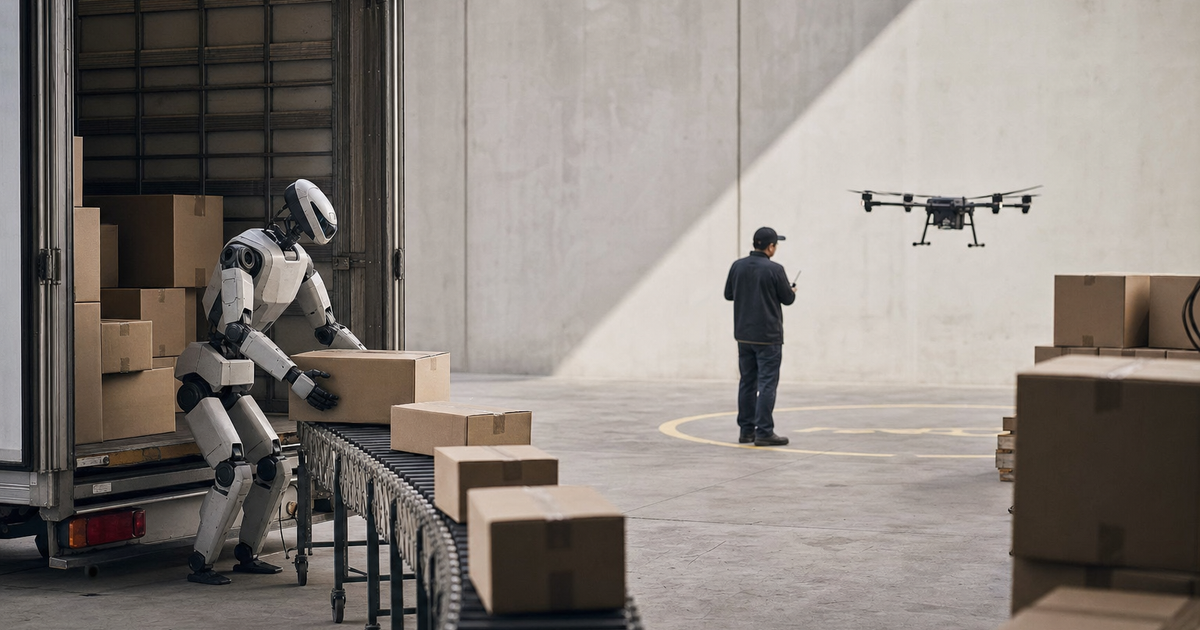
The timing aligns with broader industry momentum. Apptronik is running fleets of its Apollo 2 robots continuously across multiple Robot Park locations and customer sites, collecting real-world operational data to train AI models for future humanoid systems. Google DeepMind is a named partner in that effort. The Robot Park model is notable because it treats commercial deployments as a data generation engine, not just a revenue source.
On the AI training side, Humanoid Inc. published details of its KinetIQ Ascend reinforcement learning approach this week. The system has been validated on bin picking, object handoff to human workers, and bimanual container lifting and transport. Those are exactly the manipulation scenarios that have historically blocked humanoid adoption in manufacturing and warehousing.
Inbound logistics gets its first full-cycle physical AI system
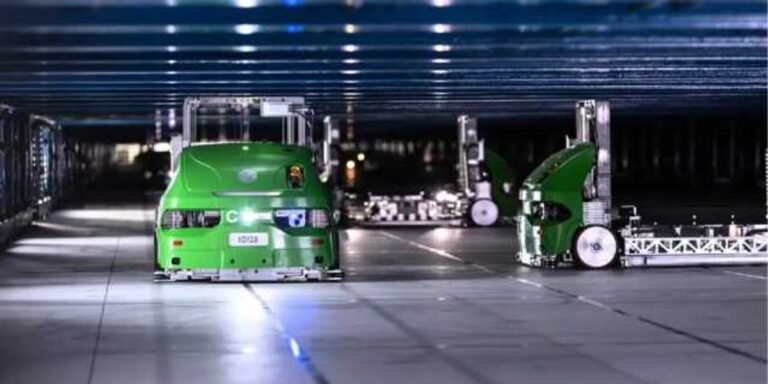
Ambi Robotics and Pickle Robot announced a commercial integration this week that they describe as the first physical-AI solution to fully automate inbound logistics from truck unloading through palletizing. The two specialized robotic systems now operate as a unified workflow, removing the need for human intervention between arrival of a trailer and completion of a pallet.
For distribution center operators, the significance is the end-to-end scope. Point solutions for either unloading or palletizing have existed for several years, but a commercially deployed integration covering the full inbound arc is a different procurement conversation. Operations teams evaluating inbound automation no longer need to architect the handoff between systems themselves.
Cobot programming barriers keep falling
Productive Robotics is bringing its 7-axis OB7 collaborative robot to IMTS this year, with a focus on abrasive machining, sawing, finishing, and gear production. The OB7 is configured for zero programming in a plug-and-play setup, which directly targets the skills gap that has kept smaller manufacturers from deploying cobots. The company is exhibiting at booth 237138 in the north building.
Separately, Electromate introduced the new Kollmorgen Essentials controller with expanded high-voltage drive capability, aimed at machine builders who need scalable motion control without proportionally scaling integration complexity.
Safety certification and sensor hardware catch up to deployment pace
Sonair unveiled the ADAR One, a 3D ultrasonic sensor it says is the world’s first safety-certified sensor of its type for human-robot collaboration. The device is certified for SIL2 and PL d applications and meets the European machine directive requirements for safe human and object detection. Certification at that level matters operationally because it determines whether a robot cell can run without physical guarding, directly affecting floor space, throughput, and capital cost.
InDro Robotics released its Cortex compute and sensor integration module this week. The unit weighs 679 grams, measures 11 by 14 by 10 centimeters, supports 5G data transmission with near-zero lag, and is designed to mount on virtually any robotic platform or framework. Platform-agnostic compute at that form factor addresses a persistent integration bottleneck for organizations managing mixed robot fleets.
Autonomous field equipment reaches full integration in agriculture
Sabanto and Verdant Robotics announced a technical integration that combines autonomous tractor navigation with Verdant’s SharpShooter plant-level precision application system. The two platforms now operate as a single solution, enabling fully autonomous field work from field navigation through individual plant treatment without an operator in the cab. For agricultural operations teams, this removes the last manual step that previously required a human touchpoint between passes.
Industry leadership and recognition
Jane Heffner was named the new president of the International Federation of Robotics this week, with Adrien Brouillard appointed as vice president. At the market level, Denmark’s Mobile Robot Company won the IFOY Industrial Truck of the Year Award 2026 for a self-driving pallet jack designed to automate repetitive warehouse transport while keeping human operators in supervisory control. The IFOY award is an independently judged evaluation, making it a useful reference point for procurement teams shortlisting autonomous mobile robot vendors.
Mouser Electronics received more than 25 distributor-of-the-year awards from manufacturer partners for its 2025 performance, a recognition that carries supply chain relevance for engineering teams sourcing components for automation builds.
What this means for your team
- If you are evaluating humanoid robots, the MICS application centre in the Netherlands now offers a structured environment to test systems in production-representative conditions rather than vendor-controlled demos.
- Inbound logistics teams should request a reference visit or case data from the Ambi Robotics and Pickle Robot integration before finalizing point-solution procurement, given the full-cycle scope now available commercially.
- Operations teams running mixed robot fleets should assess whether a platform-agnostic compute module like InDro Cortex can reduce the integration overhead currently sitting on their engineering teams.
- For any robot cell requiring SIL2 or PL d safety certification, Sonair’s ADAR One is now a citable option that may eliminate the need for physical guarding, with direct implications for floor space planning and throughput modeling.