Astronomers may have just found a first-of-its-kind phenomenon buried in the shadow of one of the Milky Way‘s most famous stellar explosions: two stars that died in separate supernovas, after spending millions of years orbiting each other.
Using 16 years of data from NASA’s Fermi Gamma-ray Space Telescope, researchers detected high-energy gamma rays coming from a faint, previously overlooked supernova remnant called G189.6+3.3, which sits right beside the well-studied remnant IC 443 (nicknamed the Jellyfish Nebula). Their analysis suggests that the two remnants aren’t just neighbors by coincidence. Instead, they may be the leftover wreckage of a binary star system, making this the first confirmed case of two supernova remnants traced to the same stellar pair.
“We weren’t really looking for a binary supernova remnant,” study first author Miltiadis Michailidis, an astrophysicist and postdoctoral fellow at Stanford University, told Live Science. The team originally set out to characterize G189.6+3.3, which had long been overshadowed by its brighter neighbor. IC 443 is one of the best-studied remnants in the galaxy and among the first ever confirmed to accelerate protons — one of the key ingredients thought to produce cosmic rays, the high-energy particles that constantly strike Earth’s atmosphere.
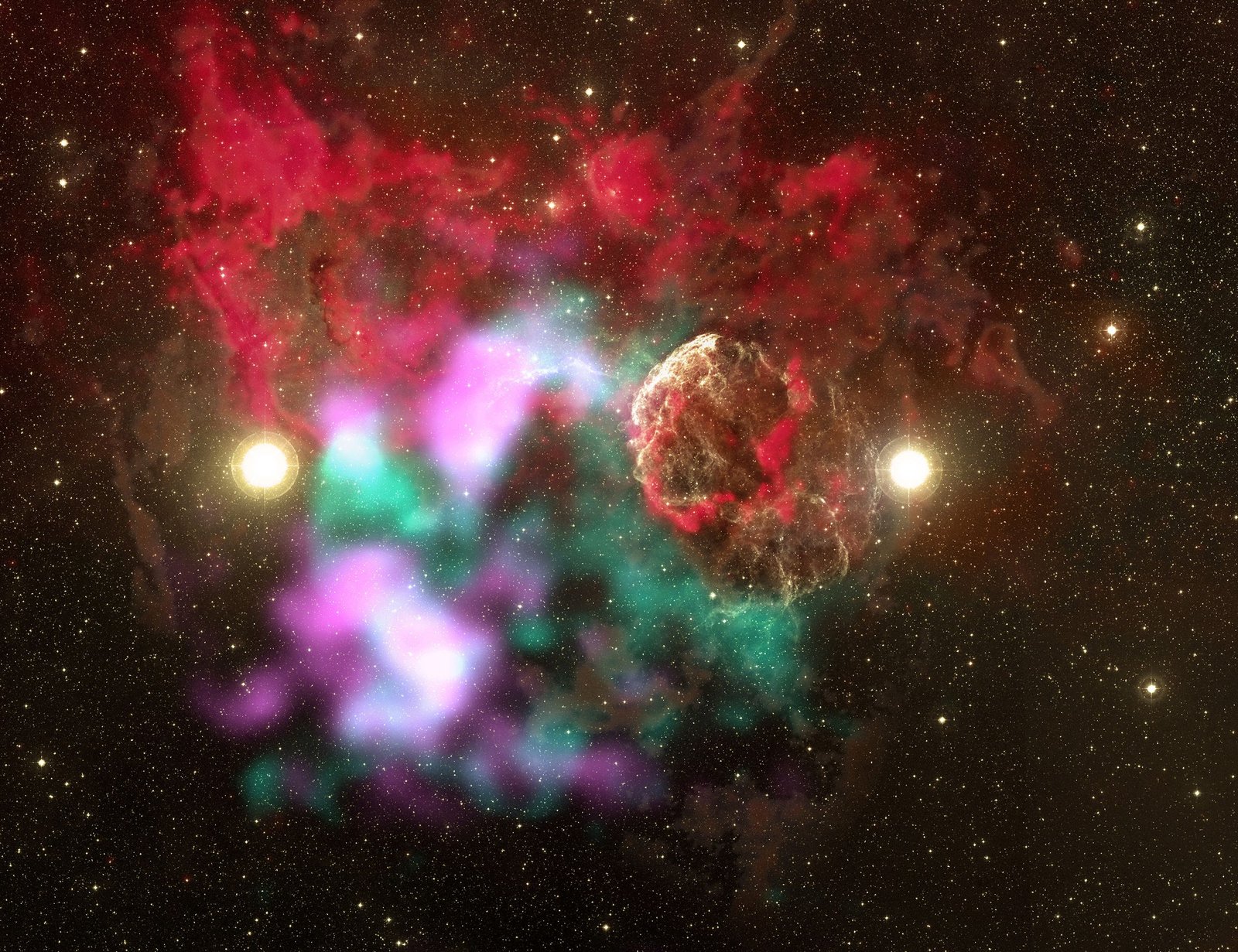
By combining Fermi’s gamma-ray data with X-ray, radio, ultraviolet and optical observations, the team teased out G189.6+3.3’s faint signal and found something strange: Instead of glowing uniformly, its northern half was dominated by accelerated protons, while its southern half was dominated by electrons. It’s the first time such a clean split has been spotted within a single remnant.
The explanation, they found, came down to the environment: The northern edge of the remnant presses against a dense cloud of hydrogen gas, which gives fast-moving protons something to collide with, thereby producing gamma rays, Michailidis said. The southern half lacks that dense material, letting a different, electron-driven process take over instead. Ultraviolet observations showed that the northern shock wave had slowed after slamming into the cloud, backing up that interpretation.
A dense cloud of hydrogen gas helped astronomers uncover clues that two neighboring supernova remnants may share the same origin.
(Image credit: M. Michailidis et al. 2026)
Earlier work had already shown that IC 443 interacts with the same cloud, which implies that both remnants sit at roughly the same distance from Earth. To rule out coincidence, the researchers simulated 1 million hypothetical binary star systems and calculated how often two unrelated remnants would wind up this close together purely by chance. Depending on the method used, the odds came out to somewhere between 1 in 1,000 and 1 in 100. In other words, it’s highly likely that the two supernova remnants are related.
Get the world’s most fascinating discoveries delivered straight to your inbox.
The team also estimated when each star likely exploded, finding that the two blasts were probably separated by tens of thousands of years. That finding is consistent with one star in a binary pair going supernova first, with its companion following suit long afterward.
Rather than relying purely on computer models, astronomers can use this real-world system to test long-standing theories about how massive binary stars live, interact and eventually explode.
Michailidis said the team’s next step is to search for similar binary remnant pairs elsewhere in the galaxy, to understand why this system has stood alone until now. He pointed to one particular payoff: Measuring the distance between two remnants’ explosion centers can reveal how much energy a supernova actually released — a quantity that, until now, astronomers could only estimate from theory. “Now we can actually test it,” he said.
Michailidis, M., Lemoine-Goumard, M., Willcox, R., Gabici, S., Di Lalla, N., & Omodei, N. (2026). Shared cloud interactions unveil a candidate binary-system supernova pair with no known analogue. Nature Communications, 17(1). https://doi.org/10.1038/s41467-026-74978-x
Nearly 30 years ago, researchers discovered two unusual molecules in rye pollen that appeared to slow tumor growth in animal studies. Despite the promising findings, the research reached a dead end because scientists could not determine the molecules’ exact three dimensional structures. Now, chemists at Northwestern University have solved that long standing mystery. By constructing…
The diarrhoea-causing parasite Cyclospora cayetanensis reproduces through egg-like structures called oocysts (stained orange in this microscope image).Credit: CDC/DPDx – Melanie Moser A microscopic parasite found in contaminated food products is ruining summer meals across the United States in the largest outbreak of its kind in the country’s history. And health officials have yet to identify…
NASA has successfully completed the primary phase of an experimental communications mission designed to help spacecraft connect through multiple satellite networks. Following the achievement of its core goals, the agency is extending the project to explore new partnerships and demonstrate additional capabilities through April 2027. Known as the Polylingual Experimental Terminal (PExT), the technology is…
Nitrogen is essential for every known form of life on Earth. Now, scientists say this common element may also help explain how the earliest life evolved on our planet and how life could develop elsewhere in the universe. “All living organisms need nitrogen to survive and, though it’s all around us, we can’t access it…
Peak star formation took place during the Cosmic Noon between two to three billion years after the Big Bang. The star formation rate (SFR) back then was up to 100 times greater than it is today. For the SFR to be so high, gas had to move through galaxies efficiently. Astronomers have struggled with this…