SETI Expands the Search for Alien Signals — Have We Been Listening to the Wrong Radio Channel?

Staring into the starry night sky convinces many of us that we can’t be alone in this universe. So far, astronomers have been looking for alien signals in a specific part of the radio spectrum, which seemed the most likely frequency other intelligent life forms would want to communicate through. But now they’re wondering: Have we not heard from aliens yet because we were listening to the wrong channel all along?
A new study led by a researcher from the University of Manchester and presented at the Royal Astronomical Society’s National Astronomy Meeting before being published as a paper proposes expanding the search to higher radio frequencies for technological signals (radio signals that are unlikely to occur naturally and may instead indicate advanced technology) from non-human civilizations.
While initial trials exploring different, largely unexplored frequencies did not detect any signals in this study, future Search for Extraterrestrial Intelligence (SETI) surveys may now investigate a broader stretch of the radio spectrum. Moreover, changing the strategy has also helped scientists better understand where they’ve already looked for signals and where to focus next.
“For decades, SETI searches have concentrated on a relatively small part of the radio spectrum. We wanted to ask what might happen if we looked somewhere very different,” said Astronomer Louisa Mason, a researcher at the University of Manchester, in a press statement.
Water Tells Astronomers Which Radio Frequencies to Tune Into
According to Britannica, natural radio sources, such as stars, gas clouds, and pulsars, typically emit radio waves across a broad range of frequencies rather than one razor-thin channel. For SETI, astronomers are usually looking for signals that have properties nature rarely produces, like extremely narrow radio transmissions, signals concentrated at one precise frequency, or those that repeat in a deliberate way.
But why radio in the first place? SETI says because radio waves come with several advantages compared to other forms of light, like gamma rays, X-rays, or infrared. They can be produced relatively easily, travel enormous distances, and pass through Earth’s atmosphere.
To narrow down the search, since the whole radio spectrum is enormous, most radio SETI surveys have focused on the “water hole” range. Located between frequencies of 1.42 and 1.66 GHz, this relatively quiet part of the radio spectrum lies between the natural radio emissions of hydrogen and hydroxyl, whose combination forms water.
Scientists made an educated guess that this region could serve as a natural meeting place because a technologically advanced civilization might recognize the importance of water and choose to communicate near those frequencies.
Read More: Unexplainable Radio Waves Under Antarctica’s Ice Defy the Laws of Particle Physics
Changing Frequencies Opens New Territory in the Search for Alien Signals
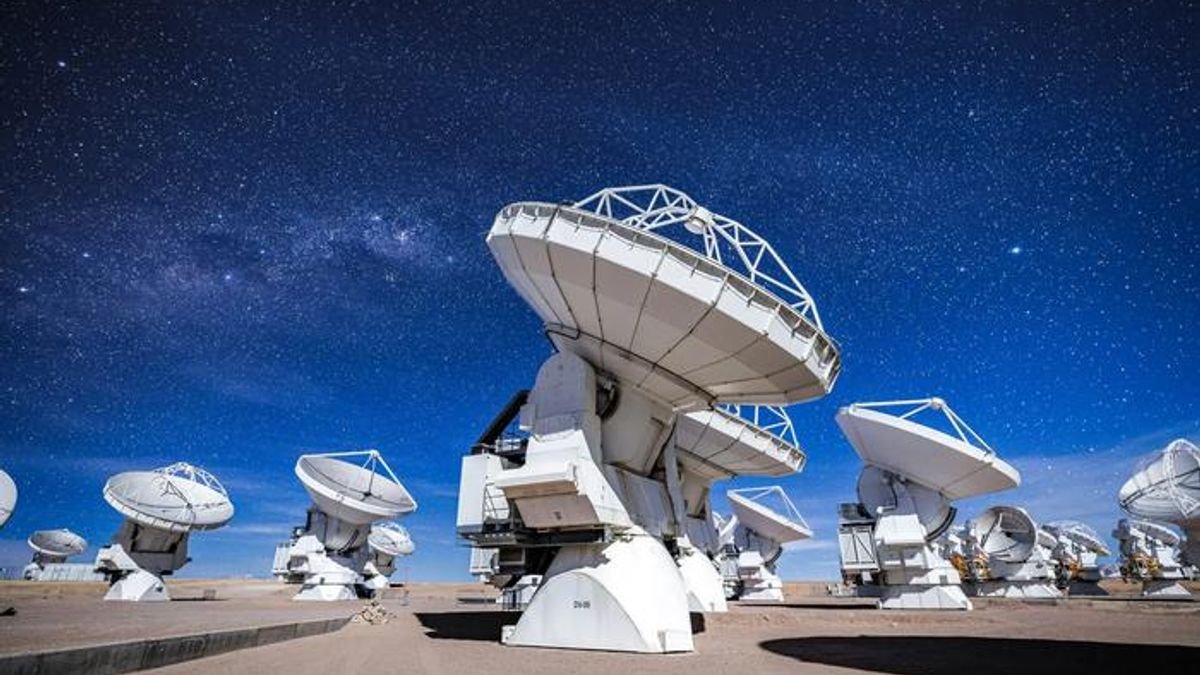
The Atacama Large Millimeter/submillimeter Array (ALMA) in Chile wasn’t built to look for aliens. Instead, it studies things like star formation, galaxies, dust clouds, and planets. Every time ALMA observes one of these objects, it records radio data.
Mason realized those archived observations could also be searched for technosignatures rather than natural astrophysical processes. According to their website, ALMA was built to observe millimeter and submillimeter radio waves, which occupy a much higher part of the radio spectrum than the traditional water hole frequencies.
“The millimetre and submillimetre radio bands remain almost completely unexplored for SETI, so this is really about opening up a new area of parameter space to search,” said Mason in the release.
So far, Mason has analyzed only four archived ALMA observations without detecting any candidate technosignatures, but she emphasized how important this new approach could be for future SETI programs.
Understanding Where We’ve Already Looked and Where To Search Next
Whenever a radio telescope points at one star, galaxy, or other target, it inevitably “sees” everything else within its field of view. The “everything else” in this context is also called “stellar bycatch.” Besides proposing to expand the search into other radio frequencies, Mason also argues we’ve been underestimating how many stars were included in previous SETI surveys.
Instead of relying on existing star catalogues, she used the Besançon Galactic Model, a simulation of the Milky Way, to better estimate how much searching humanity has already done. Using this new approach, she increased the estimated number of stars included in one previous SETI survey from about 288,000 to more than 6 million.
“One of the most exciting things about this work is [realizing] that we’ve surveyed many more stars than initially thought,” she said. “Even a very small observation can contain a huge number and diversity of stars that we might never have intended to study. By combining high-frequency observations with galactic simulations, we can better understand exactly what we’ve searched and where we should look next.”
Read More: Deep-Sea Volcanoes Could Hold the Key to Finding Alien Life in Space
Article Sources
Our writers at Discovermagazine.com use peer-reviewed studies and high-quality sources for our articles, and our editors review for scientific accuracy and editorial standards. Review the sources used below for this article: