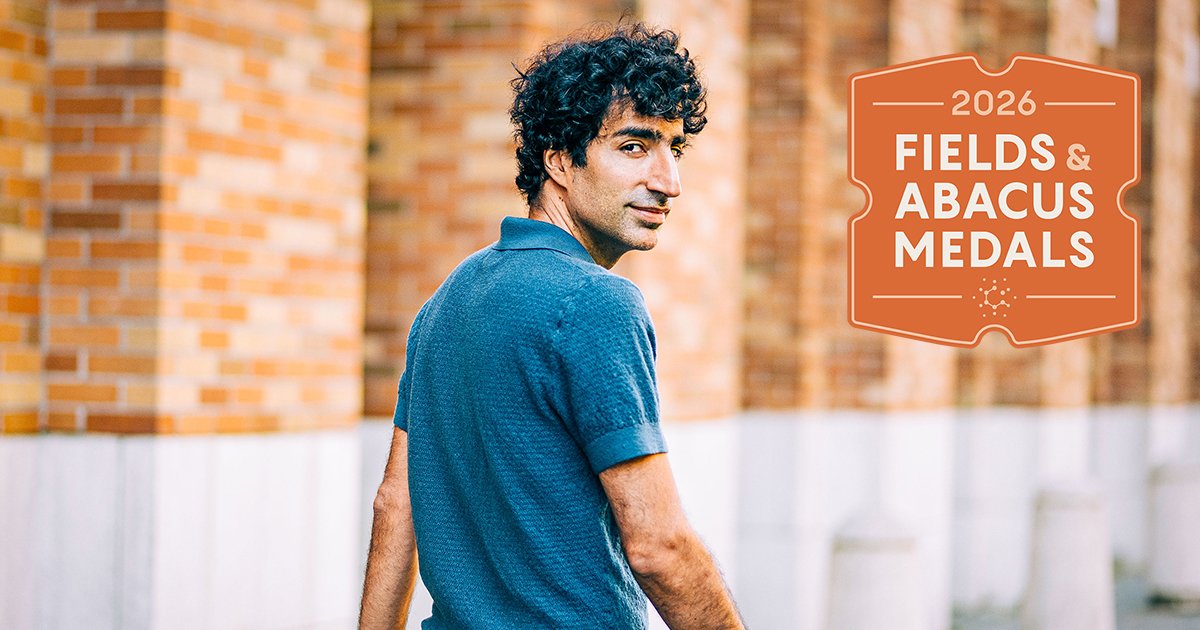
Shayan Oveis Gharan Wins 2026 IMU Abacus Medal
Researchers who draw connections between disparate fields often cultivate their breadth of knowledge at the expense of deep engagement with any one subject. But not Oveis Gharan. For all his restless energy, he has the patience to sit with hard problems for years and attend to every technical detail of a long and complex proof.
“Shayan can kind of do it all,” said Jonathan Leake, a mathematician at the University of Waterloo who collaborates with Oveis Gharan. “I don’t know how he does it, honestly.”
Restless Optimism
Oveis Gharan’s chosen field of theoretical computer science centers on understanding algorithms, the mathematical procedures that computers use to accomplish specific tasks. Some researchers seek to map the limits of computation, by identifying problems that are too hard for even the cleverest algorithms. Others aim to push the boundaries of what algorithms can do. Oveis Gharan, an optimist at heart, falls squarely in the latter group.
“I’m on the positive side,” he said. “I like to say things are possible.”
Oveis Gharan is slender and sprightly, with unruly black hair and an irrepressible smile. His enthusiasm for his work is palpable, even infectious. “He’s incredibly fun to work with,” Karlin said. “He’s a believer that you can make progress.”
Recent events outside mathematics have tested Oveis Gharan’s characteristic optimism. In the past 12 months alone, his fellow Iranians have endured a violent crackdown on protests by their government; a raft of punitive economic sanctions imposed by the United States, the European Union, and the United Nations; and airstrikes by the U.S. and Israel whose targets included Sharif University of Technology in Tehran, Iran’s leading science and engineering school and Oveis Gharan’s alma mater.
“I see a lot of my old friends and family members suffering,” he said. “It gets hard to work.”
Oveis Gharan was born in the historic city of Isfahan in 1986 during another difficult time in his country’s history — the eight-year war with Iraq. His father was a civil engineer, and his mother, Fatemeh Khoei, was a middle-school biology teacher who earlier in life had reluctantly set aside her aspirations to study mathematics.
“At the time she was growing up, the culture was ‘girls should not get into math,’” Oveis Gharan said. “She didn’t have the opportunity.”
Instead, Khoei pushed her children to excel academically. Shayan was the youngest of five. He grew up watching his siblings, who range in age from six to 13 years older than he is, studying math, science, and medicine. As a boy, he was shy but had a competitive streak, and he was eager to prove that he could match his talented siblings’ accomplishments. “He was always comparing himself with older kids,” Khoei said in Farsi as her daughter Shadi translated.