Shipwrecks of Shackleton and Scott recreated in 3D digital form after deep sea expedition | Science
Moments after devouring the final glimmers of light, the seafloor offered nothing but darkness and silt. Then the bow appeared.
More than 1,000ft (305 metres) below the surface of the Labrador Sea, off the coast of Canada, the skeleton of the final ship used by the famed polar explorer Ernest Shackleton appeared in its silty grave.
“To see a very large ship in the abyss, and to realise you are among the first humans to see it, and to realise that it is largely intact is a powerful experience,” said John Geiger, the head of the Royal Canadian Geographical Society (RCGS). “It moves you.”
Days later, Geiger was again inside the Alvin, the first submersible to take people to the Titanic shipwreck four decades prior, staring at the remains of the Terra Nova – the ship used by Robert Falcon Scott on his ill-fated Antarctic expedition.
An expedition to the two ships began in early July, funded by the RCGS, and has now released what the team hopes will define future expeditions to the fringes of the planet: highly detailed 3D “digital twins” of the wrecks.
Geiger, the expedition leader, said the project represented a “golden era for shipwreck hunting and investigating” as technological leaps allowed researchers to better map and model the final resting sites of the famed ships.
The 21-day expedition left Woods Hole Oceanographic Institution in Massachusetts on 2 July and for two weeks has been attempting to digitally preserve the final ships of Britain’s most acclaimed polar explorers.
Shackleton was among the titans of an era historians often refer to as the “heroic age” of Antarctic exploration, one defined by obsession and hubris. His 1914 exploration trip to the Antarctic region on the Endurance ended after his ship was trapped in the ice and eventually crushed. The crew survived on ice floes, then made their way to Elephant Island, off the east coast of Antarctica. Over repeated trips that took months, Shackleton ensured his entire team survived.
In 1922, at 47, he died of a heart attack while on Quest, the ship he had outfitted to explore Canada’s high Arctic. The Quest later sank in 1962 and wasn’t discovered until 2024, in an expedition also led by Geiger.
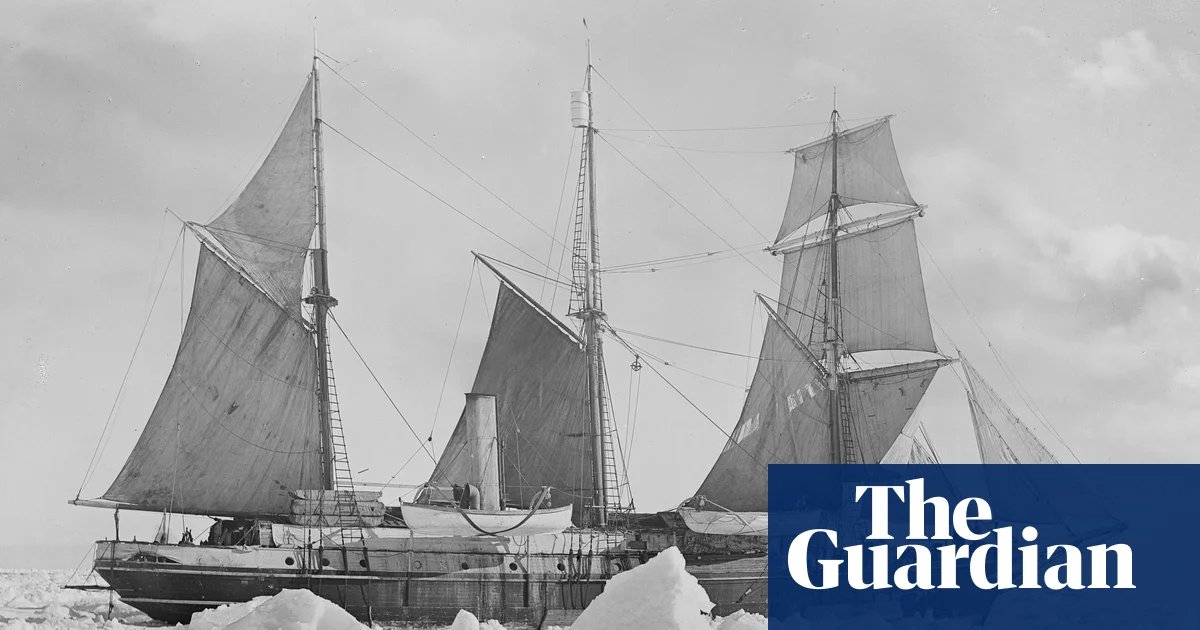
The Terra Nova, a wooden-hulled three-masted ship, carried Scott and his crew in their 1910 bid to be the first people to reach the south pole. Scott reached it on 17 January 1912, only to learn that the Norwegian explorer Roald Amundsen had beaten him by a month. Scott and all four members of his south polar party died on the return journey. The Terra Nova carried news of their deaths to the world and was later used in the Newfoundland seal fishery before sinking in 1943.
The RCGS team used underwater imaging technology developed by the Canadian company Voyis to build detailed, three-dimensional models of the wrecks, in the knowledge that the Terra Nova and the Quest will one day be fully reclaimed by the ocean.
“We’re scanning these wrecks and collecting thousands of high-resolution 3D images that are then kind of knitted together on the spot. We’re seeing these ships magically appear through this process in front of us on the screen,” said Geiger. “It’s just mind-boggling.”
While Shackleton suffered his heart attack on the Quest, neither ship experienced casualties prior to sinking – meaning there were no large, unsolved mysteries surrounding their fates. Instead, for this expedition, Geiger said the aim was to inspire a new generation of explorers.
“There’s so little of the ocean that’s mapped,” he said. “The territorial waters of Canada are largely unmapped in the Arctic. There’s so little we know and I’m staggered at the ignorance we have about the oceans and about ocean life.”
He said marine biologists were “over the moon” about the chance to learn more about the wildlife living around the wrecks and the forces of nature reclaiming the wood hulls. The crews also saw first-hand the effects of deep-sea fishing trawlers: heavy, weighted nets partly covering the wrecks.
Recent advances in submersible technology promise to reveal new frontiers in exploration. Five years ago, the Alvin was approved to extend the depths it could safely explore, from 14,700ft to 21,300ft.
“This opens up a lot of new territory for us,” said Benen ElShakhs, the pilot for the trip to Terra Nova. “Most of what we do is scientific research, and so staring at a wood ship from over 100 years ago that was in Antarctica, that now sits more than 500 below the surface, is a wild experience. If there wasn’t a titanium hull and a lot of sea water [between the Alvin and the wreck], you feel like you could just reach out and touch it.”
Geiger said although the expedition relied on the tools of modern explorers, it was driven by the age-old human experience of pushing towards the unknown.
“Future expeditions will surely use robots and automated vehicles. But I don’t think we can ever abandon, when possible, the human role in exploration. Because what is lost is poetry, romance and wonder. Those are not the characteristics of machines. They are the uniquely human threads that connect us to the past – and what push us forward.”