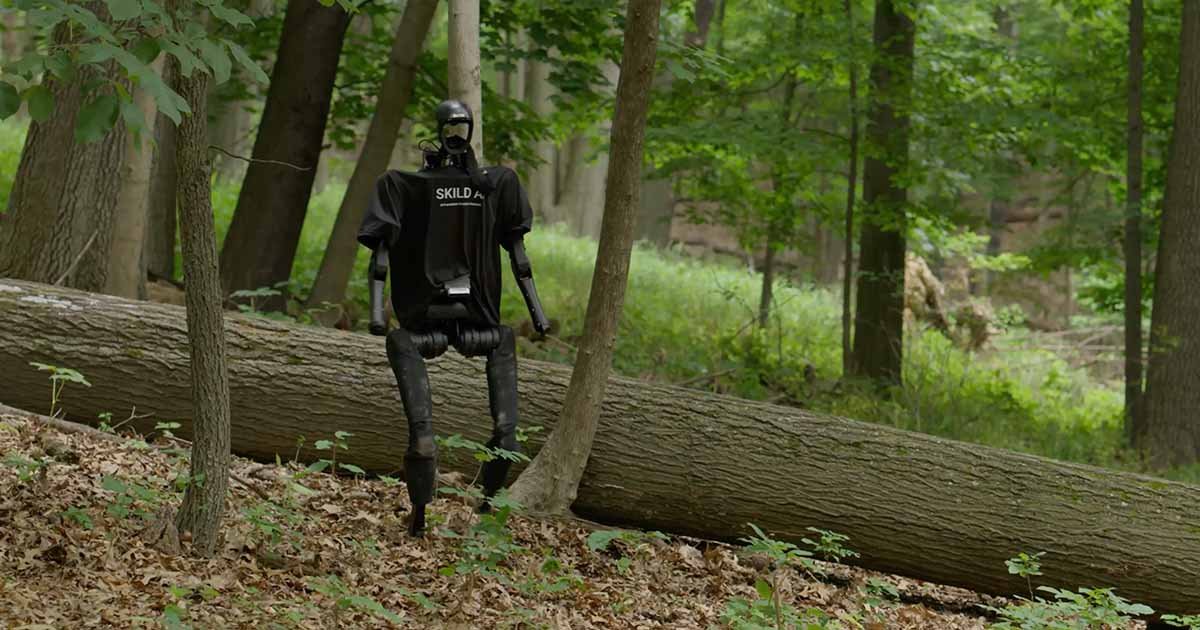
Skild AI Builds Omni-Bodied Robot Brain With NVIDIA
Skild AI uses Isaac Lab to create the simulation training scenarios necessary for reinforcement learning development of robots across challenging conditions. The company leverages Cosmos Transfer to augment training datasets with environmental variations, expanding the scope and robustness of neural training data. This multi-pronged simulation approach enables Skild AI to acquire a millennium of experience within days, making large-scale robotic training feasible at unprecedented speed.
Skild AI created massive-scale simulations with thousands of robot instances across multiple embodiments—including humanoids, quadrupeds, and robotic arms—each with distinct morphologies and deployed across thousands of environments to maximize generalization. This synthetic data generation training powers an omni-bodied brain, preventing the AI model from memorizing solutions for specific hardware configurations and instead forcing it to develop in-context learning strategies that work universally across all robot types.
Synthetic data generation through advanced simulation represents a core pillar of Skild AI’s technology stack. The company generates billions of training examples through physics-based simulation, enabling robots to experience failure scenarios safely and extensively.
This is essential because robots have countless ways to fail compared to the limited ways they can succeed, making it impossible to capture all failure scenarios through traditional data collection. With Cosmos Transfer, Skild AI is able to augment and multiply datasets via text prompts, generating varied environmental conditions, lighting scenarios, and visual features to maximize training robustness. Simulation allows robots to experience millions of failures in diverse environments safely before mastering the correct approach, building the robustness needed for real-world deployment.
The model demonstrates remarkable adaptability to mechanical changes, recovering from jammed wheels within 2–3 seconds and broken legs after several attempts rather than experiencing failure. This resilience extends to extreme scenarios, including walking on stilts with extended leg-to-body ratios that exceed training parameters, and is a form of zero-shot learning that showcases true generalization capabilities.
The second key part is learning from human videos. To capture the diversity of the real world, Skild AI leverages the trillions of videos available online showing humans performing various tasks across platforms. By treating humans as biological robots, the company developed advanced techniques to extract affordances—helping the robot brain understand how objects should be manipulated by observing human interactions.
NVIDIA’s AI computing infrastructure powers the massive computational requirements for training robotics foundation models across multiple data modalities simultaneously. Together, NVIDIA’s accelerated computing and simulation libraries and frameworks create the foundational infrastructure that enables Skild AI to achieve breakthrough results with cost-effective hardware, developing robots that cost $4,000–$15,000 compared to traditional robotic systems that require $250,000+ investments.





![Better webcam composites without a green screen! [OpenAI Build Week]](https://jobssz.com/wp-content/uploads/2026/07/IFzSH0ZZkDtLlEORpGZNdXEqj-5TN3nFEoDbBXwxpuk.jpeg)