SKKU-led Team Identifies ‘Zinc Oxide Spin Qubit’ — A Semiconductor-Based Quantum Technology
Insider Brief
- Researchers from Sungkyunkwan University, the University of Wisconsin–Madison, and the University of Washington identified a molybdenum–oxygen-vacancy defect in zinc oxide that theoretical simulations indicate could serve as a high-performance spin qubit for quantum computing, communications, and sensing.
- The proposed defect combines bright visible-light emission, a low Huang-Rhys factor, and an estimated spin coherence time of about 4 milliseconds, properties that support efficient quantum light generation and high-fidelity single-shot spin readout.
- Because zinc oxide is a well-established semiconductor material compatible with existing crystal growth and fabrication techniques, the researchers suggest the defect could provide a scalable platform for integrated quantum devices if experimentally realized.
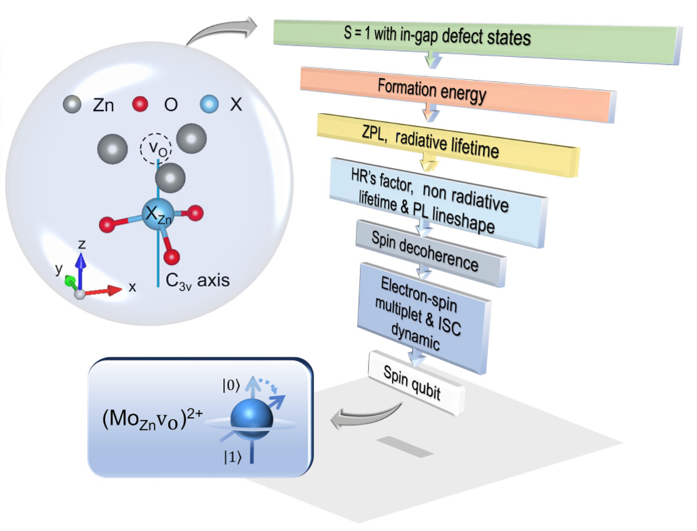
- Image: Schematic diagram illustrating the design process of a point-defect spin qubit in a zinc oxide semiconductor. (PRX Quantum 7, 020348 – Published 3 June, 2026, DOI: https://doi.org/10.1103/v3fp-821b)
PRESS RELEASE — A research team led by SKKU Professor Hosung Seo of the Department of Quantum Information Engineering and the SKKU Advanced Institute of Nanotechnology, working with the University of Wisconsin–Madison and the University of Washington, has identified—for the first time—an atomic defect structure in the zinc oxide (ZnO) semiconductor with outstanding properties for use as a “spin qubit,” a core building block of future quantum computers, quantum communications, and quantum sensors. The results were published in PRX Quantum, one of the most prestigious journals in quantum information science.
Electron spins trapped at point defects in solid-state crystals can operate at room temperature and retain quantum information for long periods, making them a leading platform not only for quantum computing but also for quantum communications and ultra-sensitive quantum sensing. The nitrogen-vacancy (NV) center in diamond has been the most prominent candidate, but diamond is difficult to grow as large-area, high-quality crystals and is poorly suited to standard semiconductor fabrication, posing major obstacles to the integration and mass production of quantum devices.
To overcome this bottleneck, the team turned to zinc oxide, a material already widely used in the semiconductor industry and whose physical properties are well established. Zinc oxide is considered an ideal host for qubits: it is “magnetically quiet,” containing almost no nuclear spins, and can be grown as ultra-high-purity crystals. Using state-of-the-art first-principles quantum simulations on supercomputers, the team systematically screened candidate defects across the periodic table and designed a “molybdenum–oxygen-vacancy complex,” in which a molybdenum (Mo) atom replaces a zinc (Zn) atom next to a missing oxygen atom, and analyzed its properties in detail.
The analysis showed that, under illumination, the defect emits bright, sharp light in the visible range with high efficiency. Notably, its Huang-Rhys factor—a measure of how much energy leaks into crystal vibrations during light emission—is far smaller than that of previously known defects in zinc oxide, confirming that the defect can produce the sharp, well-defined emission ideally suited for quantum light sources.
The team further showed that the defect’s electron spin can stably retain quantum information for about 4 milliseconds (4/1,000 of a second) even in the presence of surrounding magnetic noise. Combined with strong spin-orbit coupling and a stable, symmetric structure, these properties enable high-fidelity “single-shot readout”—determining the spin state accurately in a single measurement—as the team demonstrated theoretically. Single-shot readout is an essential capability for quantum error correction and quantum networks.
Professor Hosung Seo said, “This work is the first to show that a robust, deep-level spin qubit is feasible in zinc oxide, a representative oxide semiconductor. Combined with mature oxide-semiconductor growth and fabrication technologies, it could develop into an integrated, scalable platform for quantum light sources, quantum sensors, and quantum networks.”
Taejoon Park, a Ph.D. candidate at SKKU, participated as a co-first author together with researchers at the University of Wisconsin–Madison. Professor Hosung Seo served as a co-corresponding author with Professor Kai-Mei C. Fu of the University of Washington and Professor Yuan Ping of the University of Wisconsin–Madison.