Smashed Ice Worlds Formed Neptune’s Inner Moons and Rings
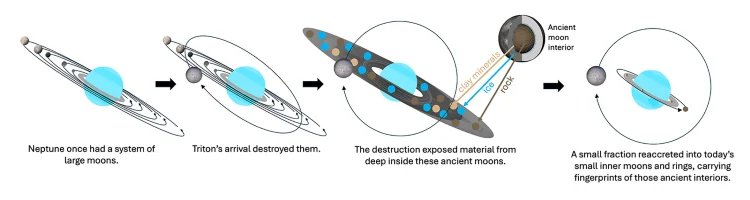
The planet Neptune has 16 known moons, with its largest Moon, Triton, comprising more than 99.5 percent of the mass of all of them. Triton’s incredible size has led scientists to hypothesize it was a captured object originating from the Kuiper Belt, which wreaked havoc on Neptune’s original moon system upon its capture and subsequential elliptical orbit. Today, some remnants of these original moons are part of the dusty rings that orbit Neptune. But what did that original moon system consist of? Were they the same small worlds observed today or are they pieces of what was once much larger worlds?
Now, a team of researchers led by the California Institute of Technology (Caltech) might be one step closer to answering this conundrum as they investigated the potential origin of Neptune’s rings and three of its smaller moons: Proteus, Larissa, and Galatea, whose diameters are about 420 kilometers (261 miles), 194 kilometers (120 miles), and 175 kilometers (109 miles), respectively. For context, Triton’s diameter is about 2,705 kilometers (1,681 miles). The findings for this study were recently published in Science Advances and hold the potential to help scientists better understand the origins of not just Neptune’s moons but other outer solar system moons.
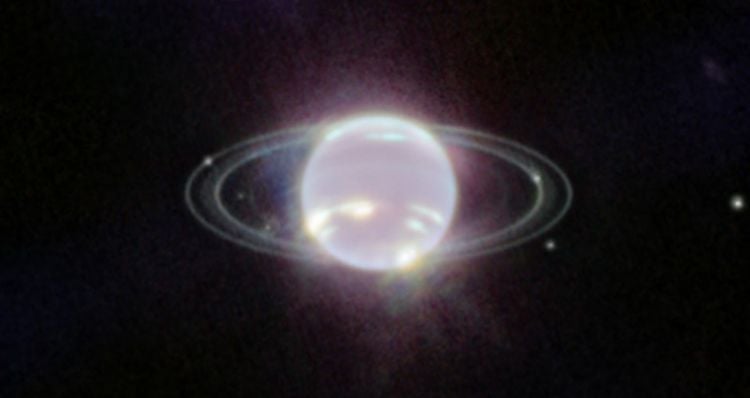
Image of Neptune, its rings, and several inner moons, taken by the Near-Infrared Spectrograph (NIRSpec) instrument onboard NASA’s James Webb Space Telescope. (Credit: Image: NASA, ESA, CSA, STScI; Image Processing: Joseph DePasquale (STScI), Naomi Rowe-Gurney (NASA-GSFC))
Using the Near-Infrared Spectrograph (NIRSpec) instrument onboard NASA’s James Webb Space Telescope, the researchers identified that all three moons and the rings don’t possess water ice. This contrasts outer solar system objects given the enormous distance from the Sun, thus indicating a different potential origin rather than starting as they are. Additionally, two of the moons (Larissa and Galatea) and the rings were identified to have water-rich clay minerals with magnesium, indicating a different origin, too.
In the end, the researchers concluded that all three moons and the rings originated as interiors of larger moons, and possibly a dwarf planet, that were ripped apart when Triton was captured by Neptune long ago. Afterwards, this material clumped together (known as accretion) to form today’s moons and rings. The team also concluded that Proteus not containing the water-rich clay minerals with magnesium indicates the small moon formed from a different part of the debris disk.
“If Neptune once had a system of moons that looked something like what we see at Uranus today, we expect it would’ve been completely destroyed by the process of Triton getting captured,” said Dr. Ryleigh Davis, who completed his PhD at Caltech in 2026 and is lead author of the study. “This is exciting new evidence that something catastrophic happened at Neptune that completely destroyed its original satellites, and we’re getting to see the fingerprints left behind by that process.”
Neptune was first discovered in September 1846 with Triton being discovered only one month later. It then took more than 100 years until the next Neptunian moon was discovered, which was Nereid in 1949. This was followed by Larissa in 1981, whose discovery was confirmed by NASA’s Voyager 2 during its historic flyby in 1989. During this same flyby, Voyager found five additional moons (Naiad, Thalassa, Despina, Galatea, and Proteus), but the official records note the spacecraft found six new moons with Larissa’s confirmation. The year 2002 marked another leap in discovering new Neptunian moons, as five additional moons were discovered (Halimede, Sao, Laomedeia, Neso, and S/2002 N 5). The moon, Psamathe, was discovered in 2003, followed by Hippocamp in 2013, and finally S/2021 N 1 was discovered in 2021.
What new insight into the history of Neptune’s moons will researchers make in the coming years and decades? Only time will tell, and this is why we science!
As always, keep doing science & keep looking up!