Soft Robotics Market Size to Exceed $32.87 Billion By 2035
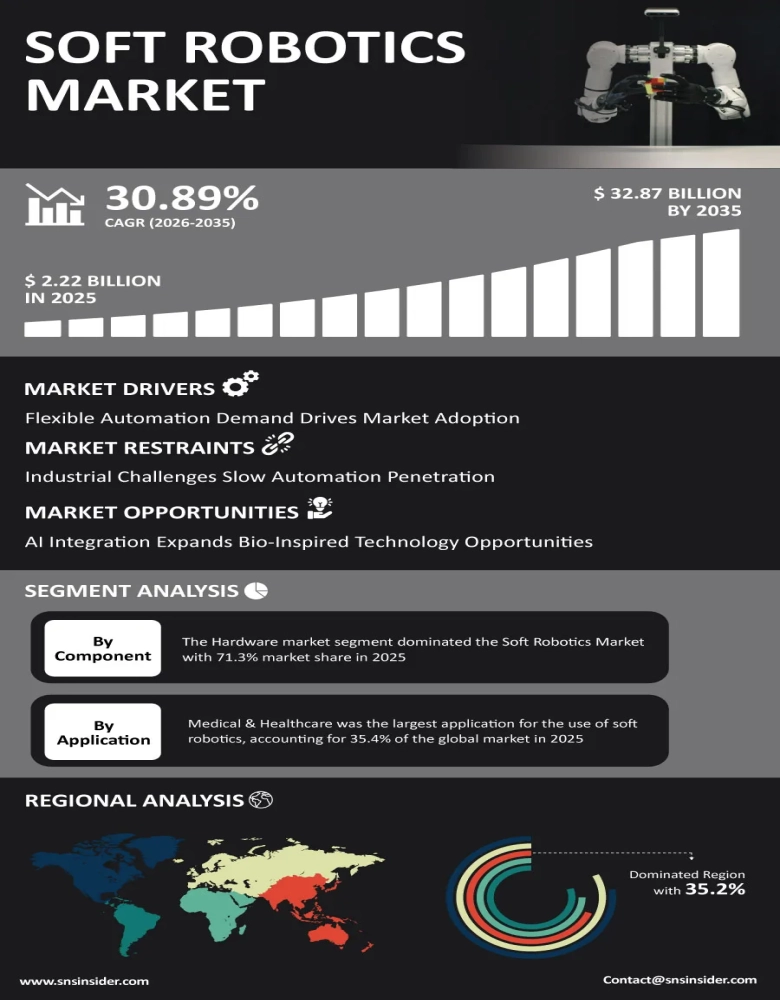
The global Soft Robotics Market is entering a period of exceptional expansion as industries increasingly seek automation systems capable of safely handling fragile products, irregular objects, and complex human-interaction tasks. According to a recent study by SNS Insider, the global Soft Robotics Market size valued at USD 2.22 billion in 2025, is anticipated to grow to USD 32.87 billion by 2035, registering a CAGR of 30.89% over the 2026–2035 forecast period.
The quick development of artificial intelligence, machine learning, new material science, and sensors has changed the abilities of robots. Contrary to conventional robots, which have fixed and stiff mechanical design, the design of soft robots enables them to change their forms and movements; therefore, they become more applicable in food production, medicine, logistics, electronics, and manufacturing industry.
Increasing labor shortage, growing investment in automation, and development of the e-commerce sector are also pushing companies to use flexible robots. Companies seek automation solutions that can operate together with the staff members and fit a larger number of goods and conditions.
To Get Detailed Insights on the Soft Robotics Market – Request a Sample Report
AI Integration and Flexible Automation Create New Growth Opportunities
The collaboration between AI and soft robotics opens up immense potential for both developers and users. Intelligent control systems allow robots to identify objects, adjust grip strength, and react to environmental changes independently. The benefits are especially beneficial in cases where there is a great difference between products in terms of shape, size, weight, and fragility.
The healthcare industry offers another avenue of growth. Soft exoskeletons, rehabilitation devices, and other types of wearable robotics enable providing physical assistance without risking patient safety. It is forecasted that further development of minimally invasive medicine will expand the commercial potential.
Soft grippers can become an increasingly popular solution for the automated handling of fragile food and beverage products, whereas logistics companies deploy adaptive robots to solve issues connected to increasing parcel volume and complexity.
Key Market Insights Highlight Shifting Demand Patterns
By component, hardware segment accounted for 71.3% of global market revenue in 2025, supported by spending on actuators, sensors, robotic structures, and end-effectors. Software is projected to be the fastest-growing component as AI-driven perception, machine learning, and advanced control algorithms become increasingly important to autonomous robotic operations.
Based on type, soft grippers segment held around 37.4% market share in 2025 due to their broad use in food processing, logistics, pharmaceuticals, and manufacturing. Cobots are forecast to experience the fastest growth as companies seek robotic platforms capable of operating safely alongside human workers without extensive physical separation infrastructure.
By material, elastomers segment held the leading position in 2025 owing to their flexibility, resilience, and suitability for actuators and gripping mechanisms. Gels are projected to register the fastest growth as their high compliance makes them attractive for fragile-object manipulation and selected medical applications.
In terms of application, Medical & Healthcare segment dominated with 35.4% share of market revenue in 2025, reflecting growing deployment in rehabilitation, wearable assistance, and medical procedures. Advanced Manufacturing is expected to be the fastest-growing application as flexible robotics gain traction in precision assembly, electronics, automotive production, and quality inspection.
Adaptive Robotics Expands Across Diverse Industrial Environments
This market is seeing benefits owing to the increasing demand for automation of those processes which have always been challenging for robotic solutions because of their rigidity. With soft robotics, manufacturers and logistics companies can handle the variability of products while keeping the process fast and consistent.
Intelligent grippers along with AI-enabled robot vision are making significant enhancements in terms of performance of automation technology. Since these technologies will be able to learn and adapt themselves according to the environment and product variety, they have the potential to go beyond the confines of assembly lines.
Asia Pacific Secures 35.2% Market Share in 2025 Through Strong Manufacturing and Robotics Growth
In the year 2025, the Asia-Pacific region is predicted to contribute 35.2% of the total market revenue due to the presence of robust manufacturing industry, rising electronic production, and considerable investments made in the automation industry in the countries, such as China, Japan, and South Korea.
Growth for North America is expected to be the fastest up to 2035 owing to the adoption of advanced technologies, automation in the warehouse, healthcare robotics, food processing, and innovation in the field of robotics.
As businesses across major economies address workforce constraints and pursue greater operational flexibility, demand for advanced robotic automation is expected to remain strong.
Industry Participants Focus on Intelligent Platforms and Commercial Expansion
The competitive landscape is evolving rapidly as robotics companies invest in AI-enabled control systems, advanced materials, adaptive grippers, collaborative platforms, and wearable robotic technologies. Strategic partnerships, geographic expansion, and application-specific product development are becoming important priorities as companies compete to commercialize soft robotics across high-growth industries.
Key companies operating in the global Soft Robotics Market include Soft Robotics Inc., Festo AG & Co. KG, ABB Ltd., Kawasaki Robotics, Universal Robots (Teradyne), OnRobot A/S, Grabit Inc., Boston Dynamics, ReThink Robotics, SIASUN Robot & Automation Co., Ltd., Piab AB, Shadow Robot Company, Roam Robotics, Ekso Bionics Holdings, Inc., and RightHand Robotics.
An SNS Insider analyst Sushant Kadam commented, “The rapid convergence of AI, advanced materials, and flexible automation is positioning soft robotics as an important technology for the next generation of industrial and healthcare systems. Companies capable of delivering reliable, adaptive, and commercially scalable robotic platforms will be well positioned to capture opportunities across logistics, manufacturing, food processing, and human-assistance applications.”
About the Author