Sony’s AI Robot “Ace” Defeats Professional Table Tennis Player, Published in *Nature*, Ushering in New Era of Embodied Sports AI — BigGo Finance
Japanese tech giant Sony’s artificial intelligence research division has recently made a breakthrough in the field of physical sports. An autonomous table tennis robot named “Ace” has successfully defeated a human professional player in an official match adhering to International Table Tennis Federation (ITTF) rules. This milestone research was published on April 22 in the prestigious international academic journal Nature, symbolizing AI’s official transition from virtual board games into the arena of physical sports requiring high-speed reaction and precise bodily control.
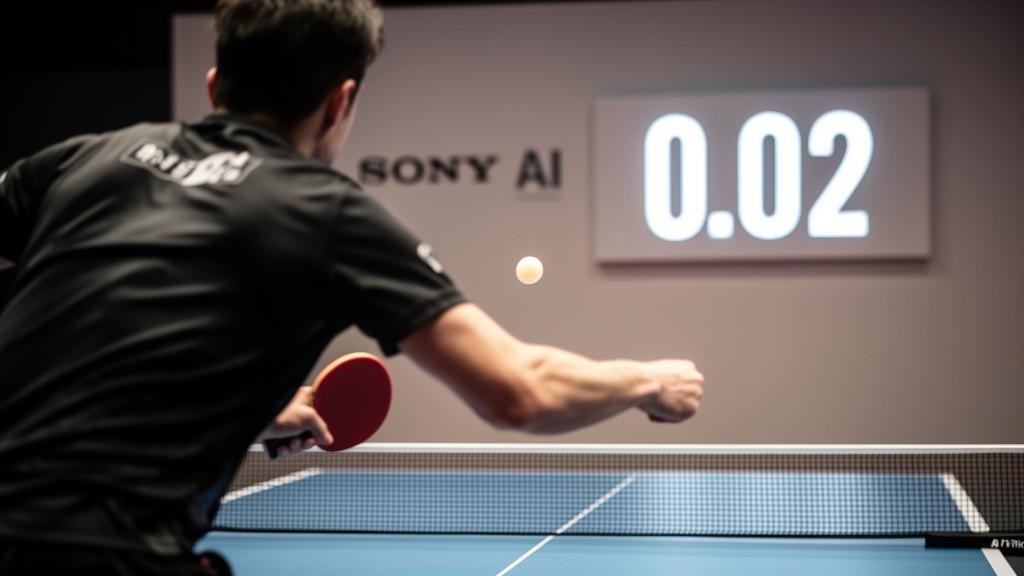
The research, led by Peter Dürr, Director of Sony AI’s Zurich branch and project lead for Ace, shows that Ace achieved a record of 3 wins and 2 losses in matches against five elite-level players in April 2025. Although it lost against the highest-ranked professional players at that time, the research team emphasized that Ace’s capabilities have continued to evolve since the paper was submitted. The robot has since defeated professional table tennis players in December 2025 and March 2026, including a player ranked within the world’s top 25.
How Did the AI “Learn” to Play Table Tennis?
Unlike previous AIs (such as AlphaGo) that defeated humans in strategy games like chess or Go, physical table tennis presents a completely different challenge for AI. It requires not only rapid decision-making but also the execution of precise perception, prediction, and physical movement within milliseconds, all while continuously adapting to an opponent’s unpredictability.
Ace’s system architecture integrates several cutting-edge technologies. Its perception system consists of nine synchronized cameras and three vision systems, capable of tracking the trajectory of a high-speed, spinning ball with extreme precision. Its processing speed is sufficient to capture movements that appear blurred to the human eye. The research team built a dedicated robotic platform with eight joints for Ace—the minimum number of joints required to execute competitive-level shots—controlling the racket’s position, angle, and the speed and force of the stroke.
More crucial is its “brain.” Ace does not learn by watching videos of human matches. Instead, it employs a reinforcement learning algorithm, training through millions of self-play matches in a simulated environment. This allows it to develop unique shot patterns and strategies distinct from those of humans.
Professional Players’ Firsthand Experience: Unpredictable and Emotionless
Professional player Mayuka Taira, who lost to Ace, stated that the robot’s advantage lies in being “very difficult to predict and showing no emotion.” She noted that because she couldn’t read its reactions, it was impossible to discern which shots it disliked or struggled with, making the match exceptionally difficult.
Another elite player, Rui Takenaka, who traded wins and losses with Ace, shared a tactical observation: “When I used a serve with complex spin, Ace would return the ball with complex spin, which was hard for me to handle. But when I used a simple, non-spinning serve, Ace’s return was also simpler, making it easier for me to attack on the third shot.” This indicates that while Ace is powerful, human players can still find ways to counter it through strategy.
Technical Specifications and Performance Comparison
To clarify Ace’s technical advantages, the following table summarizes its key performance metrics:
| Item | Ace Robot | Top Human Athlete |
|---|---|---|
| Reaction Time | ~0.020 seconds | ~0.23 seconds |
| Learning Method | Reinforcement Learning in Simulated Environment (Self-Play) | Coach Guidance, Observation, Practical Training |
| Perception System | 9 Synchronized Cameras + 3 Vision Systems, Event-Based Sensing | Binocular Vision, Experience-Based Anticipation |
| Action Execution | 8-Joint Robotic Arm, Precise Control of Position, Angle, Force | Full-Body Muscle Coordination, Flexibility & Adaptability |
| Emotional Impact | None | Can be affected by pressure, fatigue |
Note: Reaction time refers to the time from perceiving the incoming ball to initiating the return action.
Beyond the Court: Opening the Door to Broad Physical Applications
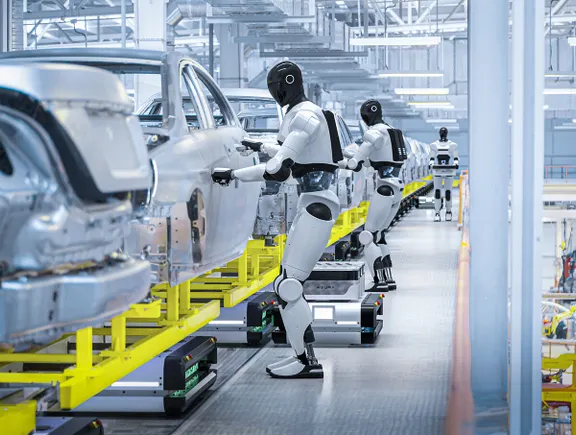
The research team emphasizes that the goal of developing Ace extends far beyond winning matches. Peter Dürr pointed out: “Ace’s success, achieved through its perception system and learning-based control algorithm, demonstrates that similar technologies can be applied to other fields requiring fast, real-time control and human-robot interaction.” This includes precision assembly and sorting in manufacturing, service robots, the entertainment industry, and even physical operation domains with extremely high safety requirements.
Dr. Peter Stone, Chief Scientist at Sony AI, further elaborated: “The significance of this achievement goes far beyond table tennis. It is the first proof that an AI system can effectively perceive, reason, and act in a complex, rapidly changing real-world environment that demands precision and speed. When AI can demonstrate expert-level capability under these conditions, it opens the door to entirely new types of physical applications for us.”
Global Competition: Embodied AI Becomes the New Focus
Ace’s breakthrough is not an isolated case; it reflects the rapid development of the global Embodied AI field. Just last Sunday, at a half-marathon in Beijing, a humanoid robot developed by Honor finished the race at a speed surpassing the men’s world record. In China, Hangzhou-based Zhi Wuji also demonstrated a humanoid table tennis robot capable of rallying over a hundred consecutive shots, overcoming the technical challenges of full-body motion control.
These advancements show that robots are evolving from mechanical arms fixed on production lines, or intelligence residing solely in servers, into physical entities capable of working alongside or interacting with humans in a dynamic real world. From assisting athlete training and serving as commercial practice partners to industrial sorting and even home companionship, the scope for their application is rapidly expanding.
As AI proves its capabilities in the realm of physical sports, the contours of a new era where intelligent machines participate more deeply in the human physical world are becoming increasingly clear. Sony’s Ace is not just a victor on the table tennis table; it is a pioneer knocking on the door to that future.