The Future at Work: Inside Alliance Automation’s Push to Reinvent Pallet Manufacturing and Recycling
Labor shortfall continues to drive the need for more automation in pallet plants. Three Alliance Automation customers share how adoption of new solutions has helped address their labor challenges while improving operational performance. These aren’t theoretical technologies; they are the future at work today.
These testimonials include a hardwood pallet recycler, a longtime custom-pallet builder and an oversized-pallet specialist. Add a conversation with Browning Sheehan, who gave me the company-side view, and a picture emerges that’s less about robots replacing people and more about an industry rebuilding itself around a labor market that isn’t coming back.

Southwood Pallet: Learning Curve, Real Savings
Southwood Pallet, recently acquired by River City Wood Products, installed the first Woodchuck automated board-feeder systems mounted on a Viking Duomatic nailer back in January. It has been running for six months and is getting closer to where the company finally wants it to be. John Weaver, maintenance supervisor, and Kevin Weaver, vice president of operations (no relation), were refreshingly honest, “I would say we’re probably about two-thirds of where we want to be with it,” John said.
The ROI case is straightforward. “You’re going from four operators to two with a little less downtime,” Kevin explained. So far, the Woodchuck board- feeding system is on track for the estimated payback timeline. He added, “We sort of put a buffer in there of a year. We were looking at a three-year ROI, and I think we’re on track for that.” Knowing they’d be an early adopter, Southwood padded the payback math on purpose. “We’re the test case taking the hit up front…them things are being solved as we go,” said Kevin.
This learning curve showed up most visibly in the AI-driven lumber inspection built into the system. “With the AI scanning system, you can set your parameters on what it kicks out quality-wise,” Kevin said, “so we were able to have a little better-quality control on the pallets as well.” John described the human variability it replaces this way. He said, “Automated inspection removes human variability if a grader or quality- control person is having a bad day. But the fine tuning of the system wasn’t instant. That did take a little time.” One thing the Woodchuck did right away was it kicked out a lot of lumber. John added, “Now we’ve got it to where it’s accepting more lumber as we have adjusted the parameters regarding board thickness, length, knot size and the real-world variability of hardwood.”
Cycle time tells a similar story. The Woodchuck is spec’d for roughly nine seconds; Southwood is currently running closer to 11, closing the gap as training builds. “The machine capabilities is what Alliance was saying it would be,” John acknowledged, “but we’re still working on getting it consistently there.”
Where John didn’t hold back praise was the support offered by Alliance Automation. A snapped robot cable was fixed within 24 hours. He commented, “I can’t say enough about Alliance as far as response. They have some awesome people there.” He also liked the reject-tracking dashboard the system generates, which shows whether a rejected board was broken, waned, thick, long or short.”

Dan Reardon: Two Generations, One Honest Verdict
Few people have watched Alliance’s evolution as closely as Dan Reardon, an established pallet recycler now on his second generation of the company’s robotic dismantling technology. He wasn’t a first mover on the original vacuum-and-foam pickup robot by design. He bought the 30th or 40th robot sold, a deliberate choice to avoid capital exposure. Looking back at Alliance’s early rise, Reardon stated, “Alliance found a good niche industry for themselves, but we as pallet recyclers needed the Robotic Pallet Dismantler more than we realized.” He also credits Alliance’s Urban Sawmill with reshaping his custom-pallet business by cutting waste from manual trim-saw guesswork. “The Urban Sawmill changed everything for us. Now we’re off to the races.”
The original Robotic Pallet Dismantler had one trouble spot. The foam consumable on that original tool was a real cost burden, according to Reardon. He noted, “Fifty percent of the cost to tear that pallet down was the foam at that time.” Most recently, he became an early adopter of Alliance’s new end-of-arm tool, a mechanical clamp that eliminates the foam entirely. The payback was fast. “We were doing within two weeks exactly the same production that we had with the vacuum tool, and we were doing it without the foam cost,” said Reardon. “This was very quick payback for us.” He also found an unadvertised safety benefit: the new tool “grabs the pallet and holds it on both sides of the top deck boards so that there won’t be any more pallets that fall off the robot either. That was an additional benefit for us that we hadn’t considered.”
The robot arm for the foam isn’t a perfect tradeoff in every respect. The new tool leaves a bit more material behind on block pallets than the old vacuum tool did. “It leaves the block pallets on the connecting boards or what we call legs on those pallets,” Reardon acknowledged. “We send those legs to the grinder because it just wasn’t worth the time to gain that extra board.” Getting the robot to consistently hit stringers in the right spot across varying pallet sizes has also taken some effort according to Reardon. Alliance spent 1-2 weeks on-site tuning, then remote-tuned via a camera mounted over the saw.
But the ROI has been there for Reardon Pallet when it comes to reducing worker strain and improving safety as well as productivity and foam cost savings. “The ROI depends on where you start, your priorities and current production. If I’ve got guys who can do 600, 700 [pallets a day on a manual saw], the calculus on the ROI is completely different.” For Reardon Pallet, safety matters as much as throughput. Dan Reardon explained, “We definitely want to send the more high-risk pallets through the Robotic Pallet Dismantler so those aren’t as big a risk to the person operating the manual dismantlers.”

PalletMax: Flexibility Wins for Oversized, Custom Work
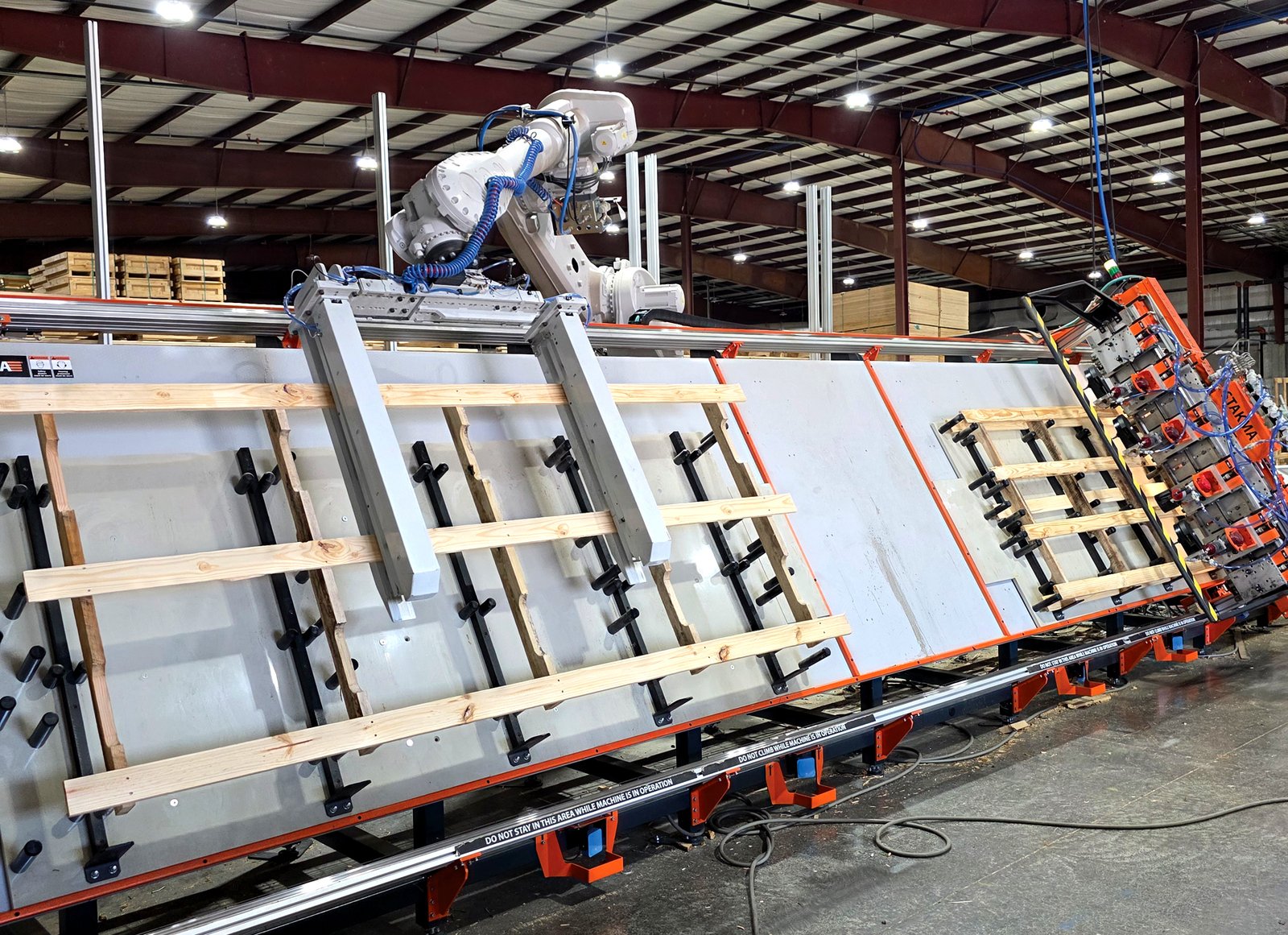
Daryl Keim of Hoosier Pallet runs an operation that builds heavily customized, often oversized pallets. Some are up to 12 feet long and traditionally required two people to handle. He’d seen Alliance’s PalletMax at an open house last year and decided to give it a try to cut labor costs. PalletMax is a CNC-controlled gantry nailer built by STAKMA, a Lithuanian manufacturing partner. The equipment is sold and serviced in the United States by Alliance Automation.
Keim declared, “We bought the PalletMax to cut back on labor costs for oversized pallets.” And the numbers on two of the main pallets produced on the machine back up the decision. “On one of the pallets, two people were getting 220 a day by hand,” Keim said. “One person is now getting 260 a day with the Pallet Max.” The machine is rated for around 400 pallets daily; Keim currently runs 360 to 380 with two operators, limited less by the machine than by how fast lumber can be fed to it. On his most specialized work, a dunnage-heavy design, Keim asked us not to describe in detail or photograph. “It was taking 22 man-hours to produce a load now we are down to 12 hours. We were using three employees for that project, and now only have two employees on it.” Keim mentioned at this point they have only produced three different pallets since the installation in May, and he believes there is still untapped potential.
After using the nailing solution, what really sold him wasn’t the raw speed; it was the flexibility. “You did not need special jigging,” Keim said. “It’s a flat table, and you build your own jigs out of whatever you want.” The differentiator, in his eyes, is that the gantry’s nail guns move independently rather than firing in a fixed line. “It doesn’t matter what you’re building. The system design allows the nailing pattern to move to produce a wide variety of pallet sizes and even crate components.” Installation was fast, too, something he credits to Alliance sending specialized techs rather than a generalist crew. Keim stated, “The machine arrived on a Monday, and on Friday we were producing a complex pallet design.”
Not everything was smooth. Programming for his tallest, custom dunnage designs took real trial and error. “It was just a programming issue; it was not actually the machine. This machine was primarily built to build normal pallets. We’re using it for very specialized things, but Alliance has been very helpful in resolving some of the special challenges.” The system comes with an automatic safety sensor that allows a human operator and the robot to work alongside each other. Keim mentioned it was a bit of a learning curve for the employees to figure out when it is clear to step into the machine’s workspace without shutting it down.
On the upside, he praised the ergonomics. Keim boasted, “The design of the machine with the angle of the table takes a lot of stress off the employee.” He added, “Training for the employee on the PalletMax is very easy. A low training burden is helpful in this labor environment. The operator’s job is fairly easy, basically loading nail guns and lumber onto the jig.”
The PalletMax is just starting to take off in North America. Keim thinks this is just the beginning, especially for anyone producing oversized or specialty pallets and containers. He suggested, “As Alliance builds a reputation in the support of this machine and people really see it, I think this is going to be a big deal.”

Alliance’s View of Where Pallet Industry Automation Is Headed
To better understand the business philosophy behind Alliance’s latest innovations and offerings, I sat down with Browning Sheehan, the chief applications officer and co-owner of Alliance Automation. He emphasized that data is becoming as valuable as the wood itself for pallet companies. He acknowledged, “Many experts have suggested that data is the next industrial revolution, and data is driving everything now, even for the pallet industry.” That’s why Alliance rebuilt its reporting module with onboard buffering and a handshake protocol after the earlier version risked losing some data. With recycled-core margins compressed since COVID, board-level yield data matters even more.
Sheehan recognized, “Now it’s almost like you need to get paid for the cores coming in. People are finding that they’re able to track loads from specific companies and better understand the yield and value of a trailer load.” This is especially true for companies that integrate their recycling operations with an optimized trim saw, either the Urban Sawmill or the Badger.
On the dismantling side, Sheehan previewed what comes next: a mechanical “alligator” tool capable of selective component removal, already deployed in Europe. “If someone has a 48×40 pallet with a broken stringer, a lot of times they don’t want to pay the labor to take the stringer out,” he said. “We will now have the ability to take that stringer out.” It’s part of a trajectory he described candidly. “It’s a viable thing going forward where no pallet will be touched by a human.” This shift in the level of automation is being pushed by internal safety pressure at large U.S. recyclers, whose safety teams increasingly say they either stop handling recycled material manually or find another way. Sheehan commented, “These repair activities are just too dangerous for some companies to be able to attract workers. This is a dynamic that Europe has lived with longer, and I think we’re just 10 years behind Europe on the labor scarcity front.”

Downstream quality pressure is compounding the need for better pallet quality, which tends to require higher levels of automation for even pallet producers and recyclers. Automated storage and retrieval systems in warehouses are quickly raising the bar for pallet quality. Fines for jammed systems can run into “multiple millions of dollars” for the companies responsible, according to Sheehan.
Alliance’s own equipment philosophy leans toward robots over fixed hard tooling, partly for its ability to be redeployed for other tasks. “You can take a robot that’s five years old and redeploy it, as opposed to hard tooling. Once the use case goes away, so does that tooling.” Field data shapes what Alliance builds, too: “The 60-inch board was 0.3% of the total products run on the line,” he said, explaining why extra footprint for that sliver of volume “just doesn’t make sense.”
Perhaps most refreshing was Browning’s willingness to push back on hype around artificial intelligence (AI) and humanoid robots alike. On the latter, he was blunt. “It’s going to take many years to get humanoid robots to the point where you can even think about applying one to what pallet companies do.” He pointed to vision-inspection systems as a cautionary tale. “Five years ago, everyone in the vision-system space said, ‘Oh yeah, we’ll be able to inspect a pallet and tell you all about it.’ Here we are five years later, and no one has the perfect mousetrap yet. Some companies are close, but technological development takes time.”
Browning is just as wary of AI as a buzzword. He warned, “Everyone wants to attach AI to everything so that they sound better, more professional, smarter. We’ve learned not to oversell something that’s not proven 100% yet.” That caution shapes rollout strategy, too. Alliance has developed strong partnerships with STAKMA in Europe and Pallet Machinery Group (PMG) in the United States. It works with just a couple of partners at a time to prove a new technology out before releasing it industry-wide, because skipping that step, in Browning’s words, “is a stupid tax that you have to pay.”
The company is growing internationally with one Robotic Pallet Dismantler in Australia, one in Austria, one in Holland and more installations quoted throughout Europe. Sheehan suggested, “I think our robotic technology is starting to break out in Europe.”

The Future of Work… Today
If there’s a single thread running through Southwood’s tuning curve, Reardon’s two generations of dismantling tech and Keim’s flexible gantry, it’s that none of these operators describe automation as a switch you flip. It’s closer to hiring a capable new employee who needs training and realistic expectations. The good news is that once trained and dialed into company-specific parameters, it doesn’t call in sick or have a bad day grading lumber. It is consistent and provides reliable, recordable data. These automated solutions reduce strain on workers, increasing your labor pool. They can also free your best people for higher-value work. None pretended that the transition was frictionless. All three said they’d do it again.
Sheehan left me with cautious optimism about the broader industry, echoed independently by Reardon, who pointed to a demand uptick that began in April. “We’re starting to see a little bit of an uptick in the manufacturing sector, not only in the pallet space, but elsewhere,” Sheehan recognized. And he suggested, “I hope it’s sustainable because we need it to tick.”
That’s the future at work today in pallet plants. It’s not a lights-out plant humming along without a soul in sight, but real people figuring out in real time how much of the load a machine can carry, and how much still depends on human operators. For more information, visit www.allianceautomation.com, call (419) 238-2520.