The Hobbit Marks Magic: The Gathering’s First Return To Previously Visited Universes Beyond
While the Preview Panel at MagicCon Amsterdam focuses on the future of in-universe Magic: The Gathering, Universes Beyond did make its presence known. A separate panel, focused solely on The Hobbit, gave players a look at Magic’s return to the world of Tolkien before its August release.
We sat down with set lead Annie Sardelis, executive producer Zakeel Gordon, and principal game designer Gavin Verhey, in both one-on-one and roundtable discussions, to talk about what The Hobbit will bring to Magic: The Gathering as the first-ever Universes Beyond sequel set. From card design to special treatments, there’s a lot featured in The Hobbit that should make players excited to go there and back again, and the team thinks they have something precious on their hands.
Returning to Tolkien
The Hobbit marks a major milestone for the Universes Beyond initiative within Magic: The Gathering, as it is the first “sequel” to a previous UB product. Gordon explained that while the team put a tremendous effort into the set’s design, the idea of it being a sequel set wasn’t as much as a motivator.
“I think a lot of the pressure for specifically Universes Beyond sets comes from the teams that are assigned to it wanting to make something that’s exciting. We want to deliver on the moment,” Gordon said. “For a lot of people, this may be their first interaction with Magic, but for others, this is the second breakfast. As a design team, we’re just trying to figure out how to make this as exciting as possible, and how to make sure it’s something that we want to play. We are mostly accountable to ourselves to just make awesome gameplay experiences.”
One key benefit to this being the first sequel set, however, was being able to keep the team that worked on The Lord Of The Rings together for The Hobbit. “We were able to really keep the train rolling coming off of The Lord of the Rings; a lot of the same team internally kept working on this set, from art directors and a lot of our narrative team,” Gordon said. “Most Universes Beyond development cycles are like five years, but we were able to effectively shave off a year and a half, being able to ship The Lord of the Rings in the middle of 2023 and then this in the middle of 2026 just because the team is already familiar with the content.”
A smaller source material
Despite The Hobbit being only one novel, as opposed to the trilogy of The Lord of the Rings, the team found that there was still ample material in order to build out their set. The approach, because of that smaller source material size, was to get as granular as possible.
“Any time we made up a creature, we would search through the book for a characteristic about that creature we can evoke, because we could get specific,” Sardelis said. “We didn’t need to broadly say ‘This is a Mirkwood elf,’ we can say ‘This creature is the one that served drinks’ or ‘That creature guarded the gates of the cells.’ It was more challenging because if we weren’t being specific, we might miss a fun detail, and we have the luxury of being able to find details like that because it is such a short book.” As an example of how specific they got, Sardelis says one of the creatures in the set is based on of a creature whose only appearance in the Hobbit is when Gollum mentions it at one point in the story.
That said, The Hobbit is still filled with many notable characters, which usually appear as legendary creatures in a MTG set like this. With Marvel Super Heroes featuring 128 legendary creatures–the most ever in a Magic set–some players may have legendary fatigue. Sardelis says that, while there aren’t nearly as many legendaries in this set, named characters will still get the treatment they deserve.
“In the red/white archetype, we did want to deliver a legend for each named dwarf, because it’s honestly way more fun to draw a hand of cards and see names like Bifur, Bofur, and Bombur than, say, ‘Flute-Owning Dwarf,'” Sardelis said. “It was a little indulgent in red/white, but the other four color pairs are much more sparse in terms of legends, and that’s the nature of the scope of the product.”

Honing the new mechanics
A notable new mechanic being introduced in The Hobbit is Hone, as seen on Sting, Bilbo’s Sword. Hone adds counters to Equipment, and the more hone counters that Equipment has, the more powerful the equipped creature will become. While the idea of an Equipment getting counters of any kind may give seasoned players flashbacks to one Umezawa’s Jitte, Sardelis says this mechanic shouldn’t produce anything like that.
“There are plenty of examples of designs in that shape where we felt like this output was relatively safe,” Sardelis said. “We definitely learned from past examples and felt out what was going to be balanced and fun. Just giving power is different from giving power and toughness, because it’s fun to attack; don’t block with your 10/10, just get in there!”
Verhey revealed that this mechanic came from a special inter-office event. “We have what we call ‘hackathons’ where we try to come up with new ideas and products. For example, Modern Horizons, Commander Legends, and Jumpstart have all come out of internal hackathons,” Verhey said. “More recently we’ve run some mechanical hackathons, we were doing some explorations around the color red and what it could do to build up over time, because red is notoriously bad at building up over time. One idea we came up with was this Hone mechanic, because red loves equipment, and you could hone an equipment and make it better over time in a very red way.”
The other major new mechanic is Storied, which grants a static effect if a player fulfills the requirement of having three historic–artifacts, legendaries, and/or Sagas–in play. Sardelis compares Storied to City’s Blessing from Ixalan which required ten permanents to trigger, though with Storied, the resulting effect won’t be as powerful due to the lowered requirement.
Sardelis also acknowledges that the mechanic was balanced to be most effective in the Limited format, whereas in formats like Commander, players will be able to access it quickly. “Storied is largely built out for Limited play, because it is a little challenging to have those three things online in Limited, and specifically in this set,” Sardelis said. “There’s definitely Treasure tokens, but you might want to use those to ramp, so they’ll go away. You might have a Saga out, but you might not play your other cards in time before it goes away. It’s definitely balanced around Limited, but I can see in Commander and other formats where you are playing ramp artifacts, it’s essentially just going to be on the second you play one of the cards.”
The Booster Fun treatment
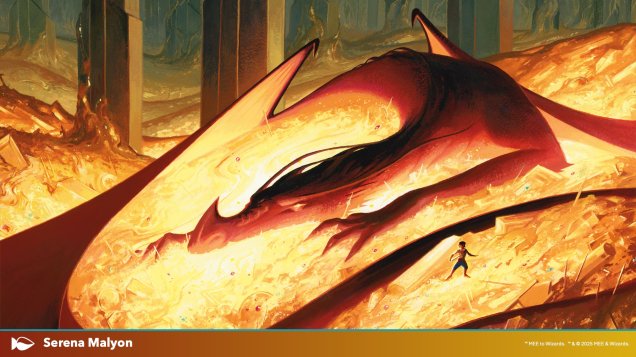
Alternate artworks and treatments in each Magic set have become a major part of collecting the cards, and The Hobbit has a few striking frames for players to find. Not every player is going to open the Gleaming Gold Smaug Headliner card, for example, but they might see him and other dragons on the Dragon’s Hoard border treatment. Gordon points to the missing scale on the Dragon Hoard version of Smaug himself as one of the many Easter eggs players can find in the set.
However, the marquee treatment for those keeping track of card previews is the Book Cover treatment, which turns some of the legendary creatures found in the set into cover art of a classic fantasy novel. Gordon says that for all the treatments that were pitched, this one just made perfect sense.
“As we were going through development, we had multiple touchpoints where we synced up with the designers and asked ‘What are the cards we’re most excited about? How do we really highlight the legends in this set? How do we highlight the notable characters?'” Gordon said. “The book covers were just an awesome thematic throughline that I think feels very resonant for the IP. There is similar imagery throughout the years of Tolkien history, and our approach was really just trying to accent these cards and make them amazing.”

Lessons for future Universes Beyond
Though it’s made a significant splash in the game since its inception, Universes Beyond products like The Hobbit are still very new to the Magic: The Gathering scene. Verhey knows that the team can continue to learn from every UB launch as more sets are released, and The Hobbit is no different.
“When it comes to Universes Beyond, it’s still in its relative infancy, right? So we’ve only been doing these for a few years,” Verhey said. “The Hobbit is such a natural fit for Magic, right? It fits Magic perfectly. I don’t think everything we do has to be that tight of a of a fit, but it’s nice. You’re gonna continue to see us experiment with all kinds of stuff, we’re putting out all kinds of things and learning from the, and all the feedback we get is going to be incorporated in what our future Universes Beyond settings are but it’s always great to come home with a cozy, high fantasy world like this.”
The Hobbit, as mentioned previously, is the first “sequel set” for a Universes Beyond collaboration. Designing that first Universes Beyond sequel set, for Gordon, felt a lot more like designing a sequel set for in-universe Magic than some may realize.
“Magic at large has done a lot of sequels and a lot of return-to sets, most recently with Secrets of Strixhaven, and there’s like a good variety of ways to approach a return-to,” Sardelis said. “You could do something more drastic, like Kamigawa Neon Dynasty, or you can do something like Secrets of Strixhaven, which was more of a ‘return-to’ in a mechanical sense. Figuring out what style of return-to The Hobbit fell into was actually really interesting, because every return-to has to be a sequel in a way, you have to give something new to the people. You already know they love it, but you don’t want to bore them, and I tried to keep that same philosophy here.”
The Hobbit launches August 14 in local game stores and big-box retailers. Prerelease events are set to begin one week earlier, on August 7.