The Sky This Week from July 17 to 24: Lunar time travel
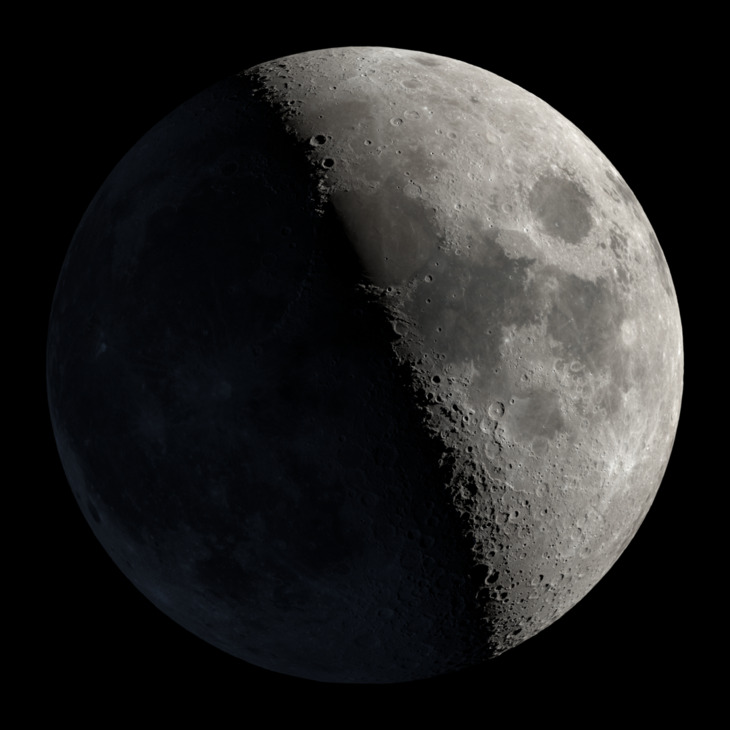
The lunar phase on July 20, 2026, is exactly the same as on July 20, 1969. Credit: NASA Scientific Visualization Studio
Friday, July 17
The Moon passes 2° south of Venus at 1 P.M. EDT. They are some 6° apart in the evening sky, sinking together in the west nearly side by side. You have plenty of time to observe, as they don’t set until about two hours after the Sun.
Both are in the constellation Leo the Lion. To their upper left as the great cat sets is the large constellation Virgo the Maiden, whose 3rd-magnitude gamma star, Porrima, is a lovely double with similarly bright components separated by some 3”. It’s an easy pair to split in any scope, so make sure to take some time to enjoy it!
Porrima also marks the join in an asterism called the Y of Virgo. As its name suggests, this Y-shaped star pattern begins at its base with the constellation’s luminary and alpha star, Spica. From Spica, draw a line up to Porrima, then glance northeast and northwest (to the upper right and lower right of Porrima as the constellation sets this evening) to find the two branches. The upper branch consists of Delta (δ) and Epsilon (ε) Virginis, also called Minelauva and Vindemiatrix, respectively. The lower branch contains Eta (η) and Beta (β) Vir: Zaniah and Zavijava, respectively.
Sunrise: 5:46 A.M.
Sunset: 8:26 P.M.
Moonrise: 9:32 A.M.
Moonset: 10:35 P.M.
Moon Phase: Waxing crescent (18%)
*Times for sunrise, sunset, moonrise, and moonset are given in local time from 40° N 90° W. The Moon’s illumination is given at 10 P.M. local time from the same location.
Saturday, July 18
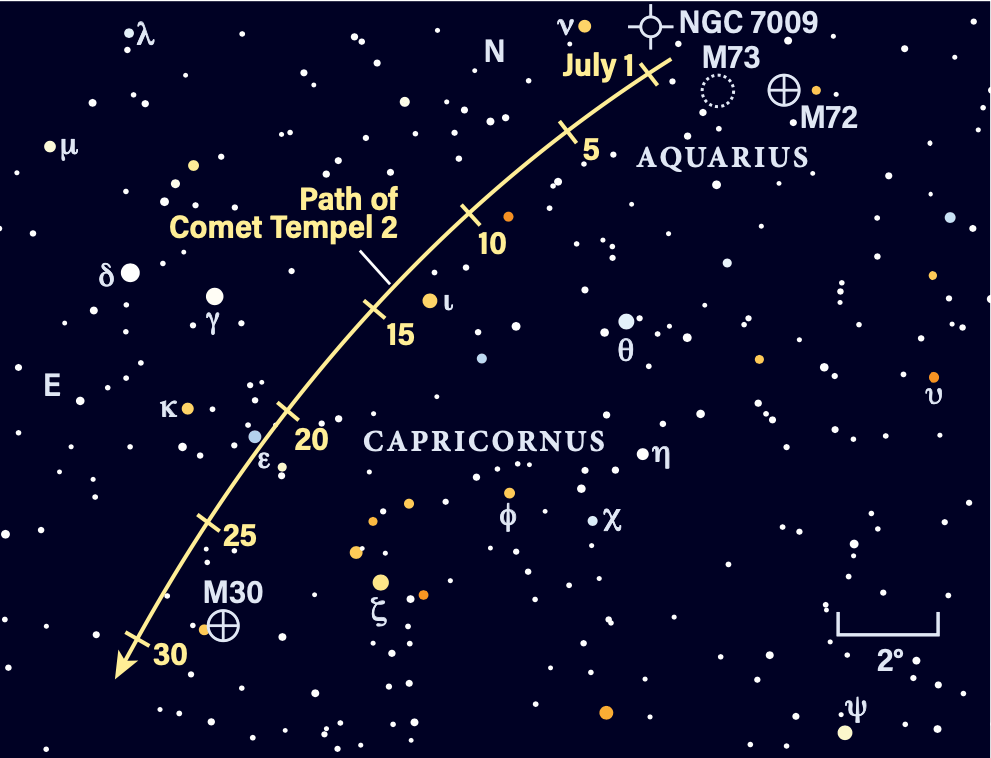
Comet 10P/Tempel (also called Tempel 2) is closing in on the Sun for an early August perihelion. It’s now undergoing some spectacular visual changes as Earth passes through the plane of the comet’s orbit. The image below shows a visualization of the orbits of Earth and Tempel 2, tilted so you can see for yourself.
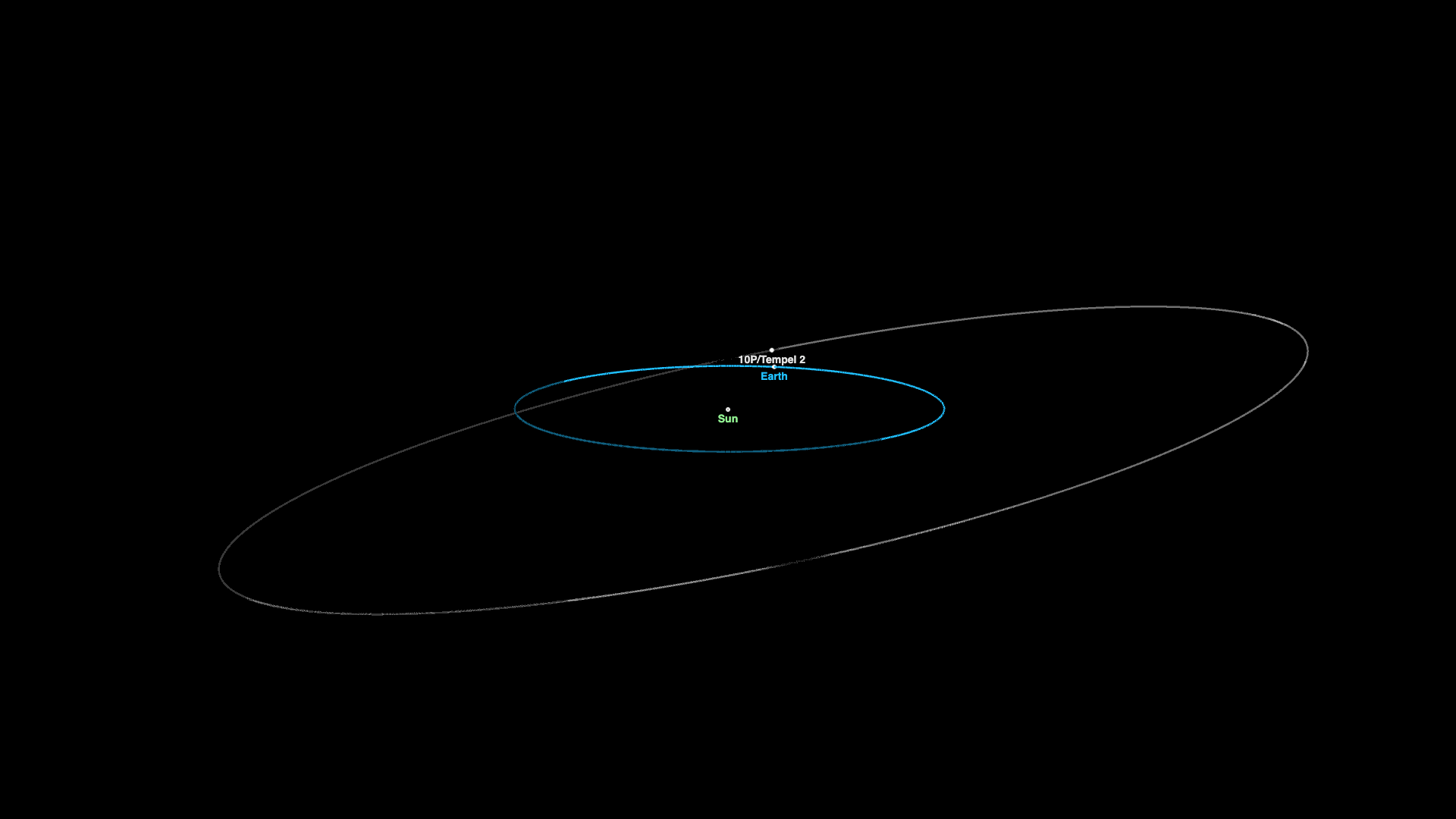
As we pass through the plane, the comet’s tail appears to thin and spread out, turning into a line that extends to either side of the nucleus, rather than the more traditional one-sided tail we’d expect.
Tempel 2 is in an extremely favorable location, rising late in the evening and visible overnight. After the Moon sets, turn southeast and look about 20° above the horizon for 3rd-magnitude Deneb Algedi, the brightest star in Capricornus. Tempel 2 is just 4.2° southwest of this star this evening, close to Iota (ι) Cap (about 1.5° northwest of this star). Check out our chart above to help you pinpoint its location. Recent observations have placed the comet around 9th magnitude — an easy catch for binoculars or any scope, especially in a dark sky.
Sunrise: 5:47 A.M.
Sunset: 8:26 P.M.
Moonrise: 10:41 A.M.
Moonset: 10:58 P.M.
Moon Phase: Waxing crescent (27%)
Sunday, July 19
Right as the Moon is setting this evening, the planetary nebula NGC 6563 in Sagittarius is reaching the highest point in its path across the sky. This oval-shaped bubble of gas, generated as well as lit up by a dying Sun-like star in its center, is best viewed through larger scopes, so this is a great target if you’ve got access to an aperture of 8 inches or more.
Glowing around 11th magnitude, NGC 6563 is located in the south around 11 P.M. local daylight time. To find it, first identify the Teapot asterism in Sagittarius. The nebula sits just 2.5° west of magnitude 1.8 Kaus Australis (Epsilon Sagittarii), which marks the righthand corner of the Teapot’s base, where the bottom of its spout meets the body. This region is just to the upper left of the curving base of Scorpius’ tail, which lies closer to the horizon.
If you have one, use an Oxygen-III filter to help enhance the nebula’s visibility. NGC 6563 is pretty compact, just 48” across. Through most modestly large scopes, it will look like a featureless disk; if you’ve got a bigger scope of 14 inches or more, you will start to notice the outer edge is a bit brighter than the inner regions.
Sunrise: 5:47 A.M.
Sunset: 8:25 P.M.
Moonrise: 11:48 A.M.
Moonset: 11:21 P.M.
Moon Phase: Waxing crescent (37%)
Monday, July 20
Astronomy is full of cycles, as orbits align and phases return. Tonight, a lunar cycle completes such that the nearly First Quarter Moon looks exactly — yes, exactly — the same as it did in 1969, as humans took their first step on our satellite’s surface. This is because the Moon’s phases repeat exactly on the same calendar date every 19 years, called a Metonic cycle. Today marks 57 years — or three of these cycles — since July 20, 1969, when the Eagle landed at Tranquillity Base.
Related: One small step: A look at how Apollo 11 made history
Rising shortly after noon, the Moon hangs in the post-sunset sky for hours, remaining visible until nearly midnight. Our satellite is moving through Virgo and appears to hang beneath that constellation’s brightest star, Spica, in the southwestern sky about half an hour after sunset. You have plenty of time to observe, as the Moon remains visible until shortly before local midnight.
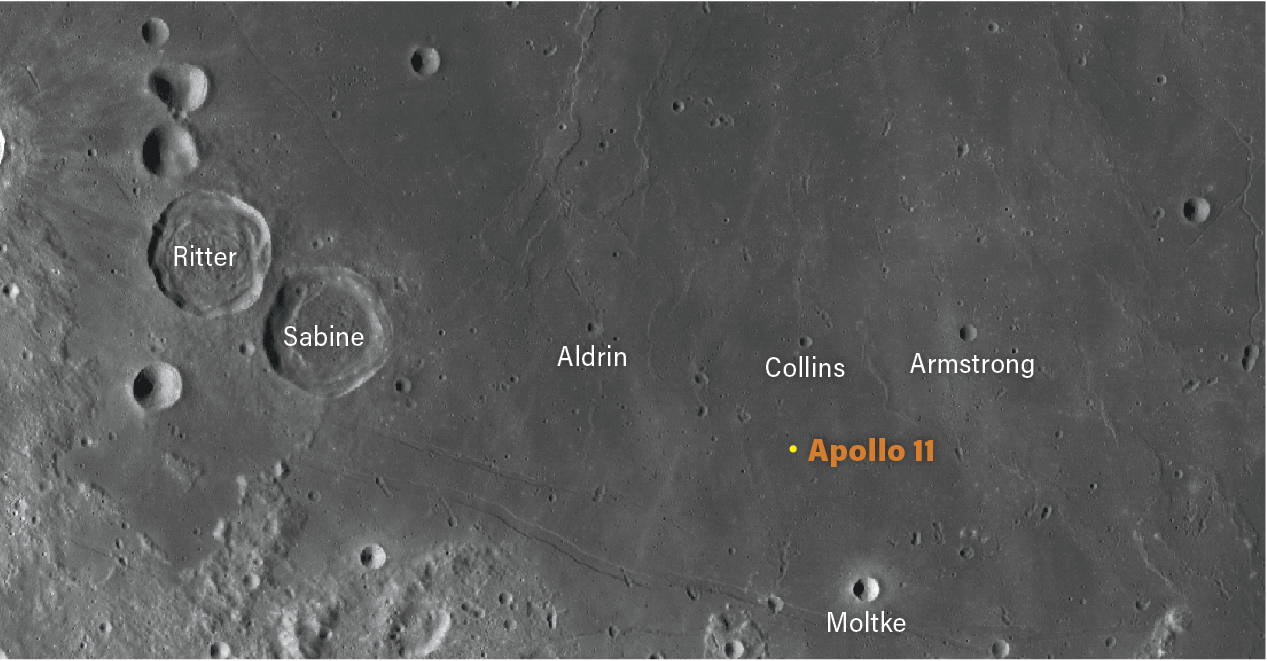
For a closer look, pull out binoculars or a telescope — with the latter, you can even search out the site where Neil Armstrong and Buzz Aldrin landed, though of course you cannot make out the actual landing site with your eyes. But to find its location, look near the center of the Moon, just to the right of the terminator (the line dividing night and day). Near the southwestern rim of Mare Tranquillitatis (the Sea of Tranquillity), you’ll find two large, shallow-floored craters: Ritter and Sabine. Just east of this pair is the Apollo 11 landing site, along with three small craters named for the mission’s crew: Aldrin, Collins, and Armstrong.
Sunrise: 5:48 A.M.
Sunset: 8:24 P.M.
Moonrise: 12:52 P.M.
Moonset: 11:44 P.M.
Moon Phase: Waxing crescent (47%)
Tuesday, July 21
First Quarter Moon occurs this morning at 7:06 A.M. EDT.
Saturn’s largest and brightest moon is Titan — a world that is, in fact, larger than the planet Mercury! Shining at mid-8th magnitude, Titan is easy to view through a telescope this morning, once the ringed planet rises high enough to easily catch in your optics.
By about 2 A.M. local daylight time, Saturn has reached roughly 25° above the eastern horizon. It’s the brightest point of light here, hanging above the large figure of Cetus the Whale. Zoom in on Saturn with a telescope and you’ll easily pick up Titan, which lies just northwest of the planet this morning. It’s moving westward as the hours pass, pulling farther away from its parent world over time, but still in the same telescopic field of view.
You’ll likely see other moons as well, such as 10th-magnitude Dione, Rhea, and Tethys. The former two lie east of Saturn, but the latter is just to the west, and depending on when you look, closing in on Saturn’s southwestern limb. It won’t quite make it, though — shortly before 4:30 A.M. CDT (as the Sun is nearly rising along the East Coast), Tethys disappears into Saturn’s shadow, which also stretches southwest of the planet.
Sunrise: 5:49 A.M.
Sunset: 8:23 P.M.
Moonrise: 1:57 P.M.
Moonset: —
Moon Phase: Waxing gibbous (57%)
Wednesday, July 22
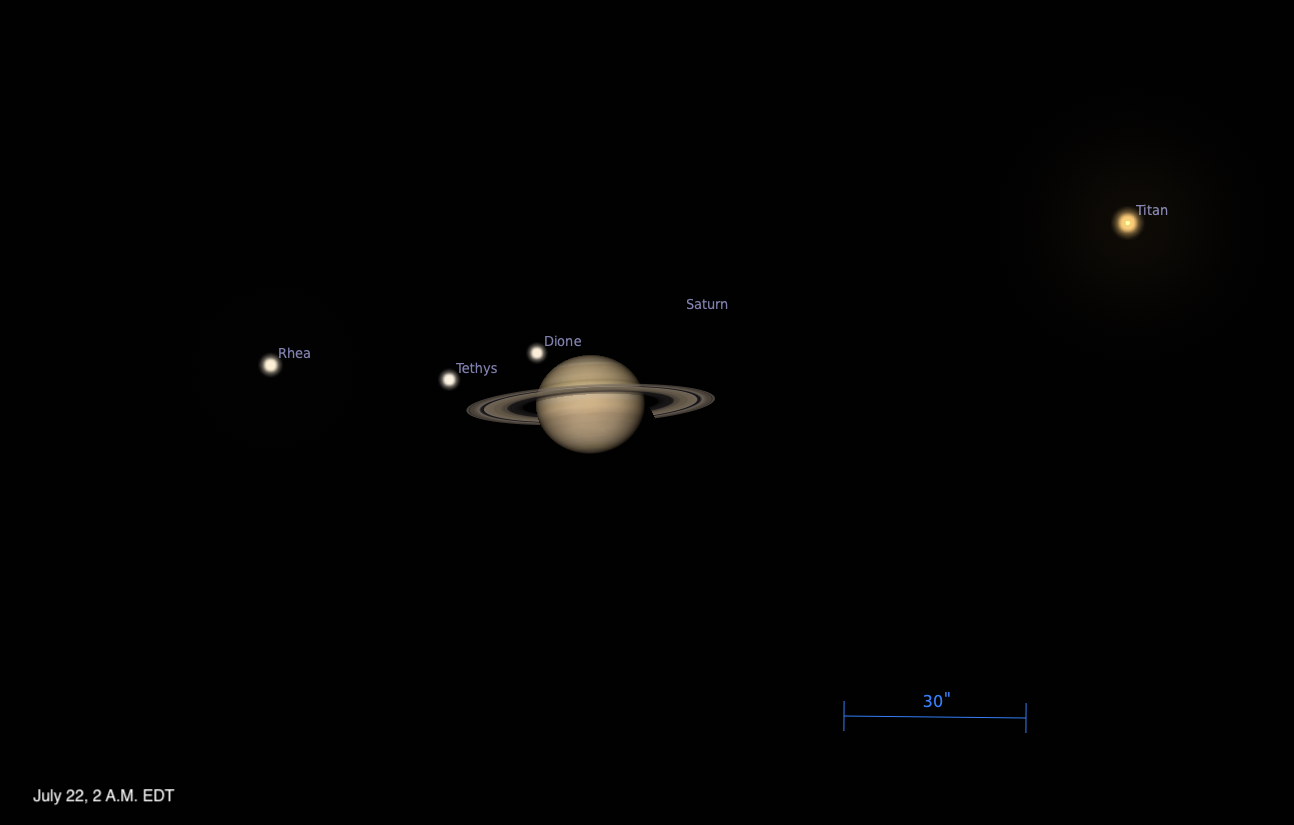
Let’s return to Saturn this morning to catch the 10th-magnitude moon Dione skimming north of the planet’s pole from about 3 A.M. to 4 A.M. EDT. Point your telescope toward the ringed planet as soon as it’s readily visible above your horizon to see how the view has changed since yesterday morning: Titan is now far (nearly 2’) to the planet’s northwest, while Rhea is quite far to the east. Around 2 A.M. EDT, Tethys is just north of the rings also to the east of the planet, and Dione is closing in from the northeast.
Over the next few hours, Dione will pass north of Saturn but won’t transit, leaving a sliver of dark space between the world’s limb and the moon. However, its tiny shadow will transit — if you’re an experienced planetary imager, particularly with video capture, this is for you. (If not, you’re not likely to see the shadow by eye.) The shadow leads the moon, appearing at the northeastern limb just after 1:30 A.M. EDT and taking two hours to complete its transit. It disappears from the northwestern limb just as Dione is roughly due north of Saturn’s pole.
Imagers, stay alert — next up is Tethys’ shadow, which appears at the eastern limb just above the rings around 4 A.M. EDT. Tethys itself then begins a transit around 4 A.M. CDT (note the time zone change). Again, only imagers will likely see this event, as the small moon will be hard to make out against the bright cloud tops. Tethys’ shadow transit ends around 4:30 A.M. MDT (again, note the time zone change), while Tethys slips away from the disk about 30 minutes later.
Sunrise: 5:50 A.M.
Sunset: 8:23 P.M.
Moonrise: 3:00 P.M.
Moonset: 12:09 A.M.
Moon Phase: Waxing gibbous (66%)
Thursday, July 23
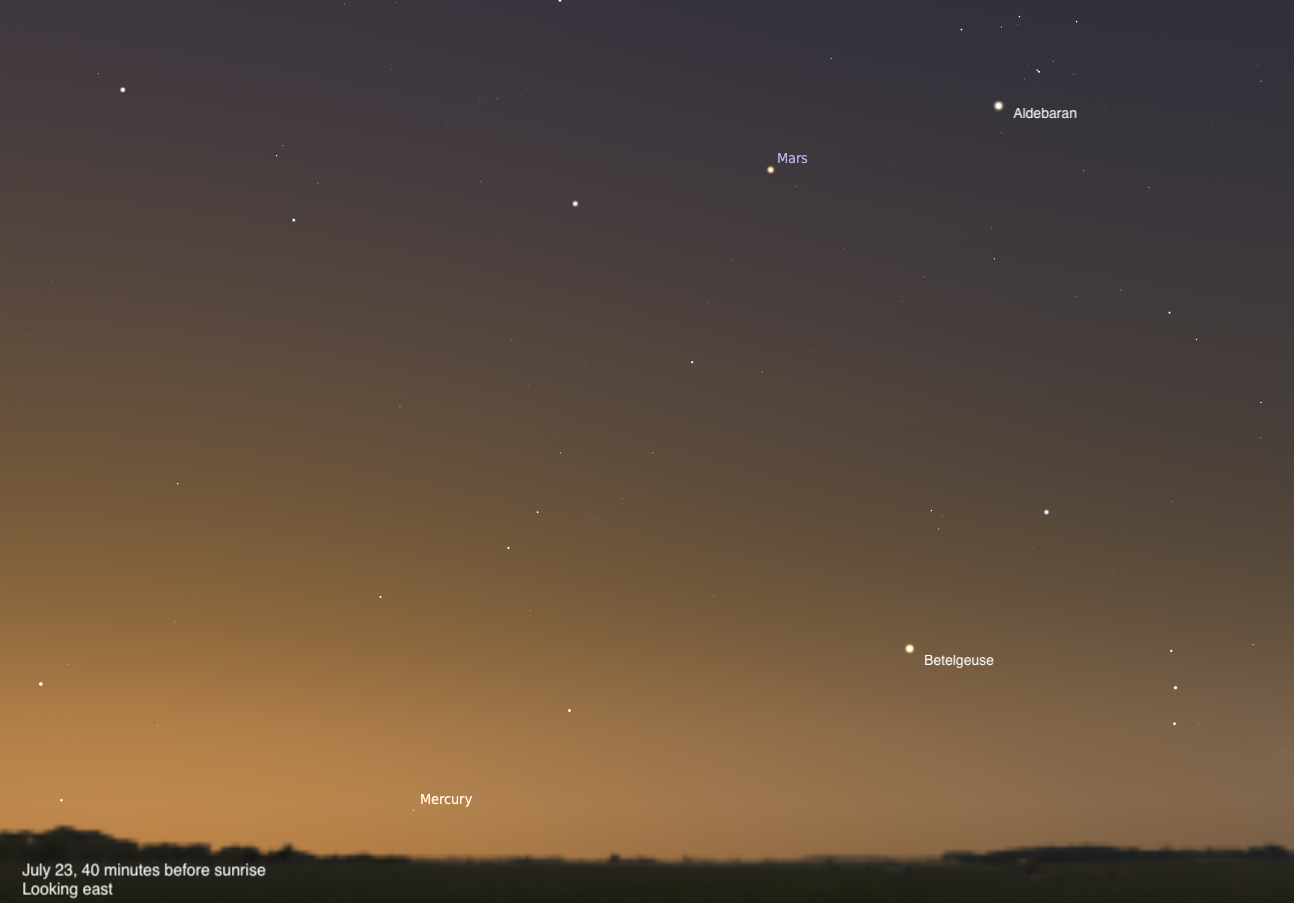
The planet Mercury is stationary at 1 P.M. EDT. Located in the constellation Gemini, the tiny world is now rising before the Sun, visible for a short time in the east before sunrise. However, it’s quite faint — magnitude 2.2 — and is best seen with binoculars or a telescope, to the far lower left of Betelgeuse in Orion, which itself stands left of the three star asterism Orion’s Belt. High above, magnitude 1.3 Mars is brighter and easier to spot, to the left of Taurus’ brightest star, Aldebaran.
Mercury is just 2° above the horizon around 5:10 A.M. local daylight time, although it’s rising. However, the sky is also brightening, so the earlier you can catch it, the better. A clear, flat horizon with no trees or buildings is best. Try using some optical aid to spot it, once you know you’re in the right area (or simply use the go-to function on your scope if you have it). Through a telescope, Mercury is just 12% lit, which is why it’s so faint despite its diameter of 10”.
Now that Mercury has paused its motion in our sky, it will stop moving westward, or retrograde, and begin moving eastward, or prograde. In the coming weeks, it will head for the eastern border of Gemini and cross into Cancer around midday on August 8.
Sunrise: 5:51 A.M.
Sunset: 8:22 P.M.
Moonrise: 4:03 P.M.
Moonset: 12:38 A.M.
Moon Phase: Waxing gibbous (75%)
Friday, July 24
The Moon passes 0.6° south of Antares, the heart of Scorpius the Scorpion, at 6 P.M. EDT. This evening, the two remain nestled close, a lovely sight in the southern sky after sunset.
About 90 minutes after the Sun disappears, the stars are truly starting to appear in the darkened sky. The waxing gibbous Moon is now about 20° high in the south, just to the lower left of ruby-red Antares. This red giant star shines at magnitude 1.0; its color helped inspire its name, which is often translated to mean “rival of Mars” because the two can be so easily confused, thanks to their similar hues and brightness.
From most U.S. locations, as you look south this evening the entire curving figure of Scorpius should be above the horizon, from its sweeping front claws to its long, winding tail. To its left is the boxy form of the Sagittarius Teapot asterism, while far to the upper right is the bright star Arcturus in Boötes, and to the far upper left is the luminary Altair in Aquila.
If you’re planning to be up past midnight, keep an eye on both Antares and the Moon, checking in every so often. As the hours tick past, the Moon will appear to pull farther away from the star, widening the distance between them as our satellite tracks quickly across our sky. Its motion relative to the stars isn’t always obvious, except when there’s a nearby signpost, as tonight.
Sunrise: 5:51 A.M.
Sunset: 8:21 P.M.
Moonrise: 5:04 P.M.
Moonset: 1:13 A.M.
Moon Phase: Waxing gibbous (82%)
Alison Klesman is senior editor of Astronomy magazine. She holds a Ph.D. in astronomy and has studied a variety of topics, from minor planets to supermassive black holes.