The Sky Today on Saturday, July 11: Dione passes north of Saturn
Everyone can watch a small moon skim Saturn’s northern pole, while advanced imagers may catch its shadow on the cloud tops.
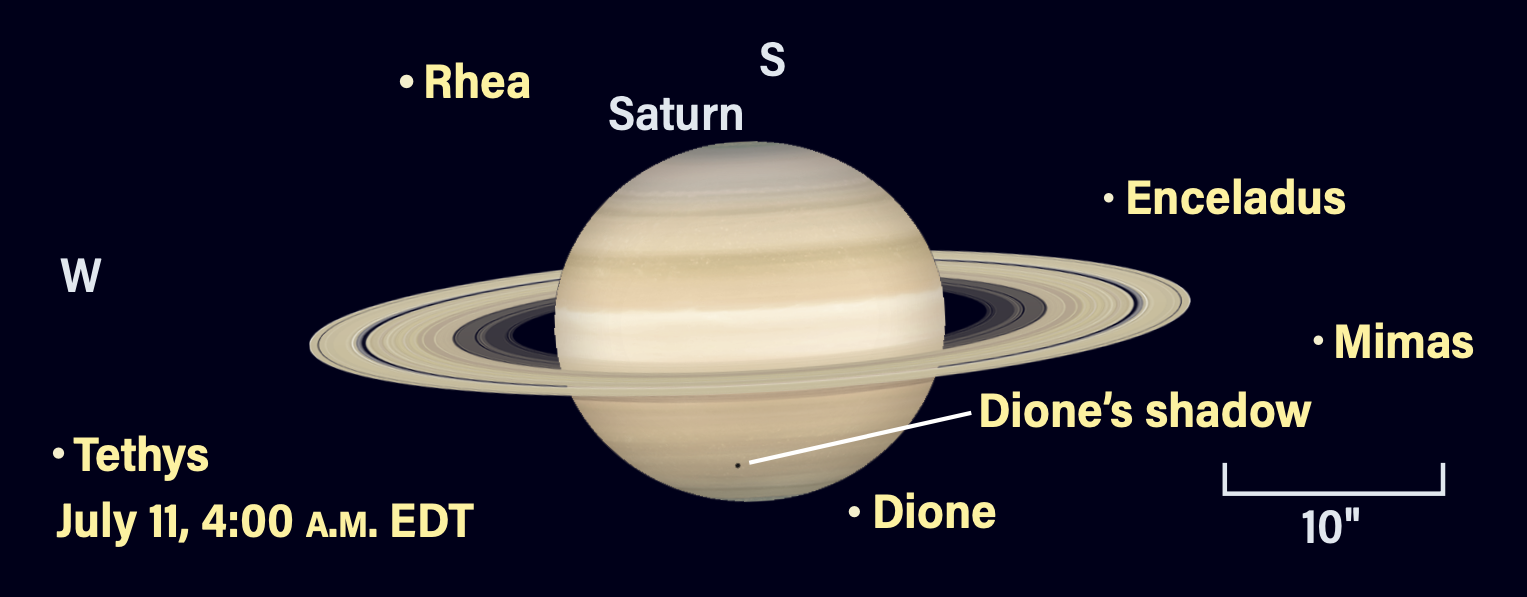
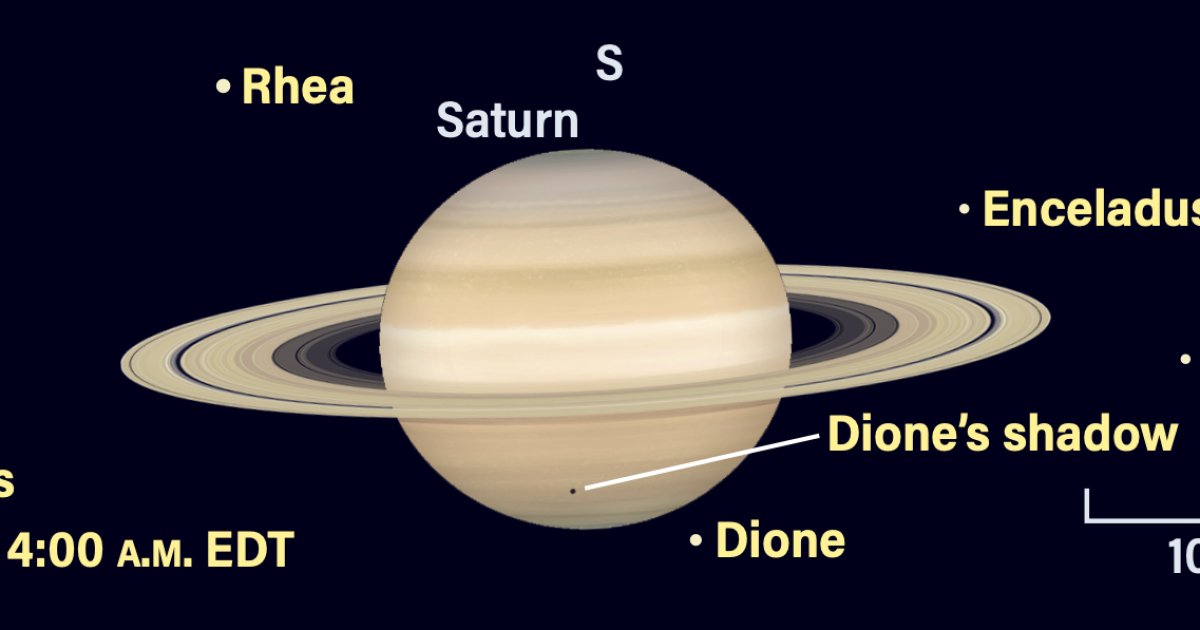
Tenth-magnitude Dione passes north of Saturn twice this month, accompanied by its shadow. The latter can only be detected via imaging. Also shown are several fellow moons: Rhea and Tethys are roughly the same brightness as Dione, while Enceladus is 12th magnitude and Mimas is 13th magnitude. Credit: Astronomy: Roen Kelly
Looking for a sky event this week? Check out our full Sky This Week column.
July 10: Meet Mizar and Alcor
Saturn’s 10th-magnitude moon Dione passes due north of the ringed planet early this morning. As the moon passes above the planet’s pole, its shadow crosses the northern regions — if you’re experienced with video-capture planetary imaging, you might pick up the tiny dot against the cloud tops in your images. It will be virtually impossible to spot visually, though.
To catch the shadow specifically, you’ll want to be set up and ready to go shortly before 3 A.M. EDT. Saturn is roughly 15° high in the east, the brightest light in this region of the sky. Through your telescope, you’ll see Dione just northeast of the planet. Its shadow appears just before 2:50 A.M. EDT and takes almost exactly two hours to cross from eastern to western limb.
Dione is also moving westward, standing due north of Saturn’s pole right as its shadow finishes its transit, shortly before 5 A.M. EDT. You’ll be able to see this visually through your eyepiece, although East Coast observers may have a little difficulty, as sunrise is approaching. The rest of the U.S. should have a good view of the small moon right above Saturn’s north pole.
Also this morning, the Moon passes 5° north of Uranus at 3 A.M. EDT. Our satellite then passes 5° north of Mars at 11 A.M. EDT. If you’re already up before dawn to catch the action at Saturn, take a moment to look over to Taurus about 60 to 90 minutes before sunrise, to spot the waning crescent Moon to the upper left of Mars and the lower left of the Pleiades star cluster (M45). No telescope is needed for this view, unless you also want to pick up Uranus, 4.7° west-southwest of Mars, directly on the ecliptic.
Sunrise: 5:41 A.M.
Sunset: 8:30 P.M.
Moonrise: 2:15 A.M.
Moonset: 6:17 P.M.
Moon Phase: Waning crescent (8%)
*Times for sunrise, sunset, moonrise, and moonset are given in local time from 40° N 90° W. The Moon’s illumination is given at 10 P.M. local time from the same location.
Return to Saturn tomorrow morning, July 12, to catch Titan, its largest and brightest moon, now close to the planet as it passes south of its parent world. Shining at mid-8th magnitude, Titan is easy to spot in any telescope. Check it out just southwest of Saturn in the few hours before sunrise.
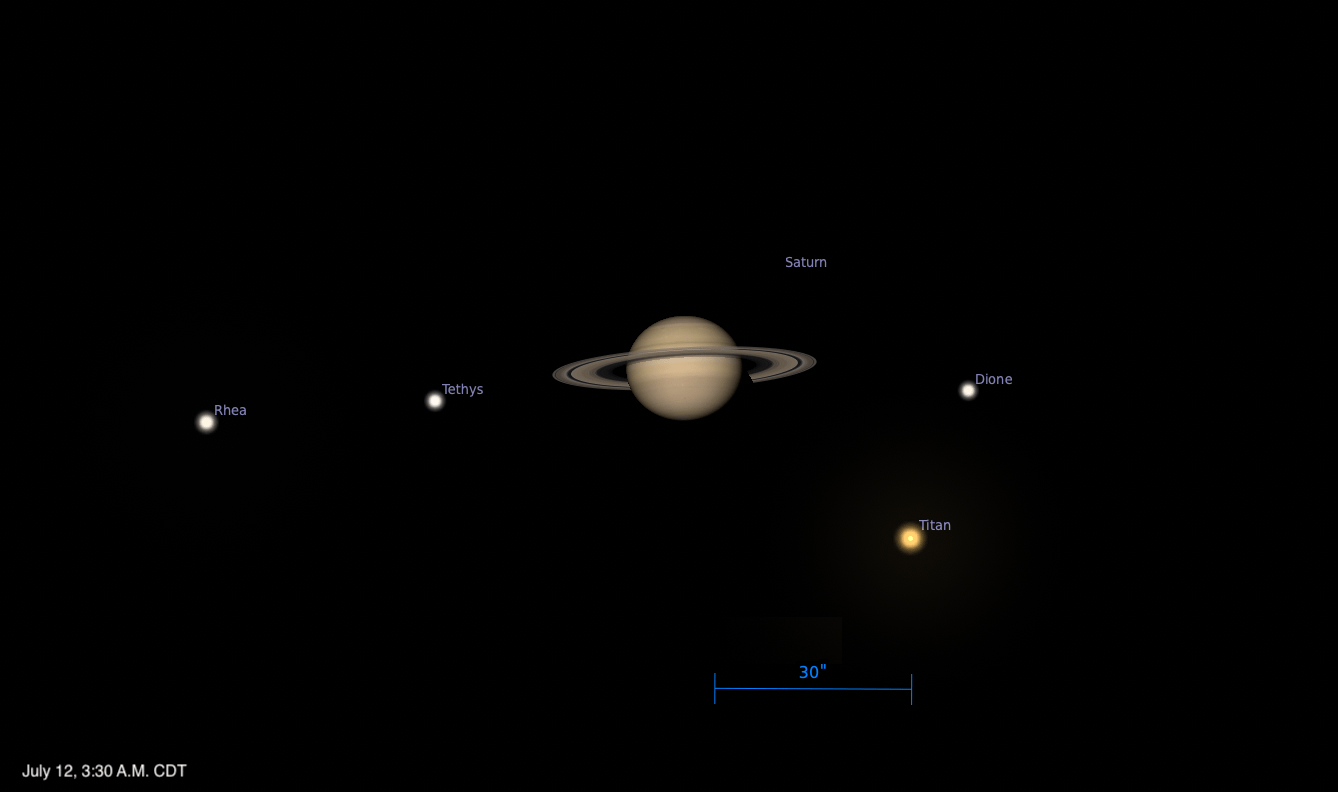
Around 3:30 A.M. local daylight time, Saturn will be some 35° high in the east. Taurus the Bull will have just risen and lies low along the horizon — Saturn is to this constellation’s upper right, the brightest point of light in an otherwise relatively unremarkable region of sky. Through a telescope, Saturn’s rings are of course the standout feature, now stretching 40” across and surrounding the planet’s 18”-wide disk. Along with Titan, several other fainter, 10th-magnitude moons cluster closer to the planet, including Dione, which is now west of the planet, roughly in line with the rings. Tethys and Rhea, also 10th magnitude, lie to Saturn’s east. Other fainter moons are also close to the gas giant, but they will be difficult to pick up in most scopes (and are not shown on the chart above).
Alison Klesman is senior editor of Astronomy magazine. She holds a Ph.D. in astronomy and has studied a variety of topics, from minor planets to supermassive black holes.