This Battery Charges in Four Minutes and Needs No Lithium
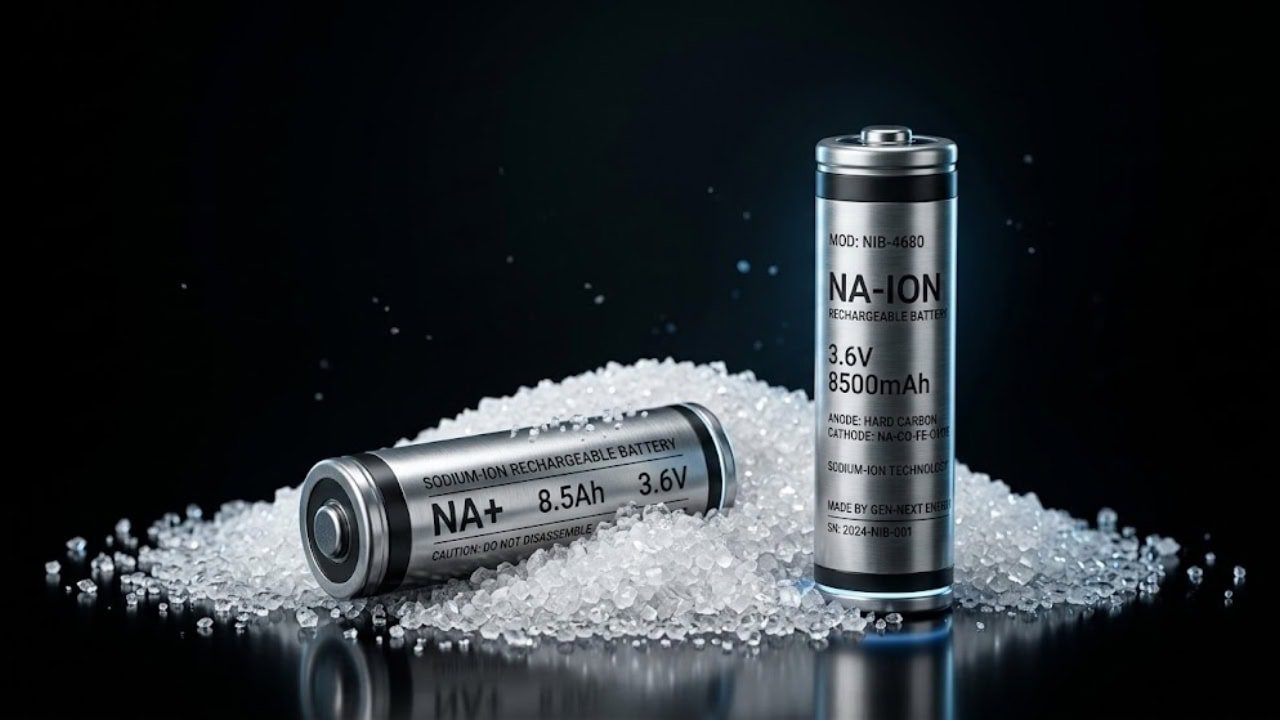
A Chinese scientist under 35 has spent a decade chasing something the field kept calling impossible. Lu Yaxiang has built a sodium battery that charges in roughly four minutes, which is the kind of number that stops arguments.
The professor at the Chinese Academy of Sciences’ Institute of Physics won the China Youth May Fourth Medal in April, the country’s top honour for achievers under 35, for exactly this work. Her cell retains 90% of its capacity after 2,000 charge cycles and runs on a quasi-solid gel electrolyte that keeps working even when repeatedly bent.

The reason China cares so intensely comes out to be more arithmetic than scientific. The country imports 75% of its lithium, leaving its entire battery industry hostage to foreign supply chains. Sodium is roughly 500 times more abundant, can be pulled from seawater, and costs a fraction of lithium. So every sodium advance is also an act of energy security.
Lu spent a decade getting here through materials engineering rather than luck. A 2020 paper in Science established how composition determines structural chemistry in sodium-ion layered oxides, which decides whether a cathode works at all. Her lab produced advanced solid-state electrolyte materials in 2023, then solved a long-standing materials question outright in 2024. Across 110 published works, her research carries roughly 17,600 citations.
Sodium-Ion vs Lithium-Ion Batteries
| Factor | Sodium-ion | Lithium-ion |
|---|---|---|
| Abundance | ~500x more abundant, extractable from seawater | Scarce, concentrated |
| Cost | Fraction of lithium | High |
| Energy density (commercial cells) | 150-175 Wh/kg | 250-280 Wh/kg |
| Best prototype | Gotion at 261 Wh/kg, 20,000 cycles | Mature |
| Fire safety | Non-flammable options emerging | Thermal runaway risk |
| Cobalt required | No | Often yes |
| Cost parity outlook | Expected by 2027 | Current benchmark |
The electrolyte thinking is delightfully contrarian: while the field chased ever-higher concentrations, Lu’s group went the opposite way, proposing an ultralow-concentration electrolyte that exploits sodium’s smaller Stokes radius. That cut costs while widening the operating temperature range, which matters hugely for grid storage in harsh climates.
Her lab also built an ampere-hour-level sodium cell using a polymerizable non-flammable electrolyte, engineered to be thermal-runaway-free. Thermal runaway is the chain reaction where a damaged cell overheats until it burns, and it remains the biggest fear in battery adoption.
Lu earned her PhD at the University of Birmingham in Britain in 2015 and joined the University of Surrey as a postdoctoral researcher. She returned to China in 2017 to join the CAS Institute of Physics through an International Young Scientist Fellowship, and was an associate professor before being promoted to professor in 2024.
The numbers behind her career are unusual too, since her work carries roughly 17,600 citations across 110 research items. If it goes commercial on a large scale, cheap and non-flammable grid storage would transform load-shedding and solar adoption alike.
![[Laptop] Acer Predator Helios Neo 16S 16" OLED – Ultra 9 275HX – 16GB DDR5 – 1TB – RTX 5060 Win11 AI PC Refurb $1209](https://jobssz.com/wp-content/uploads/2026/07/1WoQPQEHx97AzMwgvoaV4qs1mZLYDyIfeVbSJRAX_hs.jpeg)