Tianwen-2 arrives at target asteroid Kamoʻoalewa
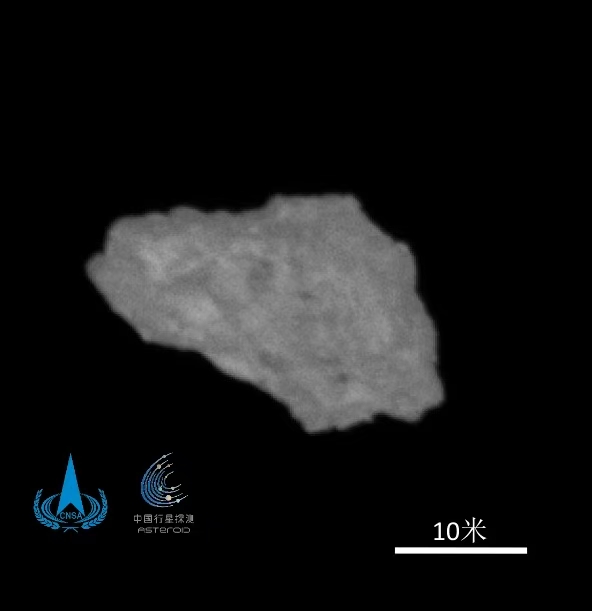
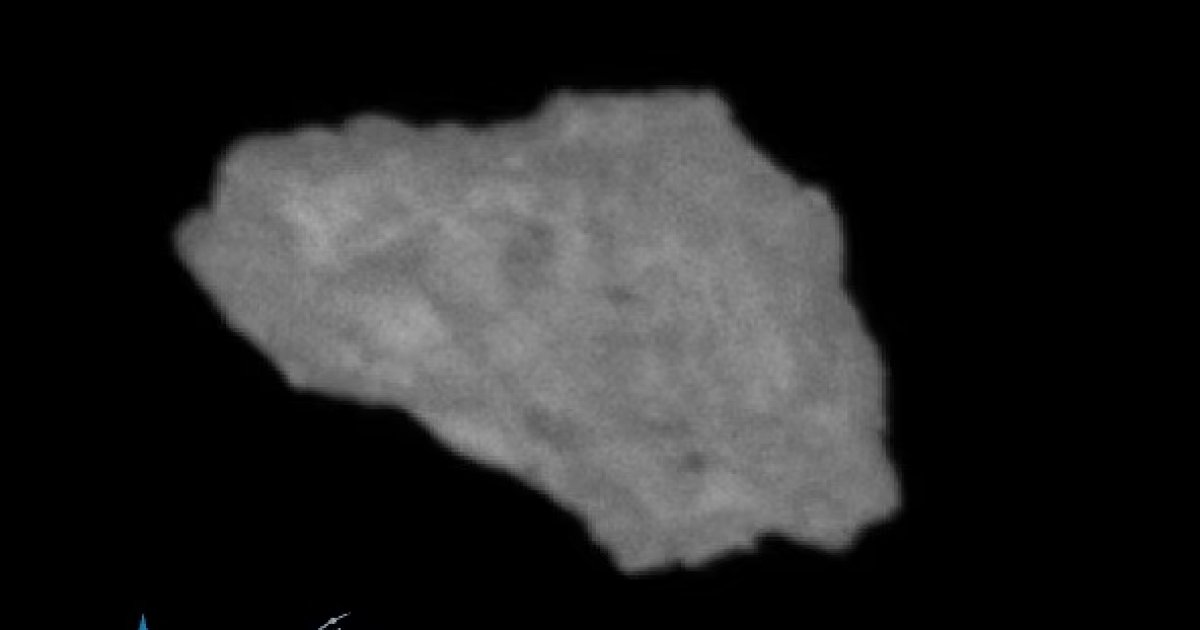
Asteroid 469219 Kamoʻoalewa’s elongated surface appears in this image, captured by Tianwen-2 from about 12 miles (20 km) away on July 2, 2026. Measured against the 10-meter scale bar, the near-Earth asteroid works out to barely 20 meters long — about half the size ground-based telescopes had estimated. Credit: CNSA
Nearly 400 days and a billion kilometers after leaving Earth, China’s Tianwen-2 spacecraft has arrived at its target: the near-Earth asteroid 469219 Kamoʻoalewa, also known as 2016 HO3. And the mission’s first photo of the rock has already had scientific impact, reopening an ongoing investigation over whether Kamoʻoalewa began as a chunk of the Moon.
The China National Space Administration (CNSA) announced July 6 that Tianwen-2 had closed to within 12 miles (20 km) of the asteroid, marking the start of its close-up science campaign. During the approach, the probe returned imagery of Kamoʻoalewa and sent back navigation data that sharpened the asteroid’s known position — trimming an uncertainty of hundreds of kilometers, the limit of ground-based tracking, “down to the kilometer scale.”
The mission is China’s first attempt at returning a sample from an asteroid, and Kamoʻoalewa is only its first stop. Over a decade-long expedition, Tianwen-2 is also bound for 311P/PanSTARRS, a comet-like body in the main asteroid belt, well beyond Mars.
Why Kamoʻoalewa is worth the trip
Tianwen-2 launched May 29, 2025, from the Xichang Satellite Launch Center, then spent more than a year maneuvering toward its target. The spacecraft first spotted Kamoʻoalewa on June 6, 2026. The next day, an engine burn from around 19,000 miles out (30,000 km) lined up Tianwen-2’s path with the asteroid’s, and by June 19 it had closed to 1,200 miles (2,000 km).
Asteroids preserve material largely unchanged since the solar system’s earliest days, offering a chance to trace the ingredients of planets back to their source. But one subset of asteroids is particularly enticing — those that orbit the Sun in near lockstep with Earth, called quasi-moons: They sit closer than other asteroids, and therefore are easier to reach. (They’re called quasi-moons because as they move in our planet’s vicinity, they drift around Earth, appearing to orbit it — but in reality, they are orbiting the Sun.)
Kamoʻoalewa stands out even in that small group. It’s one of only seven known quasi-moons of Earth, and by far the most stable. Kamoʻoalewa has already kept pace with Earth for centuries and, by some models, could remain a close companion for half a million years or more.
Studying its makeup, shape, and interior could help pin down the material, formation, and evolutionary history of the early solar system — the job of an 11-instrument suite that includes twin imaging and thermal spectrometers, ground-penetrating radar, a magnetometer, particle analyzers, and a dust detector built in Italy dubbed DIANA (Dust In-situ ANalyzer).
Three ways to grab a sample
Collecting a piece of the asteroid won’t be simple. Tianwen-2 carries three ways to grab a sample, each suited to a different kind of surface. The gentlest is hovering — as explained by reporting in Tech Times, the probe eases in close without landing and reaches out with an instrument to “collect loose material with minimal contact force,” the safest option if Kamoʻoalewa’s surface proves fragile or crumbly.
By contrast, the touch-and-go method would have the spacecraft brush the surface for seconds to minutes while a collection mechanism does its work. This is the same method Japan’s Hayabusa2 used at 162173 Ryugu and NASA’s OSIRIS-REx used at 101955 Bennu.
The boldest option is anchor-and-attach, in which four robotic arms tipped with drills would clamp directly onto the rock, holding the probe in place for a longer, more deliberate extraction. As Andrew Jones reported for IEEE Spectrum, when the mission’s sampling plan was first detailed, no spacecraft had ever attempted anchor-and-attach in deep space, and mission planners built in redundancy by carrying multiple methods to “guarantee that at least one works.”
Which technique Tianwen-2 actually uses will depend on what the ongoing survey reveals about the asteroid’s surface strength. The probe will spend the coming months mapping Kamoʻoalewa’s structure before committing to a landing site, then work toward departing with its sample in hand.
Is Kamoʻoalewa a piece of the Moon?
Kamoʻoalewa’s exact origin has been an open question since 2021, when astronomer Benjamin Sharkey and colleagues studied the asteroid’s reflected light and found something odd: Unlike other near-Earth asteroids, it reflected much more light at red and infrared wavelengths than at bluer wavelengths — a pattern that matched space-weathered lunar soil more closely than any known asteroid type. That clue launched a theory: Kamoʻoalewa might be a chunk of the Moon, blasted free by an ancient impact.
Two new pieces of evidence now complicate that picture. The first is Tianwen-2’s own photo, which shows Kamoʻoalewa is only about 20 meters across — roughly half the smallest size ground telescopes had estimated. A smaller rock reflecting the same amount of sunlight has to be much more reflective than expected, and the Moon isn’t reflective enough to match. The second is a paper posted to the arXiv preprint server on July 1 — written, notably, by the same Sharkey who proposed the lunar-origin idea in 2021, this time using new James Webb Space Telescope data. His new spectrum of Kamoʻoalewa looks distinctly less red than his 2021 measurements, closer to an ordinary silicate asteroid than reddened lunar rock, and puts the asteroid’s diameter at 18 meters — in line with what Tianwen-2 just photographed.
“So it seems that Kamo’oalewa is of asteroidal origin,” Mikael Granvik, an astronomer at the University of Helsinki and Luleå University of Technology, told SpaceNews after reviewing the first Tianwen-2 image.
What’s next for Tianwen-2?
Mission planners expect Tianwen-2 to leave Kamoʻoalewa in April 2027, releasing its sample capsule for a landing in China’s Gobi Desert that November. Only then will scientists have a sample to examine in a lab and definitively determine whether Kamoʻoalewa is an asteroid or a piece of the Moon. The spacecraft itself will keep going — after flying by Earth, it’s set to press on toward 311P/PanSTARRS, arriving at the main-belt comet in January 2035 and making Tianwen-2 the first spacecraft to visit both a near-Earth asteroid and a main-belt comet.
Brooks Mendenhall is a staff writer for Astronomy and is based in Chattanooga, Tennessee.