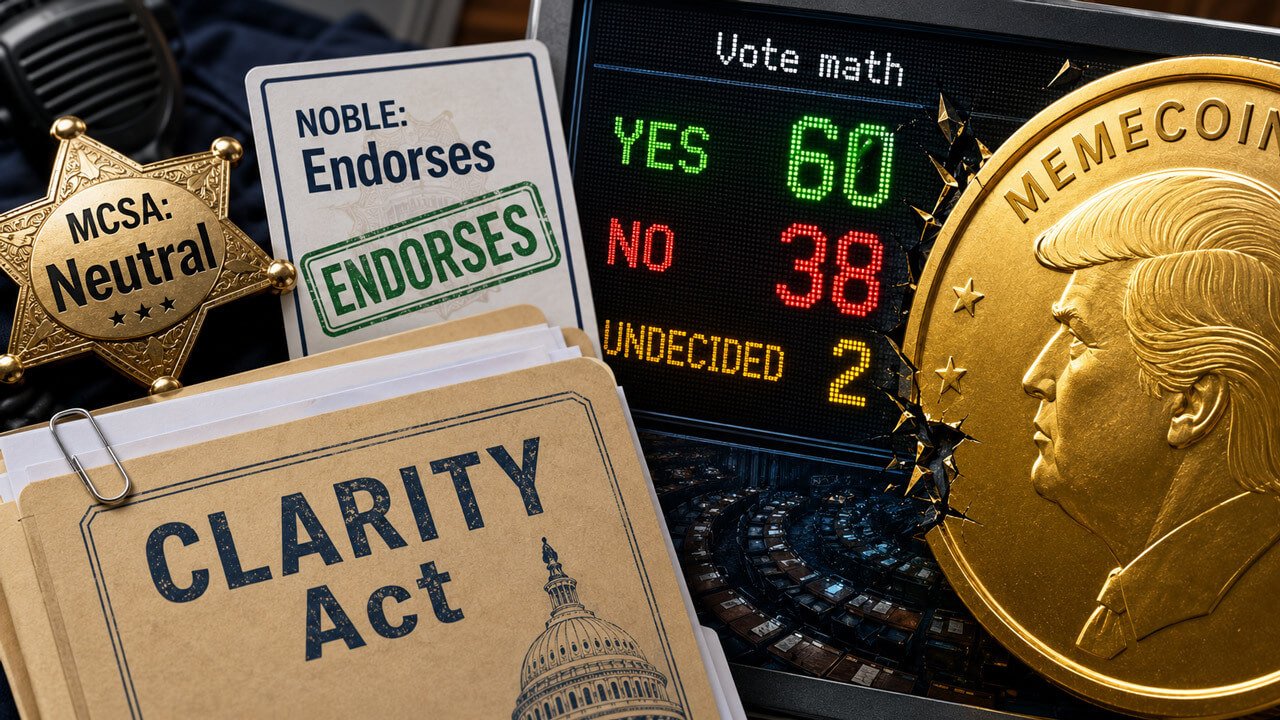
Trump memecoin ethics fight still controls CLARITY Act vote after law enforcement opposition cracks
The CLARITY Act’s two biggest obstacles are moving in opposite directions this week. Law enforcement opposition is softening, while the ethics fight over crypto conflicts of interest is sharpening.
Before this week, forecasters and prediction markets already had CLARITY at a coin flip of becoming law in 2026. The core blockers were floor time, an open ethics dispute, anti-money-laundering language, and developer-liability fights over Section 604.
That provision is the safe harbor protecting software developers who never control user funds.
| Issue | Before this week | After this week | Odds impact |
|---|---|---|---|
| Section 604 developer safe harbor | Major law-enforcement objection | MCSA moves to neutral; NOBLE endorses | Positive |
| Law-enforcement narrative | Opponents had momentum | Law enforcement is now split | Positive |
| Ethics language | Democratic vote condition | Gillibrand renews push after Trump disclosure | Mixed |
| Senate floor time | Tight | Still tight | Unchanged / negative |
| Final passage in 2026 | Coin-flip at best | Slightly better path to a vote, not a clear path to enactment | Mixed |
The sheriffs go neutral
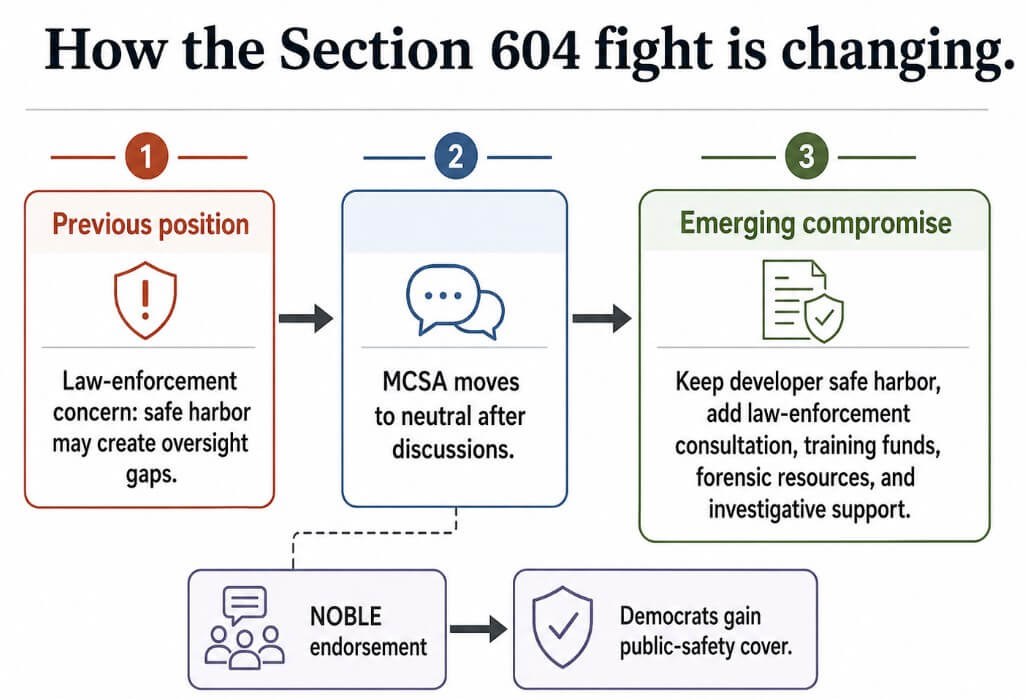
The Major County Sheriffs of America spent months inside the law-enforcement opposition to CLARITY. Its May letter warned that Section 604 could create gaps in oversight, make it harder to trace illicit crypto activity, and give criminals more room to operate.
Section 604 covers a non-controlling developer or provider: someone who writes software, enables self-custody, or supplies infrastructure without controlling user funds.
That person stays outside money-transmitter liability for those activities alone. Liability still applies to anyone acting outside that scope or moving funds with the specific intent to launder criminal proceeds.
Law-enforcement opponents argued the carve-out was too broad anyway, and warned it could shield mixers, tumblers, and some DeFi services from money-transmission rules and complicate efforts to trace stolen funds.
As Eleanor Terrett reported, a new letter dated July 3 puts MCSA in neutral territory. The group points to continued discussions and asks for something narrow in return. It wants a formal role for state and local law enforcement inside Treasury’s study and advisory bodies, plus funding for training, technology, forensics, and investigations.
That move points to Section 604 talks moving from killing or rewriting the safe harbor toward a narrower fight over consultation rights and resources, a far easier trade for the Senate to make.
A law-enforcement counterweight
NOBLE, the National Organization of Black Law Enforcement Executives, went further and endorsed the bill outright.
Terrett also reported that the group said CLARITY would add meaningful new capabilities for investigators while preserving the criminal authorities police already rely on. It directly pushed back against claims that the bill weakens tools against money laundering, unlicensed money transmission, conspiracy, aiding and abetting, or sanctions violations.
NOBLE gives wavering Senate Democrats a law-enforcement organization to point to, one that describes the bill as a net gain for investigators.
CLARITY includes a temporary hold mechanism that allows covered agencies, including state and federal law enforcement, to delay a suspicious transaction for up to 30 days, with the option to extend upon a qualified written request.
The bill also carries Bank Secrecy Act and sanctions provisions, illicit-finance studies, and funding for FinCEN. Those are the tools NOBLE points to as proof that the bill adds capability.
Law enforcement now speaks with various voices on CLARITY, a split that gives Senate supporters room to argue the public-safety case cuts both ways.
The price of Democratic votes
Sen. Kirsten Gillibrand renewed her push on July 3 to bar elected officials and their spouses from issuing or sponsoring digital assets.
Her office’s release pointed to President Donald Trump’s financial disclosures, which showed hundreds of millions of dollars in 2025 income tied to a memecoin he issued.
Gillibrand has said that CLARITY needs a provision limiting senior officials’ crypto ties to pass the Senate. Roll Call has reported that Senate Democrats broadly want language to curb public officials from profiting by sponsoring or endorsing digital assets. The Trump disclosure gave that existing demand a headline.
Democrats have already treated conflict-of-interest language as a condition for their votes, and CLARITY needs a meaningful bloc of Senate Democrats to clear the filibuster.
A narrow ethics amendment could hand Democrats a win and clear a path to their votes, while a fight that turns into a referendum on Trump’s own crypto income could consume floor time Senate leadership can barely spare.
The calendar, the hardest constraint of all, sits where it did last week. CLARITY still needs floor time, Senate passage, House reconciliation, and a signature before an election-year clock closes the window.
| Scenario | What has to happen | What it means for CLARITY |
|---|---|---|
| Best case: ethics-for-604 trade | Republicans accept a narrow ethics amendment; Democrats accept Section 604 with law-enforcement add-ons | Bill becomes a viable floor package before August recess |
| Middle case: vote improves, passage uncertain | Law-enforcement resistance softens, but ethics language remains unresolved | Floor action becomes more likely, enactment still uncertain |
| Bear case: ethics fight hardens | Republicans treat ethics language as anti-Trump; Democrats withhold votes | Section 604 progress gets overwhelmed by conflict-of-interest politics |
| Calendar failure | Senate runs out of floor time before recess | New law-enforcement support no longer matters procedurally |
| Post-recess drag | CLARITY slips into later election-year fights | Passage odds fall even if policy gaps narrow |
How the trade evolves
Republicans could accept a narrow ethics amendment limiting senior officials’ ability to profit from digital asset sponsorships.
Democrats could accept Section 604’s safe harbor once it includes the consultation role, training funding, and forensic resources that MCSA is asking for. Put those two trades together, and CLARITY becomes a real floor package before the August recess.
Republicans could treat any ethics amendment as an attack on Trump and refuse to bring it to the floor. Democrats could hold their votes until conflict-of-interest language passes, and either path burns calendar time CLARITY can barely afford.
Floor time is running out before the recess, which would strand the law-enforcement progress from this week.
CLARITY got harder to finish this week, and law enforcement now gives Senate supporters real cover on crime and public safety.
Whether that cover is enough depends on a separate fight over ethics, one that decides who gets to profit from crypto while writing its rules.