UH Researchers Find Potential Breakthrough for Crohn’s Disease Treatment
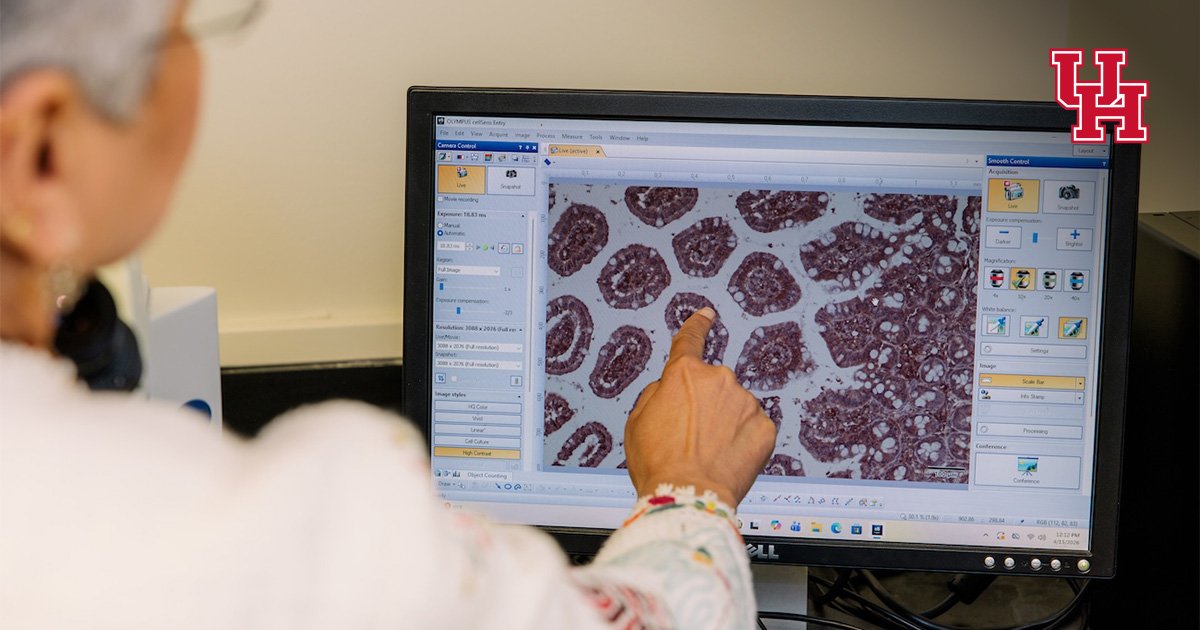
University of Houston Professor Seema Khurana points to a microscopic image showing
the expression of a protein of interest in a normal tissue section. Khurana is part
of a team focusing on finding treatment for Crohn’s disease.
Key Takeaways
- In a new study, University of Houston researchers are focusing on a stress signal
in cells that prevents the gut lining from healing in Crohn’s patients. - By using low doses of existing cancer medications, the team can bypass the decade-long
wait for new drug development to bring relief to patients faster. - The study moves away from traditional anti-inflammatory approaches to a regenerative
approach, using patient-derived “mini-organs” to prove that the intestinal lining
can be taught to repair itself.
University of Houston biologists have contributed to a potential breakthrough in treating
Crohn’s disease by shifting the clinical focus from symptom management to addressing
a primary underlying cause of the condition.
Crohn’s disease, a chronic inflammatory bowel disease affecting approximately 1 million Americans, involves a cycle where the immune system attacks the epithelial lining, disrupting
the “gut barrier.” When this lining is damaged and fails to repair itself, the barrier
is lost and bacteria and toxins leak into the body, fueling chronic inflammation and
disease progression.
While anti-inflammatory medications are the standard for treating disease relapses
or flares, only about 20% of patients achieve sustained remission through these traditional
methods.
In a new study published in Gastro Hep Advances, researchers from UH, Baylor College of Medicine and The University of Texas MD Anderson
Cancer Center propose a new idea: the disease is driven by inherent defects in the
epithelial lining, which also fuels the immune response. By repurposing two existing
cancer medications, the team aims to stop the inflammatory cycle initiated by the
epithelial cells and allow the gut barrier to repair itself.
“It’s a paradigm shift from the way we’ve thought about the disease,” said Seema Khurana,
senior author and Moores Professor of biology and biochemistry at UH. “Existing therapies
primarily manage symptoms because we don’t know what causes the disease. We believe
our research brings us closer to identifying those drivers.”
Targeting the Stress Signal

For nearly three decades, Khurana has been a leading researcher in gastroenterology.
Her team’s 2018 research first linked gut barrier health to the progression of Crohn’s
disease, noting that under chronic stress, the intestines of Crohn’s patients begin
killing off their own epithelial cells rather than regenerating.
In the new research, the team found that this dysfunction of epithelial cells furthers
disease progression by actively inhibiting epithelial regeneration.
“In a healthy cell, the stress signal goes up and when the stress is resolved, the
signal goes back down. In Crohn’s patients, this stress signal is always on,” Khurana
said. “When the stress signal is always on, the cell cannot manage the stress and
undergoes a form of programmed cell death called necroptosis, which further triggers
inflammation.”
The team determined that using low concentrations of two cancer medications could
be crucial to fixing this. Pazopanib and Ponatinib were found to inhibit the initial
cellular stress response signaling and the cell death — promoting the natural repair
and regeneration of the intestinal lining.
Focusing on Pathways to Patient Care
Repurposing existing medications offers a massive advantage in medical development.
Using medications already approved by the U.S. Food and Drug Administration reduces
the risk of clinical trial failure and significantly bypasses the hefty costs and
decade-long timelines associated with new drug discovery.
The study also utilized patient-derived organoids — “mini-organs” grown from actual
patient tissue — which is the modern gold standard for biological research. This approach
ensures that the results are highly relevant to human biology, paving the way for
future clinical applications.
“If you had to start from scratch to identify and develop a drug, it takes 10 to 15
years and can cost between $1 billion to $2 billion,” Khurana said. “For a patient
who is suffering from chronic Crohn’s disease, they’re looking for some immediate
relief. Our goal was to make our findings much more translatable to real patients.”

researchers compare healthy tissue with diseased epithelium.

Chron’s disease.