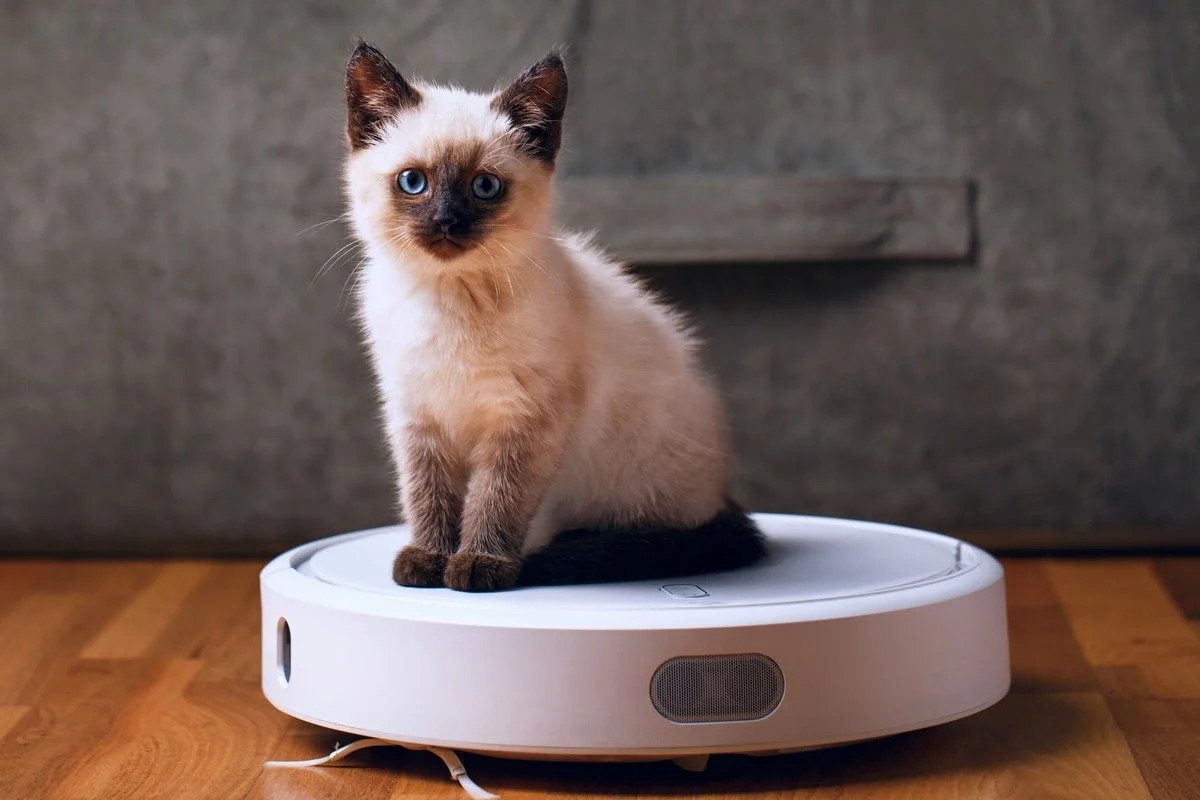
Scientists reprogrammed a Roomba to perform four new tasks, including playing with pets, in an effort to maximise their downtime (iStock/ Getty Images)
The Trump administration has banned new Chinese robots – including vacuums – amid fear over the growth of the country’s AI industry.
The ban took aim at “humanoid robots” and quadrupeds, of the kind that put AI systems into human- or animal-like bodies. But it also covers almost any kind of reasonably heavy robot that is controlled by software and is able to perceive its environment and connect wirelessly, which includes robot vacuums such as Roombas.
The ban will not include existing devices. But it will cover imports of new robots from China, as well as power inverters that are used to connect renewable energy sources into the grid.
It is part of a broad range of efforts by the US government to protect the country’s AI industry amid increasing challenge from Chinese rivals. A range of AI breakthroughs from China have led to fears that the US’s domination of technologies such as chatbots could be challenged by cheaper and more capable versions.
The Trump administration also suggested that the ban should protect the artificial intelligence supply chain from threats of disruption, data theft and cyber attacks that could come with growing Chinese industry.
“These devices could create supply chain vulnerabilities that could disrupt US economic and national security and could create a cybersecurity risk that threatened American critical infrastructure,” the FCC said in a statement. “The FCC will continue to do our part to secure America’s critical supply chains,” FCC Chairman Brendan Carr added in the press release.
The Chinese embassy in Washington said Beijing “urges the United States to heed the objective and rational voices of the business communities in both countries” and “stop smearing Chinese companies and threatening them with sanctions.”
China’s government will “take all necessary measures in response to any action that causes material harm to its interests,” the embassy said.
Some analysts forecast broad adoption of humanoid robots, topped with AI-enabled “brains,” in consumer and industrial arenas, while explosive data-center construction in the US will depend on reliable sources of inverters.
Treasury Secretary Scott Bessent has warned that Chinese AI firms could face US sanctions for stealing US intellectual property.
US officials are also keen to avoid another scenario as happened with rare earth minerals — critical inputs for tech manufacturing so dominated by China that Beijing has been able to leverage access to them to secure big wins on the international stage.
Following Tuesday’s actions, the FCC is expected to exempt many non-Chinese suppliers from the restrictions, as it has done with recent bans on foreign drones and routers, four additional sources said.
The measures, which went into effect upon publication, apply only to robot and inverter models that have not yet been released. However, the FCC has the authority to revoke authorizations for sales of models that have already been authorized for purchase in the United States.
President Donald Trump is credited with bringing international attention to the tech threat posed by China during his first term, giving voice to concerns about intellectual property theft by Chinese firms, and the threat of state-sponsored spying by Chinese telecom juggernauts like Huawei .
But he has so far taken a much more dovish approach during his second term, faced with Beijing’s aggressive use of export controls on rare earth minerals last year.
The robot ban is expected to hit Unitree, a world leader in humanoid robots with just under a fifth of global market share, according to Counterpoint Research.
The firm, which is one of three Chinese companies dominating the nascent but buzzy industry, was recently added to the Pentagon’s list of alleged Chinese military-backed companies, which can be a harbinger of tougher U.S. action.
Unitree recently formed a partnership with Nvidia to use the AI chip company’s cutting-edge Blackwell chip to power the brain of a Unitree robot. Nvidia has said data from the robots will remain in the US and that Unitree’s biggest customers are US academic and research institutions.
China hawks fear the robots could spy on key US industries, extracting data and sending it to Beijing or disrupting critical functions.
Robots “collect data that could be leveraged by malign actors to surveil Americans, enhance the capabilities of foreign intelligence services, or to remotely commandeer the robots,” the FCC said on Tuesday.
US Representative John Moolenaar, a Michigan Republican who chairs the House Select Committee on China and has proposed legislation targeting Chinese robots for national security reviews and potential bans, said the FCC move “protects our country and strengthens our nation’s robotics industry.”
China is the world’s largest maker of inverters, led by Sungrow Power Supply and Huawei, already heavily sanctioned by the US. Beijing has been expanding its share in the Western inverter market by driving down prices.
Reuters previously reported that the FCC was working on a Chinese inverter ban prompted by recent action by Europe and concerns around disruption and installation of malware.
Authorities want to avoid another Chinese government-linked hacking campaign like the one dubbed Volt Typhoon, revealed in 2023. By taking control of privately owned routers, the attackers sought to hide subsequent attacks on American critical infrastructure.
The U.S. Department of Defense is already barred from procuring solar photovoltaic cells, modules or inverters manufactured by a foreign entity of concern, which would include Chinese companies.
Unitree, Sungrow and Huawei did not immediately respond to requests for comment.
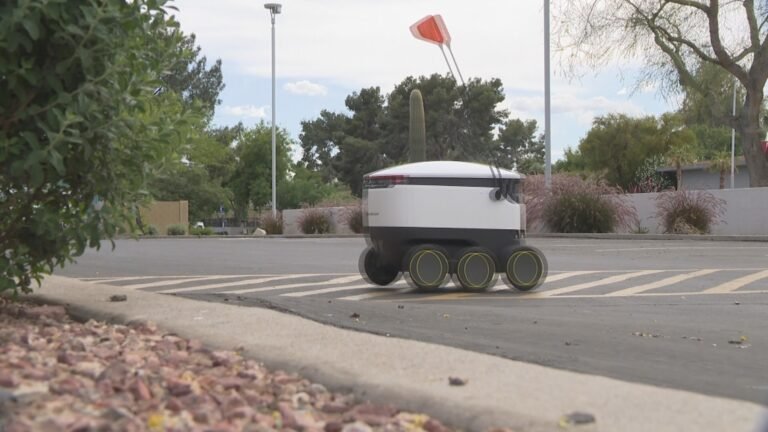
Trudy Perez, who was 73 at the time, alleges a Starship delivery robot knocked her down in 2023, causing a spinal fracture and permanent injuries. TEMPE, Ariz. — A Valley woman has sued Starship Technologies, alleging one of the company’s autonomous food delivery robots knocked her to the ground while she was working as a…
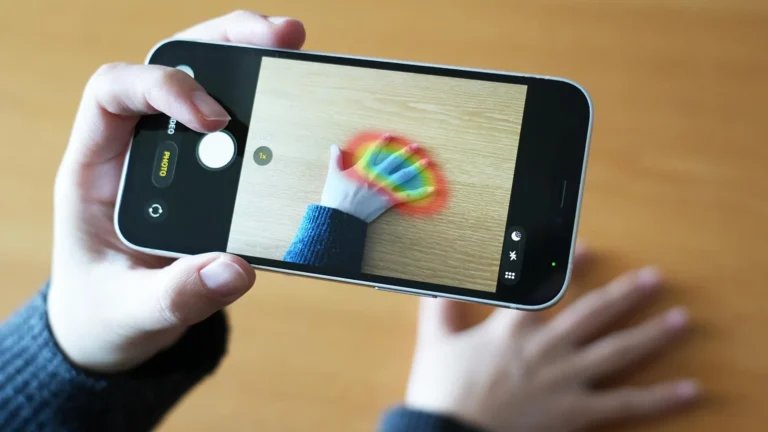
Researchers at Kobe University have created an artificial intelligence system that can identify a rare endocrine disease simply by examining photos of the back of the hand and a clenched fist. The approach avoids facial images, helping protect patient privacy while still achieving high diagnostic accuracy. Scientists say the technology could eventually help doctors refer…
Physicists have used a machine learning approach to reveal unexpected details about how particles interact in complex systems. Their work focuses on non-reciprocal forces, where one particle influences another differently than it is influenced in return. The findings, published in PNAS, come from a collaboration between experimental and theoretical physicists at Emory University. By combining…
Image credit: By Jeff Dahl – Own work by uploader, Based on the public domain document: [1], CC BY-SA 3.0, Link By Stephanie Parker This research from the NeuroAI Lab of Martin Schrimpf, part of EPFL’s Schools of Computer and Communication Sciences and Life Sciences, uses AI models to predict exactly where to stimulate the…
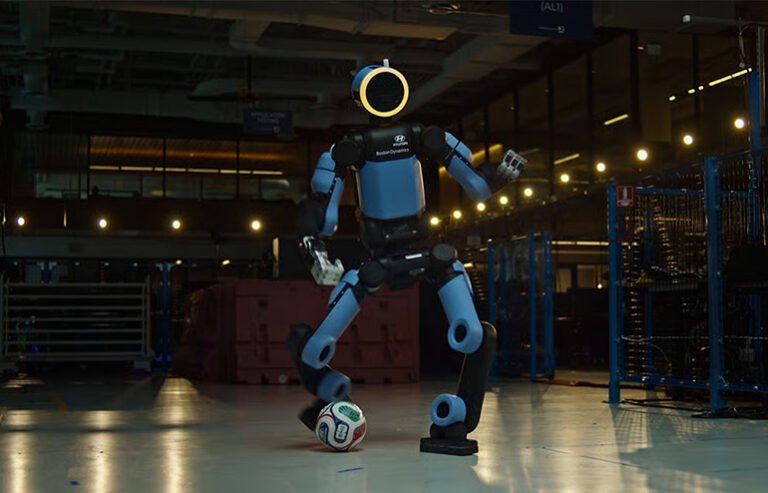
Atlas demonstrates the deceptive Ghost Rabona kick. Source: Hyundai The FIFA World Cup is not only a showcase for global athletic competition and camaraderie; it’s also an opportunity for leading legged robots to strut their stuff. Boston Dynamics Inc. has taught its Atlas humanoid to kick a soccer ball while its Spot robots support security…

![[Discussion] Gasket squeeze and groove fill: what a 100 m water resistance rating actually certifies](https://jobssz.com/wp-content/uploads/2026/07/mg0rxd0rw7gh1.png)