Walden Robotics Raises $300 Million At $1.1 Billion Valuation To Deploy General-Purpose Robots
Walden Robotics has launched from stealth with $300 million in seed funding to develop and deploy general-purpose robots that can learn continuously while performing useful work in manufacturing, logistics and other industrial environments. The financing values the Cambridge, Massachusetts-based physical AI company at $1.1 billion. Toyota and Deviation Capital co-led the round. Toyota participated through Toyota Motor Corporation, Toyota Invention Partners and Toyota Ventures. Other strategic investors included NVIDIA, Boeing, AE Ventures, Samsung Ventures, Prologis Ventures and CoreWeave Ventures. Financial investors participating in the financing included Calibrate Ventures, Colle Capital, Shine Capital, NextView Ventures, Squarepoint Capital, One Madison Group, KAS Venture Partners and Menlo Ventures, among others.
Walden plans to use the funding to expand the deployment of its general-purpose robots across production environments and continue developing the artificial intelligence models, hardware and operational systems supporting the platform.
The company is initially working with customers across automotive manufacturing, aerospace, semiconductors, electronics, logistics and life sciences.
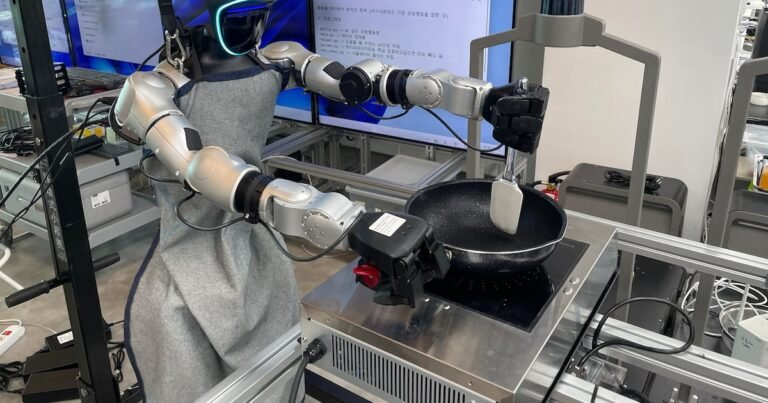
Rather than developing robots that remain in research laboratories or controlled demonstrations, Walden is placing its systems directly into operating facilities where they perform tasks alongside human employees.
The company said its robots are designed to provide value from the beginning of a deployment while becoming more capable through real-world experience.
Walden’s platform allows skilled employees to delegate repetitive, physically demanding or difficult-to-automate tasks to robots. Workers can then spend more time on responsibilities requiring judgment, craftsmanship, problem-solving and operational expertise.
The company’s approach reflects its belief that physical AI should augment people rather than replace them.
Walden said its name represents the principle that advanced technology should expand human potential and allow people to work and live with greater purpose.
The company was established in January 2026 after launching from the Toyota Research Institute.
Walden began working with customers across multiple industries shortly after its formation. Its general-purpose robots have been performing production work at a Toyota facility in North America since February.
According to the company, the deployment advanced from an initial pilot to productive operations in less than two months.
Walden believes this ability to move rapidly from demonstration to real-world work differentiates its platform from robotics systems that require extensive customization or remain limited to narrow use cases.
Traditional industrial robots are often designed for a specific task within a highly controlled environment. They may perform the same motion repeatedly and require substantial programming, engineering and infrastructure changes before deployment.
Those systems have been effective for high-volume processes in which products, equipment and operating conditions remain consistent.
However, many industrial tasks are more difficult to automate because environments change, objects vary and employees must regularly respond to unexpected conditions.
General-purpose robots are intended to adapt to a wider range of work rather than being permanently limited to a single programmed action.
Walden is developing robots that can learn new tasks, operate in dynamic environments and improve their performance as they gain experience.
The company’s technology builds on approximately a decade of artificial intelligence and robotics research conducted by members of the Walden team.
This work includes Diffusion Policy and Large Behavior Models, which provide the foundation for the intelligence powering Walden’s robots.
Large Behavior Models are designed to help robots understand and produce physical actions in much the same way that large language models learn relationships among words and generate text.
Instead of predicting the next word in a sentence, a behavior model can evaluate information from sensors and determine which sequence of movements is most appropriate for completing a task.
The models can help robots learn how to grasp objects, move materials, use tools and respond to changing physical conditions.
Diffusion Policy is an approach to robot learning that can generate complex actions based on visual observations and other inputs.
Walden combines these AI systems with hardware, real-world deployment and teams that understand industrial operations.
The company describes itself as a full-stack physical AI business because it develops the models and technology behind its robots while also managing deployment and operational integration.
Walden believes successful industrial robotics requires more than a capable AI model.
Robots must operate reliably within production schedules, safety requirements, quality standards and established employee workflows.
Manufacturing facilities also contain machinery, tools and processes that have been refined over many years. Introducing automation without understanding those systems can disrupt operations rather than improve them.
Walden plans to work closely with employees and operational leaders who understand how work is actually performed inside factories, warehouses and other facilities.
The company’s robots are intended to learn from those experts while helping organizations increase productivity and respond to workforce challenges.
Manufacturers and logistics companies are facing labor shortages, demographic changes, rising operating expenses and increasing competitive pressure.
Many businesses also struggle to recruit workers for repetitive or physically demanding positions.
General-purpose robots could help organizations maintain production levels when employees are unavailable while enabling existing workers to focus on higher-value tasks.
Walden’s technology is also intended to provide more flexibility than traditional fixed automation.
A robot capable of learning several tasks could potentially move among different workstations or responsibilities as production requirements change.
This could be particularly valuable for businesses with lower production volumes, frequently changing products or processes that cannot justify a separate automation system for every activity.
Walden is working with strategic partners that represent several potential markets for its technology.
Toyota brings extensive manufacturing experience and provides an operating environment in which Walden can test and improve its robots through real production work.
The companies share principles including kaizen, the practice of continuous improvement, and jidoka, an approach that combines automation with human oversight and the ability to stop processes when a problem occurs.
Toyota said Walden’s focus on continuously improving robots while keeping people at the center of manufacturing reflects the values shared by the companies.
NVIDIA’s participation provides a connection to a major supplier of computing platforms and AI technology used in robotics.
Boeing represents a potential aerospace application for general-purpose robots, while Samsung Ventures connects Walden with electronics and advanced manufacturing.
Prologis Ventures brings experience across warehouses and logistics facilities. CoreWeave Ventures provides exposure to the computing infrastructure supporting advanced AI systems.
Walden said its multidisciplinary team includes experts in robotics research, artificial intelligence, production hardware, operations and company building.
The company was founded by researchers and industry leaders with experience at Toyota Research Institute, the Massachusetts Institute of Technology, Stanford University and Amazon.
Walden co-founder and CEO Dr. Russ Tedrake is a professor at MIT and previously served as Senior Vice President of Large Behavior Models at Toyota Research Institute.
Tedrake’s research has focused on robotics, machine learning, control systems and the development of machines capable of operating in complex physical environments.
The company believes recent improvements in AI have made a new generation of adaptable robots possible.
However, Walden said turning those scientific advances into a scalable business requires close cooperation with manufacturers and respect for how current production systems operate.
The $300 million seed round gives Walden substantial capital to develop its technology while expanding deployments across multiple industries.
The company plans to continue improving the reliability and range of tasks its robots can perform through repeated real-world operation.
Each deployment can generate additional information about how robots interact with objects, workers and industrial environments.
That experience can be used to improve the underlying behavior models and make future deployments faster and more effective.
Walden is ultimately working toward a future in which intelligent robots are broadly available to industrial companies and can support workers across a wide variety of physical tasks.
KEY QUOTES:
“Core advances in Physical AI, and all of the excitement and attention surrounding it, has made disruptive change possible. But providing real value to customers and building a robust and scalable business requires a deep understanding and respect for how manufacturing is done today. The best way to make fast and positive progress is by working closely together with the real experts.”
Dr. Russ Tedrake, Co-Founder and CEO of Walden Robotics
“Toyota is proud to support Walden and has high expectations for this investment and the deep strategic partnership we are building together. Walden’s uniqueness is its ability to deliver robots that provide value from day one in real-world work environments: robots that continuously improve through learning, while always keeping people at the center. This reflects the values shared by Toyota and Walden, including kaizen, jidoka, and a strong commitment to supporting and developing people. Over the long term, we hope to shape the future of manufacturing together and become partners that contribute to improving quality of life for people around the world.”
Hiroki Nakajima, Executive Vice President, Representative Director and Chief Technology Officer of Toyota Motor Corporation
“Advances in AI are making a new generation of adaptable robots possible, and Walden sits right at the center of that shift. The Walden team is generational, bringing together a rare, interdisciplinary group of experts spanning foundational robotics research, large-scale production hardware, and operational and business leadership. They earn their place on the factory floor by doing real work while helping their customers increase their productivity and competitiveness for the long term.”
Colin Beirne, Founding Partner of Deviation Capital