We’ve Barely Mapped the Observable Universe — but Human Curiosity Is Driving the Biggest Maps Ever Made
Aboard the International Space Station (ISS), now-retired astronaut Sunita “Suni” Williams geared up to perform a spacewalk near one of the craft’s solar panels. Space walks are routine, prescribed, and mechanical. Williams had put on her space suit and double-checked everything was in place so many times in practice that the act was almost second nature and could even distract from the fact that she wasn’t on Earth.
But this routine spacewalk had an obstacle. One of the solar panels was not retracting properly, so Williams needed to climb up the craft. All the while, night was falling over Earth below. She was only out on the craft for about 40 minutes when the ISS passed over something Williams did not expect.

Viewing an aurora from space.
(Image Credit: NASA)
“I was like, holding on, just going, oh my god, what is that?” Williams told Discover.
Swirling across the planet beneath her, a bright aurora flared to life, illuminating the dark planet.
“To see that underneath you — this energy from the universe,” she added. “It really puts you in your place, and you are reminded how small our planet is. It’s just one piece in this big structure of our Solar System in our universe.”
While the aurora experience from Williams was unique, understanding our place in the Solar System is not a new concept; in fact, that quest has led us to ask more questions about the universe as a whole and even to begin mapping what we know.
And as Williams is an explorer in this quest, astrophysicists around the world have been collaborating on projects and missions to map parts of the universe and expand our understanding of what lies beyond our planet. In 2026, the Dark Energy Spectroscopic Instrument (DESI) released data that was collected over five years on more than 47 million galaxies and quasars. It’s the largest map we have yet of the 11 billion years of the universe’s history, but we’ve barely scratched the surface.
Currently, the European Space Agency’s (ESA) Euclid mission is photographing and mapping parts of the universe and gathering data on dark matter. With it, we’ll have a better understanding of the structure of the universe. And in late summer 2026, NASA’s Nancy Grace Roman Space Telescope (Roman) will launch, helping us gather data at a faster pace.
These missions could uncover mysteries of the unknown, and according to Valeria Pettorino, a Euclid project scientist, our human curiosity to understand where we have been and where we are going is what is driving this research forward.
“It helps to put us as human beings into context. We are very small, clearly, with respect to the cosmos, but it also shows and demonstrates how much we can achieve when we work together,” Pettorino told Discover.
Mapping the Universe and the Overview Effect
Part of our curiosity to keep exploring, even beyond our own planet, could be embedded in our genes. Some people can carry the DRD4-7R gene variant, which is connected with curiosity, thrill seeking, and even ADHD. Because this gene tends to blunt dopamine sensitivity, many who have it seek stronger stimuli and crave the next experiences, such as traveling or exploring. This desire to keep searching may have a connection to why we began exploring places like space.
It’s a risky endeavor, but finding out what lies beyond our planet could benefit our species in the long run, much like exploring our own planet led us to new resources and knowledge. The more we discover, the more we have to be curious about.
During time in space, there is a psychological phenomenon known as the overview effect. According to NASA, the overview effect is a strong change in perspective that astronauts experience when they view Earth from space. The effect can greatly influence the way a person views Earth and life on the planet below. In some cases, it gives some people a stronger urge to protect and conserve the planet. It has also changed how some astronauts think of our place in the Solar System, including Williams.

Sunita Williams looks down on Earth from the ISS.
(Image Credit: NASA)
“I’ve been super fortunate to do long-duration missions. And of course, you look for your home the first time you’re looking out the window,” Williams told Discover.
“But later on, you sort of start looking at the planet as a planet, and I think that’s for me more of the overview effect,” Williams added. “Where’s our place in the Solar System?”
That question has fueled experts throughout history. Astronomers like Ptolemy looked to the heavens to try to determine if everything revolved around Earth, or if Earth revolved around the sun, according to a report in the Transactions of the American Clinical and Climatological Association. Centuries later, Galileo Galilei used a telescope to discover that four moons orbit Jupiter, suggesting that Earth wasn’t the center of the Solar System. Fast forward to the 20th century, and humanity began launching spacecraft like Voyager 1 to gather data on what’s beyond our atmosphere and Solar System.
Advances in space technology during the 20th century would lead to new missions with the goal of mapping the universe. In 1989, the COBE satellite, and in the late 1990s, the Sloan Digital Sky Survey (SDSS), according to NASA.
The COBE satellite helped map the cosmic microwave background (the oldest light in the universe). SDSS helped create extremely detailed 3-D maps of the universe from the ground. It’s still collecting data in the present day.
These two missions would be the precursors to some of the most notable missions today, including the Dark Energy Spectroscopic Instrument (DESI), the European Space Agency’s (ESA) Euclid, the James Webb Space Telescope, and the soon-to-launch Roman Space Telescope.
When it comes to mapping the universe with this technology, there are two definitions: the observable universe and individual objects within the universe.
The observable universe is the region of space that we can observe with technology and is differentiated from the entire universe, according to Britannica. It’s about 93 billion light-years in diameter. Individual objects, according to Dominic Benford, the Program Scientist for Roman, include measuring galaxies, star-forming regions, or stars.
“Hubble and Webb are superb instruments that were designed to study individual objects,” Benford told Discover. “Those tools that they have give you a lot more information about the physical processes at work in those regions, which is valuable for understanding how things work.”
But exactly how much of the universe have we been able to measure? Not much. Even with major missions like DESI and SDSS, only a small fraction of the observable universe has been mapped in detail. In its 36 years of operation, Hubble has imaged less than 1 percent of the sky, according to Benford.
Hubble alone has observed millions of individual objects, according to NASA, but combined with other space observatories and telescopes, humanity has identified billions of stars, galaxies, and other cosmic objects, according to the Center for Astrophysics.
While we have more to map in the universe, there are new missions at work that can help us see further, cover more distance, and continue to pique our curiosity.
“This is astronomical imaging like we’ve never seen it before,” Benford said.
Read More: NASA’s Roman Space Telescope Arrives in Florida Ahead of Late-Summer 2026 Launch
What Have We Found So Far?
It’s true that early missions, like Hubble and SDSS, have only scratched the surface of universal mapping, but they have also laid the groundwork for more advanced missions.
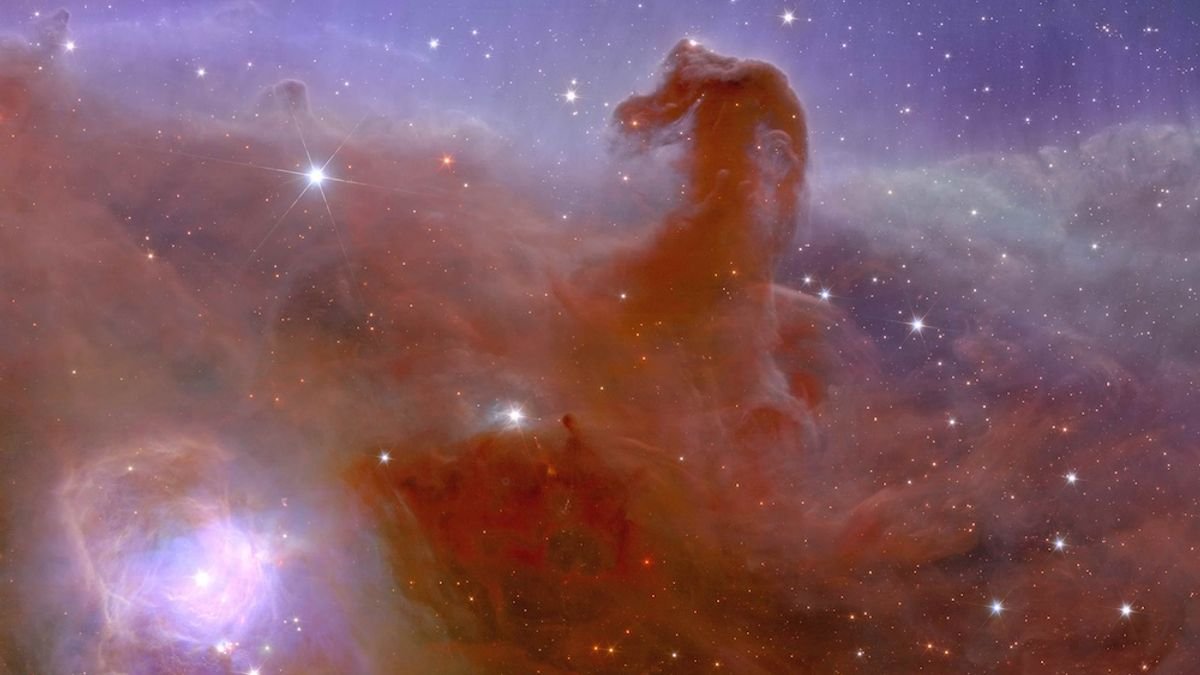
ESA’s Euclid launched in July of 2023, and so far, it’s mapped more than one-third of the total area it will eventually map, according to Pettorino. Within one week, the mission identified 26 million galaxies in a single patch of sky and will likely capture millions and millions more before its 6-year mission is over.

Euclid image of a star forming.
(Image Credit: ESA Standard License/CC BY-SA 3.0 IGO)
“With respect to other missions, the power really of Euclid is that […] in six years we will cover the whole map of the universe,” Pettorino told Discover. She also added that Euclid will be able to capture these details in high resolution, which can help speed up the research process.
One driver for mapping the universe is to uncover exoplanets that could hold life, according to NASA. Finding exoplanets, or even moons, within their star’s habitable zone is key to determining whether they could support life or be habitable for future generations of humans.
Another driver is to better understand dark matter and dark energy. Part of Euclid’s main mission at the moment is to investigate the ‘dark side’ of the universe, according to ESA. Overall, the mission will help to map the universe’s structure and observe billions of galaxies about 10 billion light-years away.
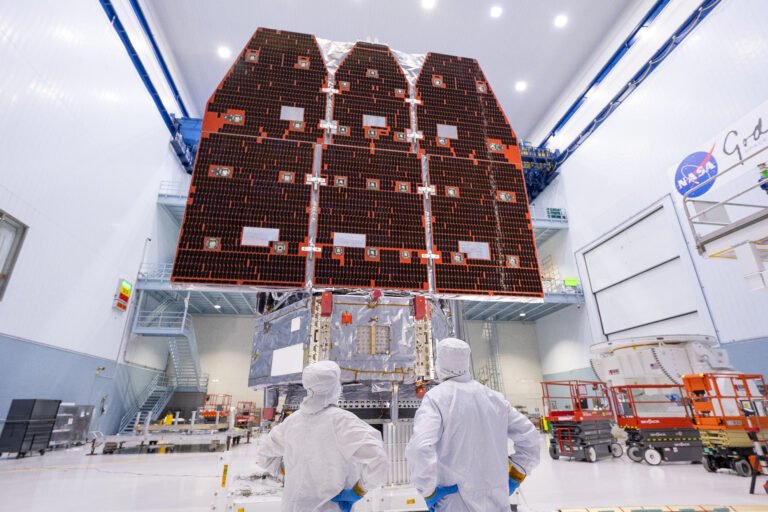
Set to launch at the end of August 2026, Roman will be one of the most advanced space telescopes to date. The Roman Space Telescope will examine dark energy and dark matter, but also explore exoplanets and other elements of astrophysics, according to NASA.
With elements similar to those of the Hubble Space Telescope, Roman will be equipped with much more advanced technology, including a wide-field survey telescope, a high-precision infrared imager, and a coronagraph, which will help collect data faster, see further, and give us more information about neighboring stars and exoplanets.
During the first 5 years of Roman’s mission, it will map about one-eighth of the sky, compared to Euclid, which will map about one-third of the sky.
“Roman […] is designed to be a survey machine. It takes giant images much faster than either Hubble or Webb, so that it can study, instead of hundreds or thousands of objects, millions of objects,” Benford told Discover.
Roman has a field of view that’s about 100 times larger than Hubble’s and is also 1,000 times faster at gathering data. Roman, according to Benford, will continue to lay the groundwork for missions that can analyze exoplanets and accurately read what sort of atmosphere other worlds may have. It could even identify potentially habitable worlds.
“What’s most exciting about Roman for me is that there will be discoveries being made from this data for decades to come that we don’t even know to ask about yet. We don’t know the questions, and Roman is going to give us all those answers,” Benford said.
Read More: Hubble Caught an Accidental Glimpse of a Comet Breakup, Snapping Pictures of Bright Blue Fragments
Why Space Exploration Continues to Matter
Thanks to space exploration, we have proven Einstein’s theory of general relativity, which is important for GPS and space travel, according to NASA, and we’ve advanced modern technology that we rely on every day.

Sunita Williams aboard the ISS.
(Image Credit: NASA)
Technologies developed for space exploration have contributed to innovations like scratch-resistant lenses, water filtration systems, medical imaging technology, and even memory foam mattresses, according to NASA’s Jet Propulsion Laboratory.
At times, Williams is asked if all the hard work, dedication, long hours, and time away from loved ones are all worth it. And her answer every time is yes.
“Hopefully people see us as stewards of humanity going out and trying to figure out – taking those next steps,” Williams said.
Filling in Gaps in the Universal Unknown
At their core, human ingenuity powers these space missions and the quest for understanding. Thousands of people work for space programs internationally, from building spacecraft to building space suits to preparing food for astronauts. Williams points out that amazing things can happen when we all work together.
“When you have to figure out how to put someone in space, you have to think outside the box,” Williams told Discover. “You might not even know all the questions you need to ask.”
That ingenuity is already paying off. Euclid has achieved about one-third of its goal, and after launch, Roman will be sending information back to Earth that could reshape our understanding of the universe.
Other missions, like NASA’s Spectro-Photometer for the History of the Universe, Epoch of Reionization and Ices Explorer (SPHEREx) mission, are already surveying space and will give us an all-sky spectral survey of our galaxy. The mission will collect data on over 450 million galaxies and 100 million stars within the Milky Way and help us better understand the universe’s origins.
According to Williams, while it may be easier to stay on Earth, where we have a good grasp of the planet’s physics and know the atmosphere is safe, leaving Earth has helped us think outside the box, be more innovative, and solve complex problems. Heading into the unknown helps us unlock a crucial part of our humanity: using our brains.
“These things are hard, but we can do them,” Williams said. “Our destiny is determined by our imagination, and your imagination can do anything, and that means that we can get there engineering-wise.”
Read More: JWST Spots a Nearby Super-Earth That Could Look Like the Moon or Mercury
Article Sources
Our writers at Discovermagazine.com use peer-reviewed studies and high-quality sources for our articles, and our editors review for scientific accuracy and editorial standards. Review the sources used below for this article: